. 2014 Oct;80(19):6243-55.
doi: 10.1128/AEM.02097-14. Epub 2014 Aug 1.

Microbial ecology dynamics reveal a succession in the core microbiota involved in the ripening of pasta filata caciocavallo pugliese cheese

Affiliations

Microbial ecology dynamics reveal a succession in the core microbiota involved in the ripening of pasta filata caciocavallo pugliese cheese

Ilaria De Pasquale et al. Appl Environ Microbiol. 2014 Oct.

Abstract

Pyrosequencing of the 16S rRNA targeting RNA, community-level physiological profiles made with Biolog EcoPlates, proteolysis, and volatile component (VOC) analyses were mainly used to characterize the manufacture and ripening of the pasta filata cheese Caciocavallo Pugliese. Plate counts revealed that cheese manufacture affected the microbial ecology. The results agreed with those from culture-independent approaches. As shown by urea-PAGE, reverse-phase high pressure liquid chromatography (RP-HPLC), and free-amino-acid (FAA) analyses, the extent of secondary proteolysis mainly increased after 30 to 45 days of ripening. VOCs and volatile free fatty acids (VFFA) were identified by a purge-and-trap method (PT) and solid-phase microextraction (SPME) coupled with gas chromatography-mass spectrometry (GC-MS), respectively. Except for aldehydes, the levels of most of VOCs and VFFA mainly increased from 30 to 45 days onwards. As shown through pyrosequencing analysis, raw cows' milk was contaminated by Firmicutes (53%), Proteobacteria (39%), Bacteroidetes (7.8%), Actinobacteria (0.06%), and Fusobacteria (0.03%), with heterogeneity at the genus level. The primary starter Streptococcus thermophilus dominated the curd population. Other genera occurred at low incidence or sporadically. The microbial dynamics reflected on the overall physiological diversity. At 30 days, a microbial succession was clearly highlighted. The relative abundance of Streptococcus sp. and especially St. thermophilus decreased, while that of Lactobacillus casei, Lactobacillus sp., and especially Lactobacillus paracasei increased consistently. Despite the lower relative abundance compared to St. thermophilus, mesophilic lactobacilli were the only organisms positively correlated with the concentration of FAAs, area of hydrophilic peptide peaks, and several VOCs (e.g., alcohols, ketones, esters and all furans). This study showed that a core microbiota was naturally selected during middle ripening, which seemed to be the main factor responsible for cheese ripening.


Figures

FIG 1
FIG 1
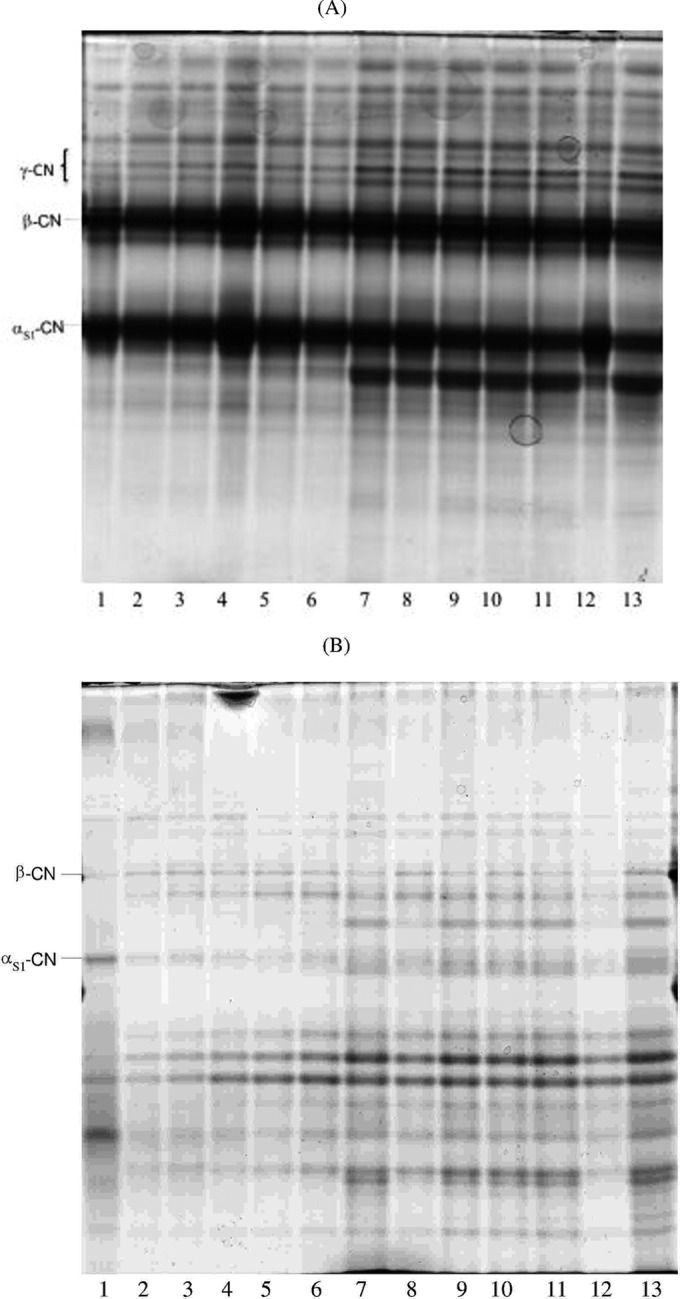
Urea-polyacrylamide gel electrophoresis (PAGE) of pH 4.6-insoluble (A) and -soluble (B) nitrogen fractions during manufacture and ripening of Caciocavallo Pugliese. Lanes: 1, bovine casein (CN) standard; 2, curd after coagulation; 3, curd after 5 h of incubation (when the pH reached a value of ca. 5.25); 4, curd after stretching and molding; 5 to 13, cheese (after brine treatment) after 1, 3, 7, 15, 30, 45, 60, 75, and 90 days of ripening, respectively.
FIG 2
FIG 2
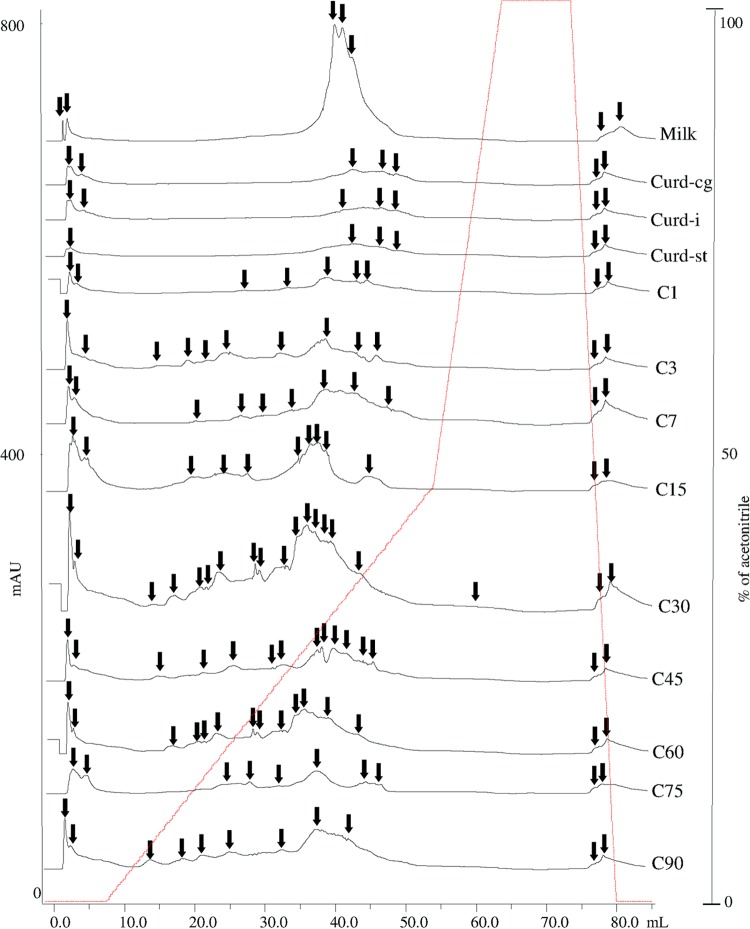
Reverse-phase fast protein liquid chromatography (RP-FPLC) of the pH 4.6-soluble nitrogen fraction during manufacture and ripening of Caciocavallo Pugliese. Data for raw cows' milk, curd after coagulation (Curd-cg), curd after 5 h of incubation (when the pH reached a value of ca. 5.25) (Curd-i), curd after stretching (Curd-st), and cheese (C) after brine treatment (C1) and during ripening (3, 7, 15, 30, 45, 60, 75, and 90 days; C3 to C90) are shown. Arrows indicate hydrophilic and hydrophobic peptide peaks. The gradient of acetonitrile is reported (red line). mAU, milli-absorbance units (UV, 214 nm).
FIG 3
FIG 3
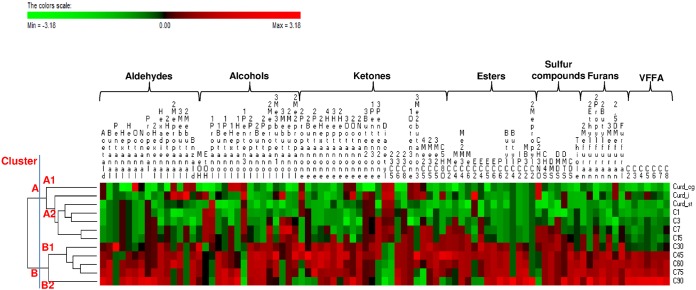
Concentrations of volatile components (log arbitrary units of area) and volatile free fatty acids (ppm) identified during manufacture and ripening of Caciocavallo Pugliese. Euclidean distance and McQuitty's criterion (weighted pair group method with averages) were used for clustering. The colors correspond to normalized mean data levels from low (green) to high (red). The color scale, in terms of units of standard deviation, is shown at the top. Acetald, acetaldehyde; 2Hexenal, 2-hexenal; Hexadienal, 2,4-hexadienal; 2Heptenal, 2-heptenal; 2Mepropanal, 2-methyl-propanal; 3Mebutanal, 3-methyl-butanal; 2Mebutanal, 2 methyl-butanal; Bnzald, benzaldehyde; MeOH, methanol; EtOH, ethanol; 1Propanol, 1-propanol; 1Butanol, 1-butanol; 1Pentanol, 1-pentanol; 1Hexanol, 1-hexanol; 1Heptanol, 1-heptanol; 1Penten3ol, 1-penten-3-ol; 2Propanol, 2-propanol; 2Butanol, 2-butanol; 2Pentanol, 2-pentanol; 2Mepropanol, 2-methyl-1-propanol; 3Me3buten1ol, 3-methyl-3-buten-1ol; 3Mebutanol, 3-methyl-1-butanol; 2Mebutanol, 2-methyl-1-butanol; 2Me2propanol, 2-methyl-2-propanol; 2Propanone, 2-propanone; 2Butanone, 2-butanone; 2Pentanone, 2-pentanone; 2Hexanone, 2-hexanone; 4Heptanone, 4-heptanone; 3Heptanone, 3-heptanone; 2Heptanone, 2-heptanone; 3Octanone, 3-octanone; 2Octanone, 2-octanone; 2Nonanone, 2-nonanone; 3Buten2one, 3-buten-2-one; 1Penten3one, 1-penten-3-one; 3Penten2one, 3-penten-2-one; Diacetyl, 2,3-butanedione; 2–3C5, 2,3-pentanedione; 2–3C6, 2,3-hexanedione; 2–3C8, 2,3-octanedione; 1Octen3one, 1-octen-3-one; 3Me2butanone, 3-methyl-2-butanone; 4Me2C5, 4-methyl-2-pentanone; 2Me3C5, 2-methyl-3-pentanone; 3Me2C5, 3-methyl-2-pentanone; C5H8O, cyclopentanone; MC2, methyl acetate; MeC4, methyl butanoate; Me2M3C4, methyl 2-methyl-butanoate; MeC6, methyl hexanoate; EC2, ethyl acetate; EC4, ethyl butanoate; EC5, ethyl pentanoate; EC6, ethyl hexanoate; PC6, propyl hexanoate; ButylC2, butyl acetate; ButylC4, butyl butanoate; IPC2, isopropyl acetate; MB3C2, 3-methyl-butyl acetate; 2MepropylC2, 2-methyl propyl acetate; C2H3NO, methyl isocyanate; CH4S, methanethiol; DMS, dimethyl-sulfide; DMDS, dimethyl-disulfide; DMTS, dimethyl-trisulfide; CDS, carbon disulfide; Thiole, thiophene; 2Mefuran, 2-methyl furan; 2Ethylfuran, 2-ethyl-furan; 2Propylfuran, 2-propyl-furan; 2Butylfuran, 2-butyl-furan; 3Mefuran, 3-methyl-furan; 2,5DMefuran, 2,5-dimethyl-furan; Furfural, furfural; C2, acetic acid; C3, propionic acid; C4, butyric acid; C5, valeric acid; C6, hexanoic acid; C7, heptanoic acid; C8, octanoic acid.
FIG 4
FIG 4
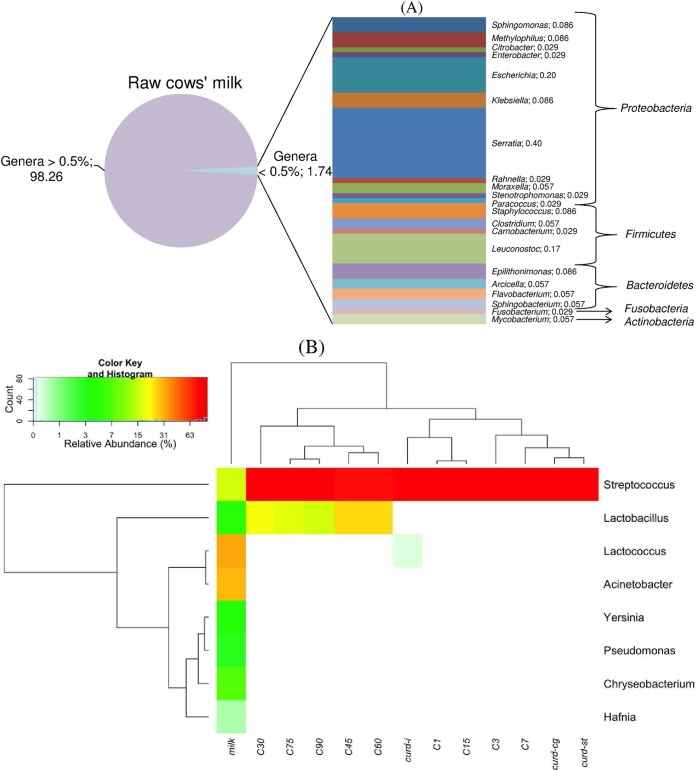
Distribution of the OTUs assigned at genus level occurring in raw cows' milk at a relative abundance lower than 0.5% (A) and pseudo-heatmap depicting the distribution (percent) of bacterial genera during manufacture and ripening of Caciocavallo Pugliese (B). Only OTUs occurring at 0.5% abundance in at least one sample were included in the pseudo-heatmap. Clustering of samples and taxa was obtained using hierarchical clustering of unweighted UniFrac distances between samples or Euclidean distance measure between taxa. Data for raw cows' milk, curd after coagulation (Curd-cg), curd after 5 h of incubation (when the pH reached a value of ca. 5.25) (Curd-i), curd after stretching (Curd-st), and cheese (C) after brine treatment (C1) and during ripening (3, 7, 15, 30, 45, 60, 75 and 90 days; C3 to C90) are shown.
FIG 5
FIG 5
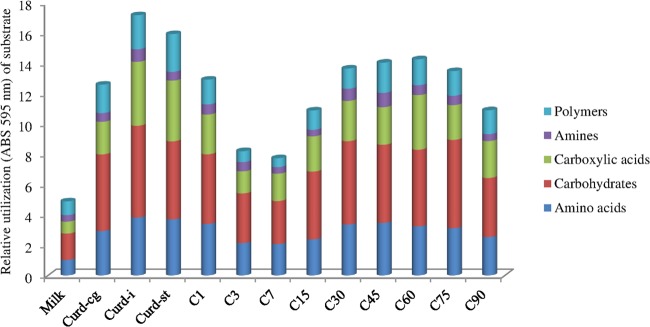
Relative utilization of different carbon sources, grouped by chemical class (carbohydrates, carboxylic acids, polymers, amino acids, and amines), during manufacture and ripening of Caciocavallo Pugliese. Data for raw cows' milk, curd after coagulation (Curd-cg), curd after 5 h of incubation (when the pH reached a value of ca. 5.25) (Curd-i), curd after stretching (Curd-st), and cheese (C) after brine treatment (C1) and during ripening (3, 7, 15, 30, 45, 60, 75 and 90 days; C3 to C90) are shown.
FIG 6
FIG 6
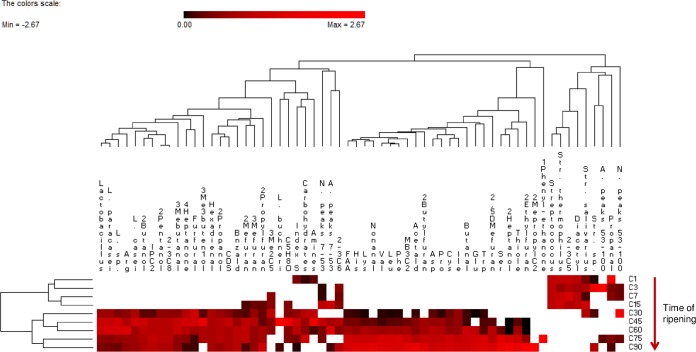
Relative abundance of OTUs assigned to genus (Lactobacillus and Streptococcus) and species (Lactobacillus paracasei, Lactobacillus casei, Lactobacillus buchneri, Streptococcus thermophilus and Streptococcus salivarius) levels, total free amino acids (FAA, mg kg−1), amino acids found at the highest concentration (>100 mg kg−1) (Arg, His, Lys, Val, Leu, Phe, Asp, Pro, Cys, Ile, Glu, Trp, and Ser), substrate richness index (S index), relative utilization of carbon sources (carbohydrates and amines), number (N) and area (A) of hydrophilic (peaks 7 to 53) and hydrophobic (peaks 53 to 100) peptide peaks, and concentrations of volatile components (arbitrary units of area) positively correlated with the abundance of L. paracasei during ripening of Caciocavallo Pugliese. Euclidean distance and McQuitty's criterion (weighted pair group method with averages) were used for clustering. The colors correspond to normalized mean data levels from low (white) to high (red). The color scale, in terms of units of standard deviation, is shown at the top. Data for cheese (C) after brine treatment (C1) and during ripening (3, 7, 15, 30, 45, 60, 75 and 90 days; C3 to C90) are shown. L., Lactobacillus; Str., Streptococcus; Hexadienal, 2–4 hexadienal; 3Mebutanal, 3-methyl-butanal; Bnzald, benzaldehyde; 2Propanol, 2-propanol; 2Butanol, 2-butanol; 2Pentanol, 2-pentanol; 2Heptanol, 2-heptanol; 3Me3buten1ol, 3-methyl-3-buten-1-ol; 2–3C8, 2-hexanedione; 3Me2C5, 2-methyl-3-pentanone; C5H8O, cyclopentanone; 4Heptanone. 4-heptanone; IPC2, isopropyl acetate; MB3C2, 3-methyl-butyl acetate; CDS, carbon disulfide; Thiole, thiophene; 2Mefuran, 2-methyl-furan; 2Ethylfuran, 2-ethyl-furan; 2Propylfuran, 2-propyl-furan; 2Butylfuran, 2-butyl-furan; 3Mefuran, 3-methyl-furan; 2,5DMefuran, 2,5-dimethyl-furan; Acetald, acetaldehyde; Diacetyl, 2,3-butanedione; 2–3C5, 2,3-pentanedione.

References

    1. Kindstedt P, Carić M, Milanović S. 2004. Pasta-filata cheeses, p 251–277 In Fox PF, McSweeney PLH, Cogan TM, Guinee TP. (ed), Cheese: chemistry, physics and microbiology, 3rd ed, vol 2 Elsevier Academic Press, London, United Kingdom. 10.1016/S1874-558X(04)80047-2 - DOI
    1. Salvadori del Prato O. 1998. Trattato di tecnologia casearia. Edagricole—Edizioni Agricole della Calderini s.r.l. Press, Bologna, Italy
    1. De Angelis M, Gobbetti M. 2011. Cheese: pasta-filata cheeses: traditional pasta-filata cheese, p 745–752 In Fuquay JW, Fox PF, McSweeney PLH. (ed), Encyclopedia of dairy sciences, 2nd ed, vol 1 Elsevier Academic Press, San Diego, CA
    1. Gobbetti M, Morea M, Baruzzi F, Corbo MR, Matarante A, Considine T, Di Cagno R, Guineee T, Fox PF. 2002. Microbiological, compositional, biochemical and textural characterization of Caciocavallo Pugliese cheese during ripening. Int. Dairy J. 12:511–523. 10.1016/S0958-6946(02)00042-0 - DOI
    1. Morea M, Matarante A, Di Cagno R, Baruzzi F, Minervini F. 2007. Contribution of autochthonous non-starter lactobacilli to proteolysis in Caciocavallo Pugliese cheese. Int. Dairy J. 17:525–534. 10.1016/j.idairyj.2006.05.010 - DOI

Publication types

LinkOut - more resources