


Infection-interactions in Ethiopian village chickens
- PMID: 25085600
- PMCID: PMC4235779
- DOI: 10.1016/j.prevetmed.2014.07.002
Infection-interactions in Ethiopian village chickens
Abstract
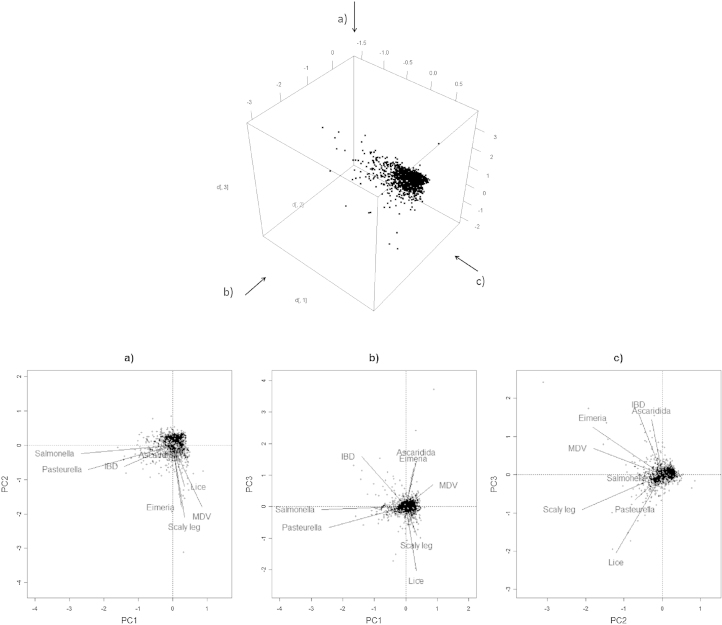
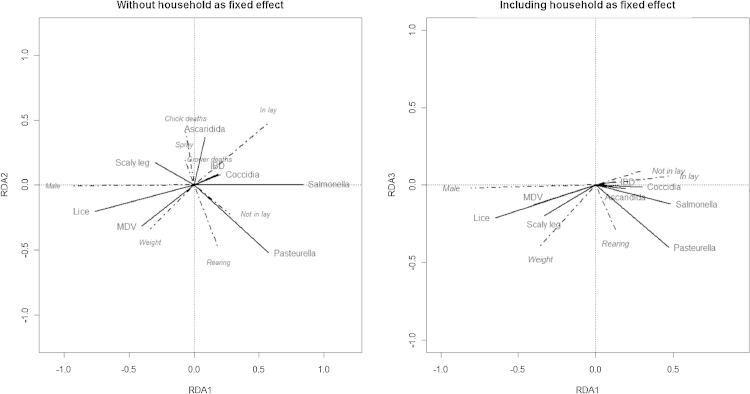
Chickens raised under village production systems are exposed to a wide variety of pathogens, and current or previous infections may affect their susceptibility to further infections with another parasite, and/or can alter the manifestation of each infection. It is possible that co-infections may be as important as environmental risk factors. However, in cross-sectional studies, where the timing of infection is unknown, apparent associations between infections may be observed due to parasites sharing common risk factors. This study measured antibody titres to 3 viral (Newcastle disease, Marek's disease and infectious bursal disease) and 2 bacterial (Pasteurella multocida and Salmonella) diseases, and the infection prevalence of 3 families of endo- and ecto-parasites (Ascaridida, Eimeria and lice) in 1056 village chickens from two geographically distinct populations in Ethiopia. Samples were collected during 4 cross-sectional surveys, each approximately 6 months apart. Constrained ordination, a technique for analysis of ecological community data, was used to explore this complex dataset and enabled potential relationships to be uncovered and tested despite the different measurements used for the different parasites. It was found that only a small proportion of variation in the data could be explained by the risk factors measured. Very few birds (9/1280) were found to be seropositive to Newcastle disease. Positive relationships were identified between Pasteurella and Salmonella titres; and between Marek's disease and parasitic infections, and these two groups of diseases were correlated with females and males, respectively. This may suggest differences in the way that the immune systems of male and female chickens interact with these parasites. In conclusion, we find that a number of infectious pathogens and their interactions are likely to impact village chicken health and production. Control of these infections is likely to be of importance in future development planning.
Keywords: Co-infection; Constrained ordination; Ethiopia; Host-parasite interaction; Village chicken.
Copyright © 2014 The Authors. Published by Elsevier B.V. All rights reserved.
Figures
References
-
- Alders R.G., Pym R.A.E. Village poultry: still important to millions, eight thousand years after domestication. Worlds Poult. Sci. J. 2009;65:181–190.
-
- Alebachew K., Mekonnen A. A survey on Salmonella infection among chicken flocks in Jimma town, Ethiopia. World Appl. Sci. J. 2013;21:1415–1420.
-
- Ashenafi H., Tadesse D., Medhin G., Tibbo M. Study on coccidiosis of scavenging indigenous chickens in central Ethiopia. Trop. Anim. Health Prod. 2004;35:693–701. - PubMed
-
- Beal R.K.P., Wigley C., Barrow P., Smith P.A.A.L. Temporal dynamics of the cellular, humoral and cytokine responses in chickens during primary and secondary infection with Salmonella enterica serovar Typhimurium. Avian Pathol. 2004;33:25–33. - PubMed
-
- Belihu K., Mamo A., Lobago F., Ayana D. Prevalence of ectoparasites in backyard local chickens in three agroecologic zones of East Shoa, Ethiopia. Rev. Med. Vet. 2009;160:537–541.
Publication types
MeSH terms
Substances
Grants and funding
- BB/H009396/1/BB_/Biotechnology and Biological Sciences Research Council/United Kingdom
- BBS/E/D/20320000/BB_/Biotechnology and Biological Sciences Research Council/United Kingdom
- BB/H009159/1/BB_/Biotechnology and Biological Sciences Research Council/United Kingdom
- BB/H009051/1/BB_/Biotechnology and Biological Sciences Research Council/United Kingdom
LinkOut - more resources
Full Text Sources
Other Literature Sources
Medical
