Meta-Analysis
. 2014 Sep;46(9):994-1000.
doi: 10.1038/ng.3052. Epub 2014 Aug 3.

Genome-wide association study identifies multiple susceptibility loci for pancreatic cancer

Brian M Wolpin  1 Cosmeri Rizzato  2 Peter Kraft  3 Charles Kooperberg  4 Gloria M Petersen  5 Zhaoming Wang  6 Alan A Arslan  7 Laura Beane-Freeman  8 Paige M Bracci  9 Julie Buring  10 Federico Canzian  11 Eric J Duell  12 Steven Gallinger  13 Graham G Giles  14 Gary E Goodman  15 Phyllis J Goodman  16 Eric J Jacobs  17 Aruna Kamineni  18 Alison P Klein  19 Laurence N Kolonel  20 Matthew H Kulke  21 Donghui Li  22 Núria Malats  23 Sara H Olson  24 Harvey A Risch  25 Howard D Sesso  26 Kala Visvanathan  27 Emily White  28 Wei Zheng  29 Christian C Abnet  8 Demetrius Albanes  8 Gabriella Andreotti  8 Melissa A Austin  30 Richard Barfield  31 Daniela Basso  32 Sonja I Berndt  8 Marie-Christine Boutron-Ruault  33 Michelle Brotzman  34 Markus W Büchler  35 H Bas Bueno-de-Mesquita  36 Peter Bugert  37 Laurie Burdette  6 Daniele Campa  38 Neil E Caporaso  8 Gabriele Capurso  39 Charles Chung  6 Michelle Cotterchio  40 Eithne Costello  41 Joanne Elena  42 Niccola Funel  43 J Michael Gaziano  44 Nathalia A Giese  35 Edward L Giovannucci  45 Michael Goggins  46 Megan J Gorman  21 Myron Gross  47 Christopher A Haiman  48 Manal Hassan  22 Kathy J Helzlsouer  49 Brian E Henderson  50 Elizabeth A Holly  9 Nan Hu  8 David J Hunter  51 Federico Innocenti  52 Mazda Jenab  53 Rudolf Kaaks  38 Timothy J Key  54 Kay-Tee Khaw  55 Eric A Klein  56 Manolis Kogevinas  57 Vittorio Krogh  58 Juozas Kupcinskas  59 Robert C Kurtz  60 Andrea LaCroix  15 Maria T Landi  8 Stefano Landi  61 Loic Le Marchand  62 Andrea Mambrini  63 Satu Mannisto  64 Roger L Milne  65 Yusuke Nakamura  66 Ann L Oberg  67 Kouros Owzar  68 Alpa V Patel  17 Petra H M Peeters  69 Ulrike Peters  70 Raffaele Pezzilli  71 Ada Piepoli  72 Miquel Porta  73 Francisco X Real  74 Elio Riboli  75 Nathaniel Rothman  8 Aldo Scarpa  76 Xiao-Ou Shu  29 Debra T Silverman  8 Pavel Soucek  77 Malin Sund  78 Renata Talar-Wojnarowska  79 Philip R Taylor  8 George E Theodoropoulos  80 Mark Thornquist  15 Anne Tjønneland  81 Geoffrey S Tobias  8 Dimitrios Trichopoulos  82 Pavel Vodicka  83 Jean Wactawski-Wende  84 Nicolas Wentzensen  8 Chen Wu  85 Herbert Yu  62 Kai Yu  8 Anne Zeleniuch-Jacquotte  86 Robert Hoover  8 Patricia Hartge  87 Charles Fuchs  88 Stephen J Chanock  89 Rachael S Stolzenberg-Solomon  87 Laufey T Amundadottir  87
Affiliations
Meta-Analysis

Genome-wide association study identifies multiple susceptibility loci for pancreatic cancer

Brian M Wolpin et al. Nat Genet. 2014 Sep.

Abstract

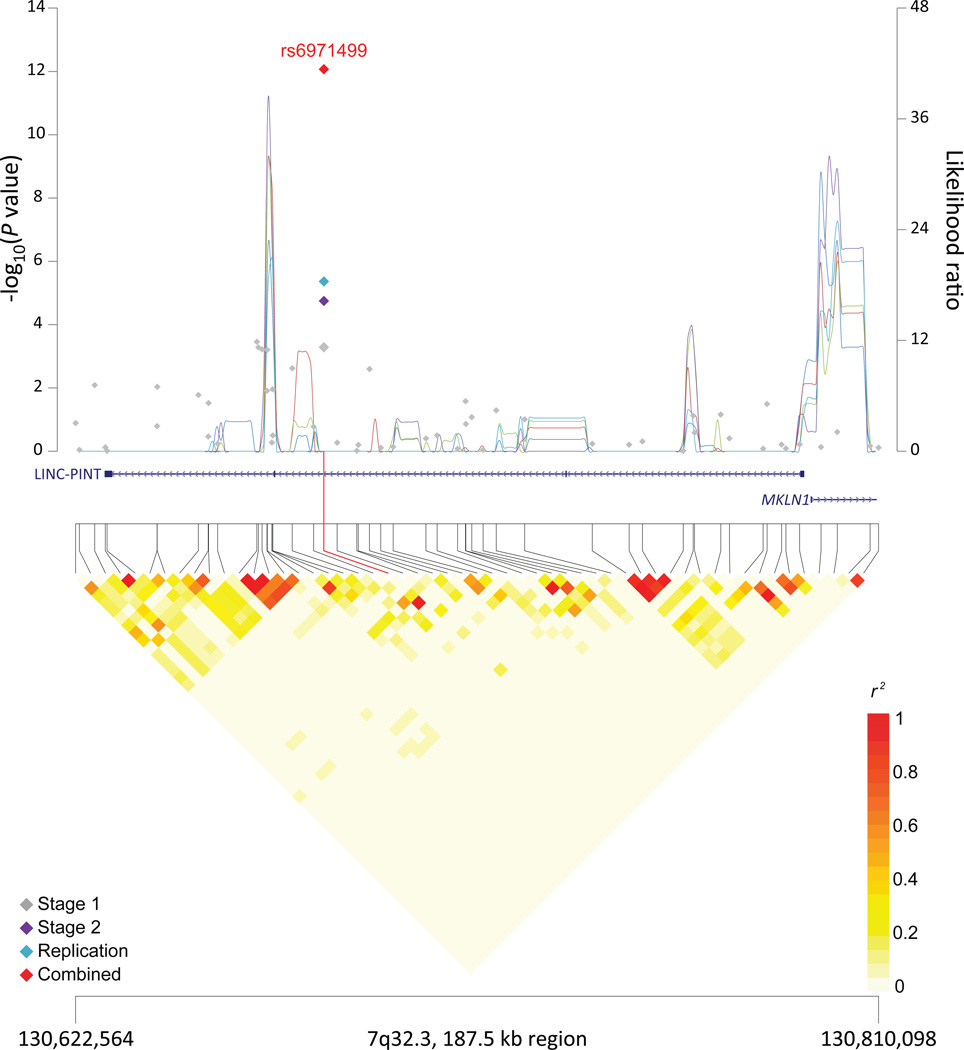
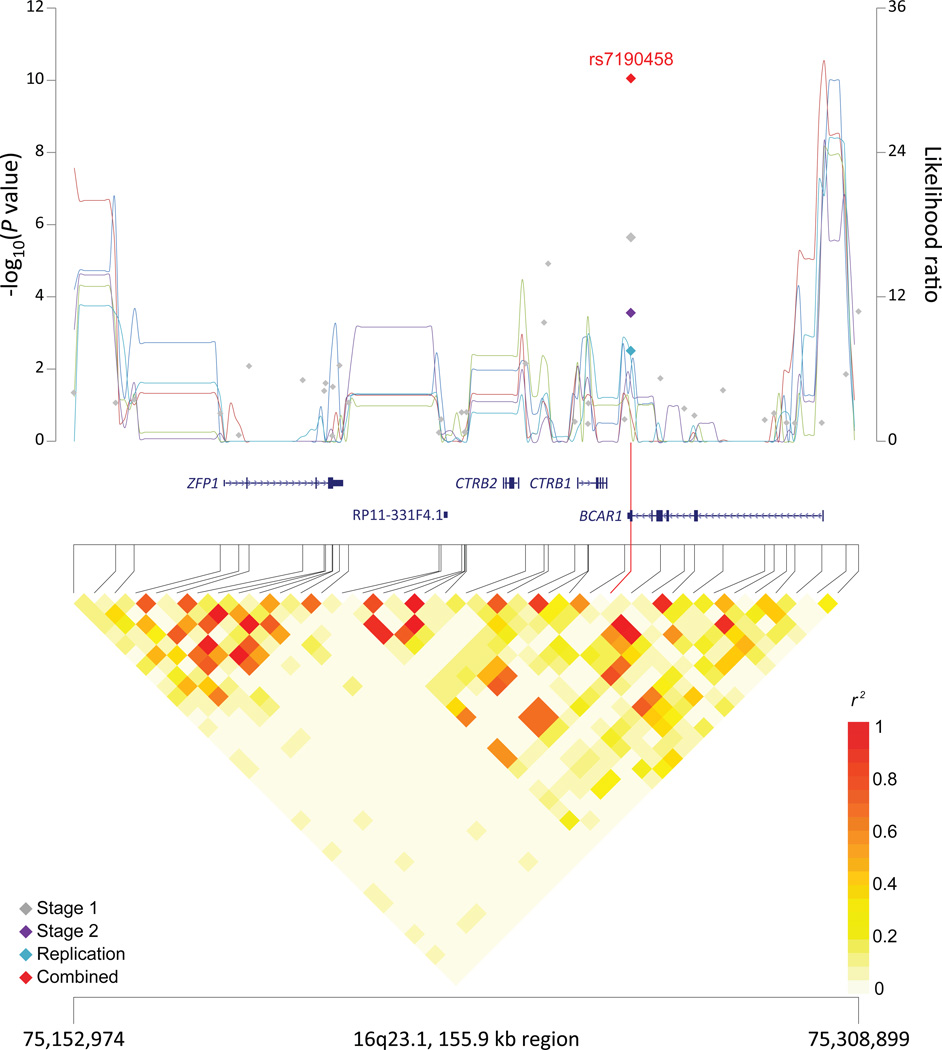
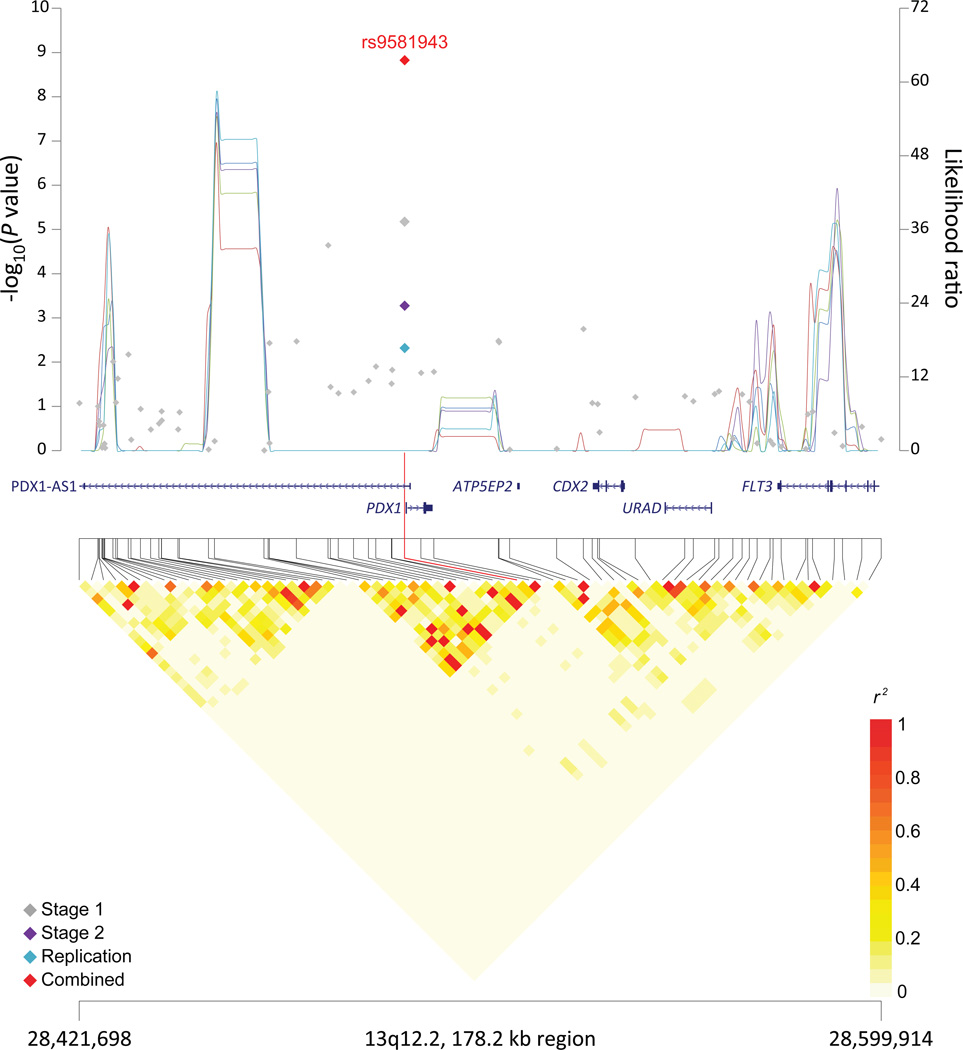
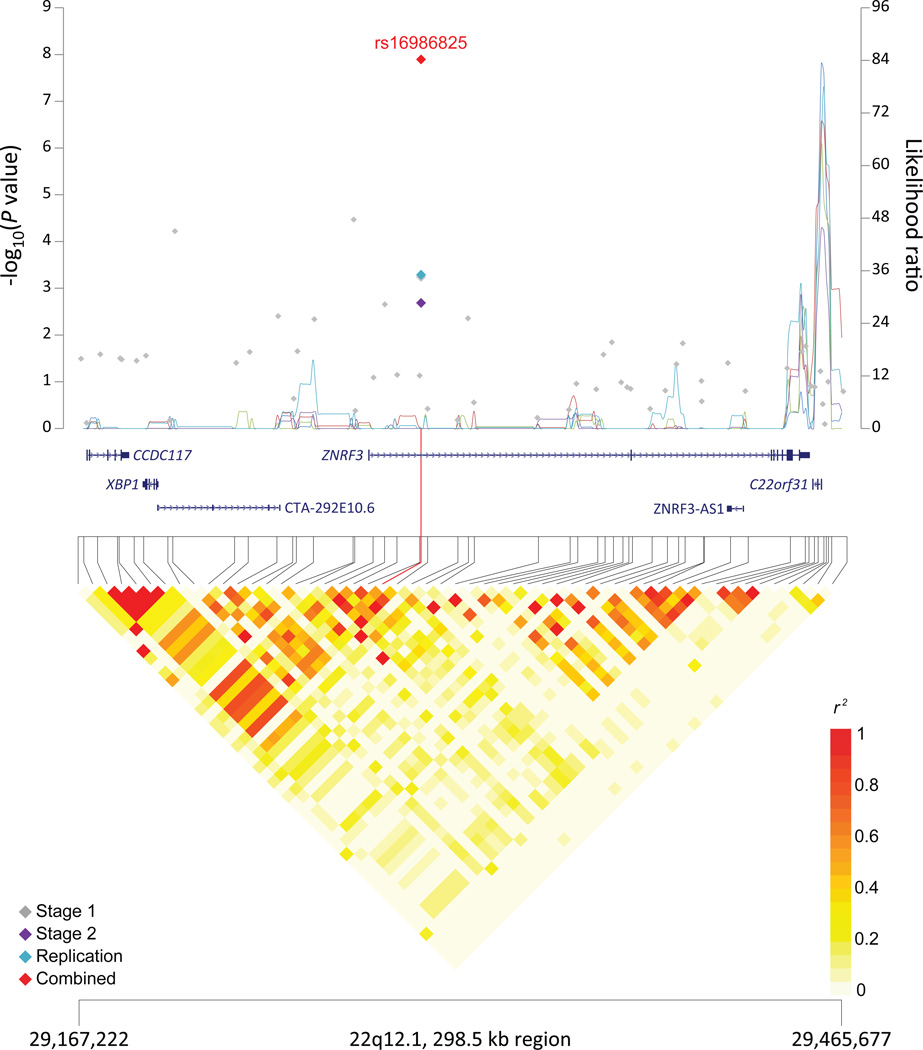
We performed a multistage genome-wide association study including 7,683 individuals with pancreatic cancer and 14,397 controls of European descent. Four new loci reached genome-wide significance: rs6971499 at 7q32.3 (LINC-PINT, per-allele odds ratio (OR) = 0.79, 95% confidence interval (CI) 0.74-0.84, P = 3.0 × 10(-12)), rs7190458 at 16q23.1 (BCAR1/CTRB1/CTRB2, OR = 1.46, 95% CI 1.30-1.65, P = 1.1 × 10(-10)), rs9581943 at 13q12.2 (PDX1, OR = 1.15, 95% CI 1.10-1.20, P = 2.4 × 10(-9)) and rs16986825 at 22q12.1 (ZNRF3, OR = 1.18, 95% CI 1.12-1.25, P = 1.2 × 10(-8)). We identified an independent signal in exon 2 of TERT at the established region 5p15.33 (rs2736098, OR = 0.80, 95% CI 0.76-0.85, P = 9.8 × 10(-14)). We also identified a locus at 8q24.21 (rs1561927, P = 1.3 × 10(-7)) that approached genome-wide significance located 455 kb telomeric of PVT1. Our study identified multiple new susceptibility alleles for pancreatic cancer that are worthy of follow-up studies.


Figures
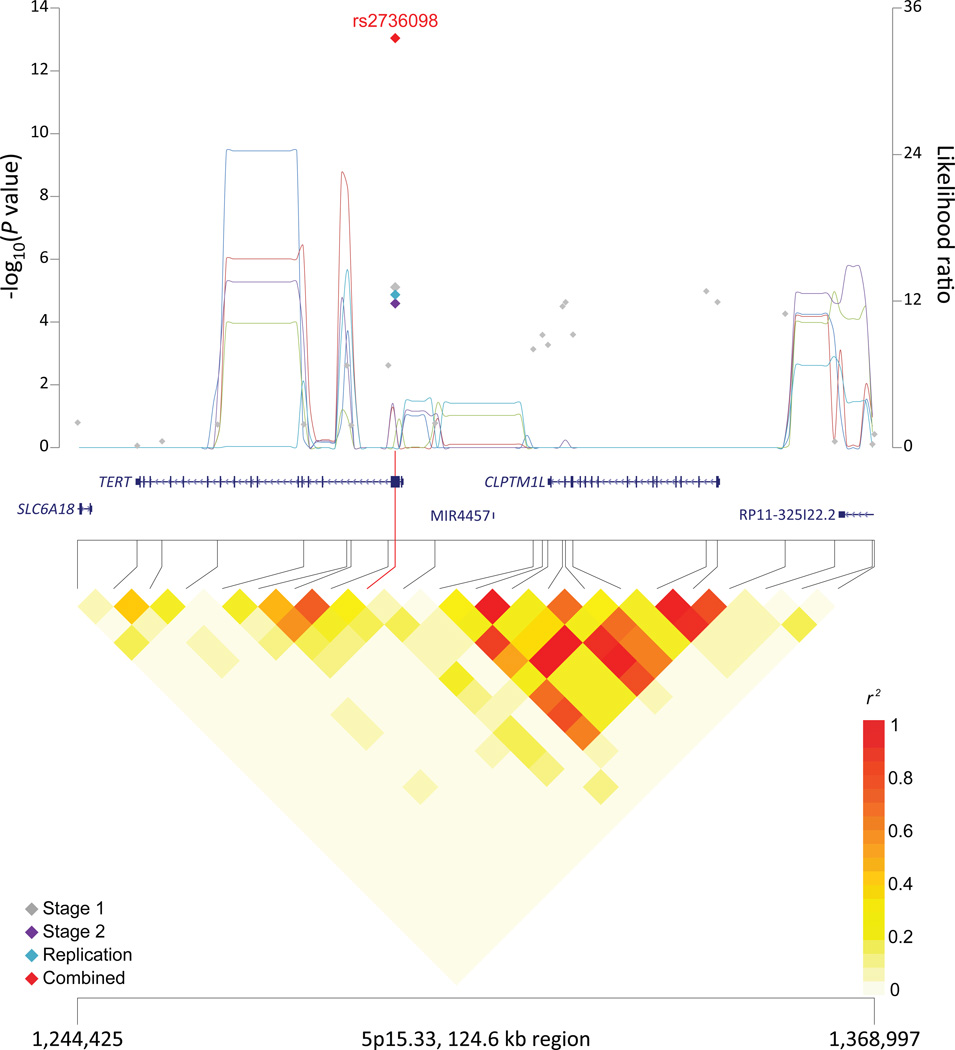
Figure 1
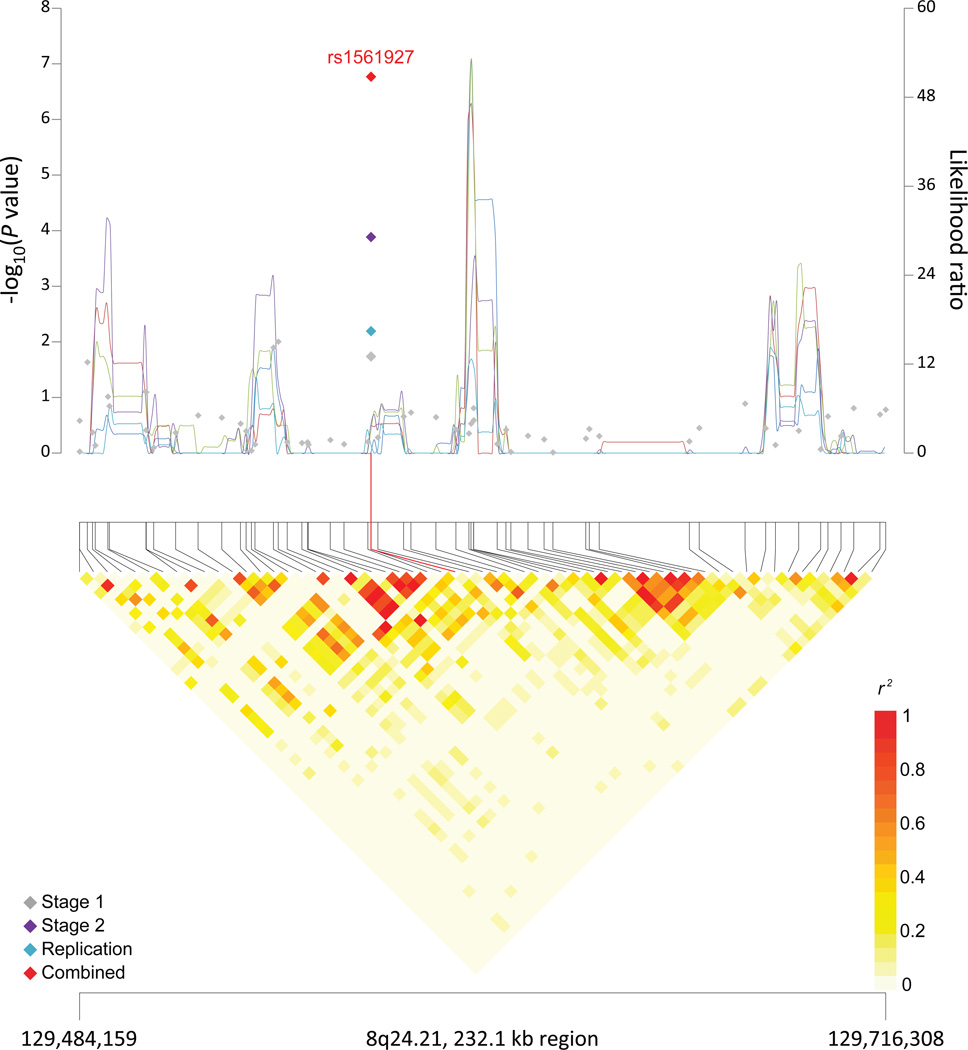
Figure 1. Association results, recombination hotspots and LD plots for new pancreatic cancer susceptibility regions (a–e) and one suggestive region (f)
Top, association results of GWAS data from the stage 1 (gray diamonds), stage 2 (purple diamonds), replication (blue diamonds) and the combined data from stages 1–3 (red diamonds) plotted against −log10 P values (left y axis). Overlaid are likelihood ratio statistics (right y axis) estimating putative recombination hotspots across the region on the basis of five unique sets of 100 randomly selected control samples. Bottom, LD heat map based on r2 values from the total control populations for all SNPs included in the GWAS. The data are based on a total number of 7,683 individuals with pancreatic cancer and 14,397 controls of European descent. Shown are results for 5p15.33 (a), 7q32.3 (b), 16q23.1 (c), 13q12.2 (d), 22q12.1 (e), and 8q24.1 (f).
Figure 1
Figure 1. Association results, recombination hotspots and LD plots for new pancreatic cancer susceptibility regions (a–e) and one suggestive region (f)
Top, association results of GWAS data from the stage 1 (gray diamonds), stage 2 (purple diamonds), replication (blue diamonds) and the combined data from stages 1–3 (red diamonds) plotted against −log10 P values (left y axis). Overlaid are likelihood ratio statistics (right y axis) estimating putative recombination hotspots across the region on the basis of five unique sets of 100 randomly selected control samples. Bottom, LD heat map based on r2 values from the total control populations for all SNPs included in the GWAS. The data are based on a total number of 7,683 individuals with pancreatic cancer and 14,397 controls of European descent. Shown are results for 5p15.33 (a), 7q32.3 (b), 16q23.1 (c), 13q12.2 (d), 22q12.1 (e), and 8q24.1 (f).
Figure 1
Figure 1. Association results, recombination hotspots and LD plots for new pancreatic cancer susceptibility regions (a–e) and one suggestive region (f)
Top, association results of GWAS data from the stage 1 (gray diamonds), stage 2 (purple diamonds), replication (blue diamonds) and the combined data from stages 1–3 (red diamonds) plotted against −log10 P values (left y axis). Overlaid are likelihood ratio statistics (right y axis) estimating putative recombination hotspots across the region on the basis of five unique sets of 100 randomly selected control samples. Bottom, LD heat map based on r2 values from the total control populations for all SNPs included in the GWAS. The data are based on a total number of 7,683 individuals with pancreatic cancer and 14,397 controls of European descent. Shown are results for 5p15.33 (a), 7q32.3 (b), 16q23.1 (c), 13q12.2 (d), 22q12.1 (e), and 8q24.1 (f).
Figure 1
Figure 1. Association results, recombination hotspots and LD plots for new pancreatic cancer susceptibility regions (a–e) and one suggestive region (f)
Top, association results of GWAS data from the stage 1 (gray diamonds), stage 2 (purple diamonds), replication (blue diamonds) and the combined data from stages 1–3 (red diamonds) plotted against −log10 P values (left y axis). Overlaid are likelihood ratio statistics (right y axis) estimating putative recombination hotspots across the region on the basis of five unique sets of 100 randomly selected control samples. Bottom, LD heat map based on r2 values from the total control populations for all SNPs included in the GWAS. The data are based on a total number of 7,683 individuals with pancreatic cancer and 14,397 controls of European descent. Shown are results for 5p15.33 (a), 7q32.3 (b), 16q23.1 (c), 13q12.2 (d), 22q12.1 (e), and 8q24.1 (f).
Figure 1
Figure 1. Association results, recombination hotspots and LD plots for new pancreatic cancer susceptibility regions (a–e) and one suggestive region (f)
Top, association results of GWAS data from the stage 1 (gray diamonds), stage 2 (purple diamonds), replication (blue diamonds) and the combined data from stages 1–3 (red diamonds) plotted against −log10 P values (left y axis). Overlaid are likelihood ratio statistics (right y axis) estimating putative recombination hotspots across the region on the basis of five unique sets of 100 randomly selected control samples. Bottom, LD heat map based on r2 values from the total control populations for all SNPs included in the GWAS. The data are based on a total number of 7,683 individuals with pancreatic cancer and 14,397 controls of European descent. Shown are results for 5p15.33 (a), 7q32.3 (b), 16q23.1 (c), 13q12.2 (d), 22q12.1 (e), and 8q24.1 (f).
Figure 1
Figure 1. Association results, recombination hotspots and LD plots for new pancreatic cancer susceptibility regions (a–e) and one suggestive region (f)
Top, association results of GWAS data from the stage 1 (gray diamonds), stage 2 (purple diamonds), replication (blue diamonds) and the combined data from stages 1–3 (red diamonds) plotted against −log10 P values (left y axis). Overlaid are likelihood ratio statistics (right y axis) estimating putative recombination hotspots across the region on the basis of five unique sets of 100 randomly selected control samples. Bottom, LD heat map based on r2 values from the total control populations for all SNPs included in the GWAS. The data are based on a total number of 7,683 individuals with pancreatic cancer and 14,397 controls of European descent. Shown are results for 5p15.33 (a), 7q32.3 (b), 16q23.1 (c), 13q12.2 (d), 22q12.1 (e), and 8q24.1 (f).

References

    1. Siegel R, Ma J, Zou Z, Jemal A. Cancer statistics, 2014. CA Cancer J Clin. 2014;64:9–29. - PubMed
    1. Ferlay J, et al. Cancer incidence and mortality patterns in Europe: estimates for 40 countries in 2012. Eur J Cancer. 2013;49:1374–1403. - PubMed
    1. Hidalgo M. Pancreatic cancer. N Engl J Med. 2010;362:1605–1617. - PubMed
    1. Klein AP. Genetic susceptibility to pancreatic cancer. Mol Carcinog. 2012;51:14–24. - PMC - PubMed
    1. Amundadottir L, et al. Genome-wide association study identifies variants in the ABO locus associated with susceptibility to pancreatic cancer. Nat Genet. 2009;41:986–990. - PMC - PubMed

Publication types