Review
. 2014 Sep 12;8(6):1095-111.
doi: 10.1016/j.molonc.2014.06.005. Epub 2014 Jul 10.

Tumour heterogeneity and the evolution of polyclonal drug resistance

Affiliations
Review

Tumour heterogeneity and the evolution of polyclonal drug resistance

Rebecca A Burrell et al. Mol Oncol. .

Abstract

Cancer drug resistance is a major problem, with the majority of patients with metastatic disease ultimately developing multidrug resistance and succumbing to their disease. Our understanding of molecular events underpinning treatment failure has been enhanced by new genomic technologies and pre-clinical studies. Intratumour genetic heterogeneity (ITH) is a prominent contributor to therapeutic failure, and it is becoming increasingly apparent that individual tumours may achieve resistance via multiple routes simultaneously - termed polyclonal resistance. Efforts to target single resistance mechanisms to overcome therapeutic failure may therefore yield only limited success. Clinical studies with sequential analysis of tumour material are needed to enhance our understanding of inter-clonal functional relationships and tumour evolution during therapy, and to improve drug development strategies in cancer medicine.

Keywords: Cancer evolution; Drug resistance; Genomic instability; Intratumour heterogeneity.


Figures

Figure 1
Figure 1
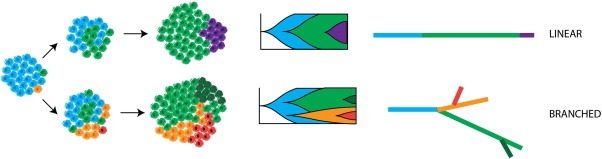
Linear and Branched Cancer Evolution. Schematic illustrating different patterns of cancer evolution. Intercellular heterogeneity followed by clonal selection leads to outgrowth of one or more subclones. If the emerging subclone outcompetes the rest of the tumour cell population, this is described as a clonal sweep, and the subclonal genotype has ‘fixed’ in the population. In linear evolution, subclones arise sequentially (top panel), while if divergent subclones emerge independently then evolution is branched (bottom panel). Incomplete clonal sweeps will generate clonal heterogeneity, which can arise in both linear and branch evolutionary trajectories. Subclonal genotypes allow the monitoring of tumour evolution over time.
Figure 2
Figure 2
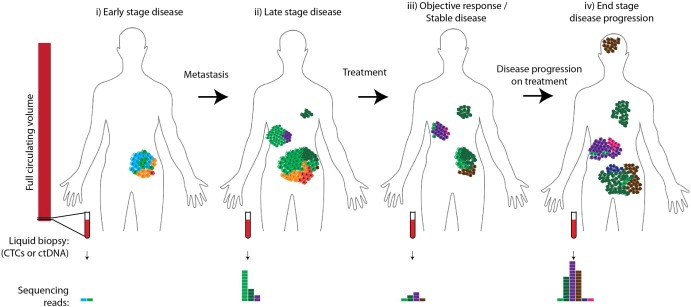
Temporal and Spatial Heterogeneity in Cancer Progression. i) The primary tumour is composed of multiple subclones; biopsies of any one part would therefore be subject to sampling bias. ii) Multiple subclones (light and dark green clones) have seeded metastases, and metastatic clones have continued to evolve (emergence of purple subclone). In the primary tumour the ancestral blue subclone is now extinct. iii) Following treatment, differential clonal response has occurred, resulting in an objective clinical response or stable disease. Orange, red and light green clones have all responded either partially or completely to treatment, while pre‐existing resistant clones (dark green, purple, brown) have continued to expand during treatment. A resistant clone (pink) has developed de novo during treatment. iv) Clinical disease progression has occurred – purple, pink, dark green and brown clones have all expanded, and a new brain metastasis has been seeded (brown). A further new drug resistant clone has emerged (blue). Biopsies taken at different timepoints in disease progression or from different sites of disease would be subject to sampling bias. Assaying circulating tumour DNA (ctDNA) may help minimise this bias, and can be performed longitudinally (bottom panel). ctDNA concentration increases with disease burden and is higher in metastatic than localised disease (Bettegowda et al., 2014). However, as only a small fraction of the circulating volume is sampled, individual subclones may not be detected (this sampling bias also affects analysis of haematopoetic malignancies) and furthermore it is not clear how uniformly different subclones shed DNA into the circulation.
Figure 3
Figure 3
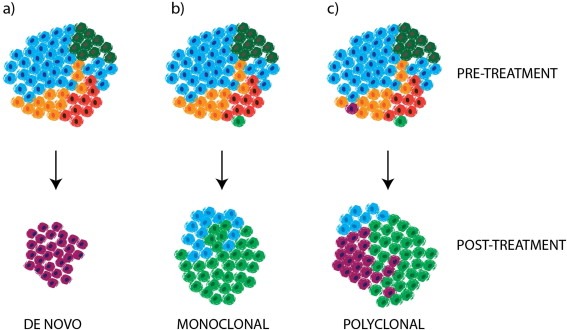
Clonal Evolution and Drug Resistance. Acquired drug resistance may emerge as a consequence of the selective expansion of: a) the de novo development of resistance in a previously sensitive clone (e.g. as a consequence of treatment induced mutagenesis, or tumour‐intrinsic genomic instability) b) a pre‐existing resistant minor subclone or c) multiple pre‐existing or de novo resistant subclones, which may be present across one or multiple sites of disease.
Figure 4
Figure 4
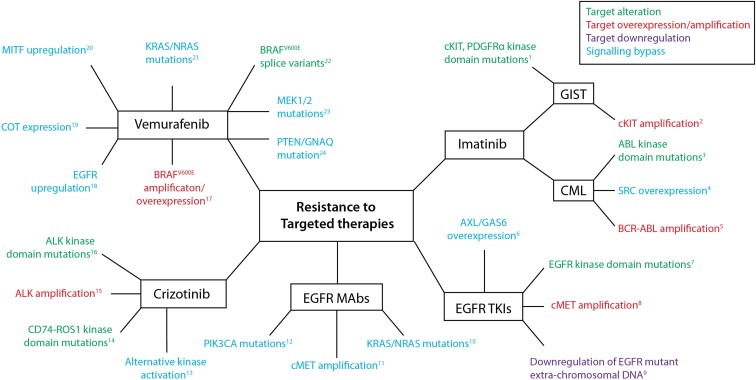
Mechanisms of resistance to targeted therapies. Schematic summarising some of the described mechanisms of resistance to a selection of targeted therapies: Vemurafenib (BRAFV600E inhibitor), Imatinib (BCR‐ABL/cKIT/PDGFRA), EGFR tyrosine kinase inhibitors (e.g. gefitinib, erlotinib), EGFR targeted monoclonal antibodies (e.g. cetuximab, panitumumab), Crizotinib (ALK, ROS1 inhibitor). 1. (Heinrich et al., 2006; Liegl et al., 2008; Lim et al., 2008; Wardelmann et al., 2006) 2. (Debiec‐Rychter et al., 2005; Heinrich et al., 2006) 3. (Shah et al., 2002) 4. (Mahon et al., 2008) 5. (Gorre et al., 2001) 6. (Zhang et al., 2012) 7. (Inukai et al., 2006; Kosaka et al., 2006; Maheswaran et al., 2008) 8. (Turke et al., 2010) 9. (Nathanson et al., 2014) 10. (Amado et al., 2008; Bardelli et al., 2013; Diaz et al., 2012; Misale et al., 2012) 11. (Bardelli et al., 2013; Engelman et al., 2007) 12. (Sartore‐Bianchi et al., 2009) 13. (Katayama et al., 2012) 14. (Awad et al., 2013) 15. (Katayama et al., 2012) 16. (Choi et al., 2010; Katayama et al., 2012) 17. (Shi et al., 2014; Shi et al., 2012; Van Allen et al., 2014) 18. (Prahallad et al., 2012) 19. (Johannessen et al., 2010) 20. (Johannessen et al., 2013; Van Allen et al., 2014) 21. (Nazarian et al., 2010; Shi et al., 2014; Van Allen et al., 2014) 22. (Poulikakos et al., 2011; Shi et al., 2012) 23. (Shi et al., 2014; Van Allen et al., 2014) 24. (Turajlic et al., 2014).
Figure 5
Figure 5
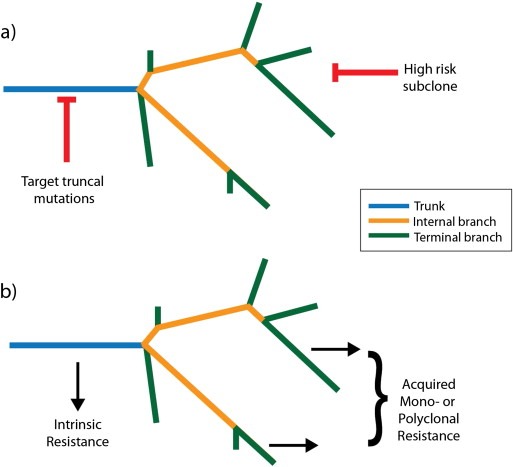
Strategies for targeting heterogeneous tumours. A) Effective therapeutic strategies for targeting heterogeneous tumours could include targeting clonal, or truncal mutations, or else targeting high‐risk subclones – this might be particularly efficacious in the context of adjuvant therapy. B) Intrinsic resistance is likely to be driven by truncal mutations, while acquired resistance is likely to be driven by one or more subclonal mutations (branched mutations in branched evolution, nested subclones in linear evolution – see Figure 1).

References

    1. Almendro, V. , Cheng, Y.K. , Randles, A. , Itzkovitz, S. , Marusyk, A. , Ametller, E. , Gonzalez-Farre, X. , Munoz, M. , Russnes, H.G. , Helland, A. , 2014. Inference of tumor evolution during chemotherapy by computational modeling and in situ analysis of genetic and phenotypic cellular diversity. Cell Rep.. 6, 514–527. - PMC - PubMed
    1. Amado, R.G. , Wolf, M. , Peeters, M. , Van Cutsem, E. , Siena, S. , Freeman, D.J. , Juan, T. , Sikorski, R. , Suggs, S. , Radinsky, R. , 2008. Wild-type KRAS is required for panitumumab efficacy in patients with metastatic colorectal cancer. J. Clin. Oncol.: Official Journal of the American Society of Clinical Oncology. 26, 1626–1634. - PubMed
    1. Anderson, K. , Lutz, C. , van Delft, F.W. , Bateman, C.M. , Guo, Y. , Colman, S.M. , Kempski, H. , Moorman, A.V. , Titley, I. , Swansbury, J. , 2011. Genetic variegation of clonal architecture and propagating cells in leukaemia. Nature. 469, 356–361. - PubMed
    1. Arjan, J.A. , Visser, M. , Zeyl, C.W. , Gerrish, P.J. , Blanchard, J.L. , Lenski, R.E. , 1999. Diminishing returns from mutation supply rate in asexual populations. Science. 283, 404–406. - PubMed
    1. Arora, V.K. , Schenkein, E. , Murali, R. , Subudhi, S.K. , Wongvipat, J. , Balbas, M.D. , Shah, N. , Cai, L. , Efstathiou, E. , Logothetis, C. , 2013. Glucocorticoid receptor confers resistance to antiandrogens by bypassing androgen receptor blockade. Cell. 155, 1309–1322. - PMC - PubMed

Publication types

Substances