. 2015 Jan 27;112(4):1167-72.
doi: 10.1073/pnas.1401965111. Epub 2014 Aug 4.

Genomic responses in mouse models greatly mimic human inflammatory diseases

Affiliations

Genomic responses in mouse models greatly mimic human inflammatory diseases

Keizo Takao et al. Proc Natl Acad Sci U S A. .

Erratum in

Abstract

The use of mice as animal models has long been considered essential in modern biomedical research, but the role of mouse models in research was challenged by a recent report that genomic responses in mouse models poorly mimic human inflammatory diseases. Here we reevaluated the same gene expression datasets used in the previous study by focusing on genes whose expression levels were significantly changed in both humans and mice. Contrary to the previous findings, the gene expression levels in the mouse models showed extraordinarily significant correlations with those of the human conditions (Spearman's rank correlation coefficient: 0.43-0.68; genes changed in the same direction: 77-93%; P = 6.5 × 10(-11) to 1.2 × 10(-35)). Moreover, meta-analysis of those datasets revealed a number of pathways/biogroups commonly regulated by multiple conditions in humans and mice. These findings demonstrate that gene expression patterns in mouse models closely recapitulate those in human inflammatory conditions and strongly argue for the utility of mice as animal models of human disorders.

Keywords: burn; inflammation; sepsis; transcriptome analysis; trauma.


Conflict of interest statement

The authors declare no conflict of interest.

Figures
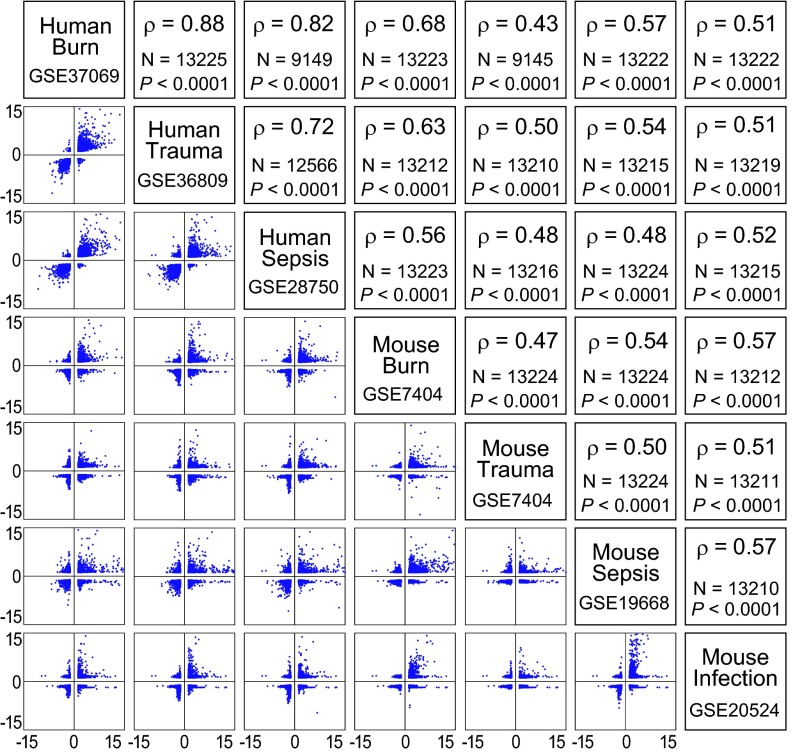
Fig. 1.
Fig. 1.
Correlations of gene changes among human burns, trauma, sepsis, and the corresponding mouse models. Scatterplots and Spearman’s rank correlations (ρ) of the fold changes of the genes responsive to both conditions for each pair of interest (P < 0.05; fold change >1.2). Vertical bar and horizontal bar for each panel represents fold change in right and upper panels, respectively. Murine models were highly significantly correlated with human conditions with Spearman's correlation coefficient (ρ = 0.43–0.68; P < 0.0001 for every comparison between human conditions and mouse models). The correlations between different mouse models were also significant (ρ = 0.47–0.57; P < 0.0001 for every comparison).
Fig. 2.
Fig. 2.
Statistical comparison of the direction of the gene expression changes between human burns and mouse models. Vertical bar represents the significance of the overlap between gene sets. Genes whose expression levels were changed in human burns significantly overlapped with those in the condition of mouse burn (A, overlap P value = 3.9 × 10⁻³⁴), mouse trauma (B, 6.3 × 10⁻¹³), mouse sepsis from GSE19668 (C, 1.2 × 10⁻³⁵), mouse sepsis from GSE26472 (D, 6.5 × 10⁻¹¹), and mouse infection (E, 3.4 × 10⁻³⁵). Value is expressed as the –log 10 of the P value. Statistical significances regarding the directionality of the gene expression changes were derived from the nonparametric ranking method provided by the bioinformatics platform NextBio.
Fig. 3.
Fig. 3.
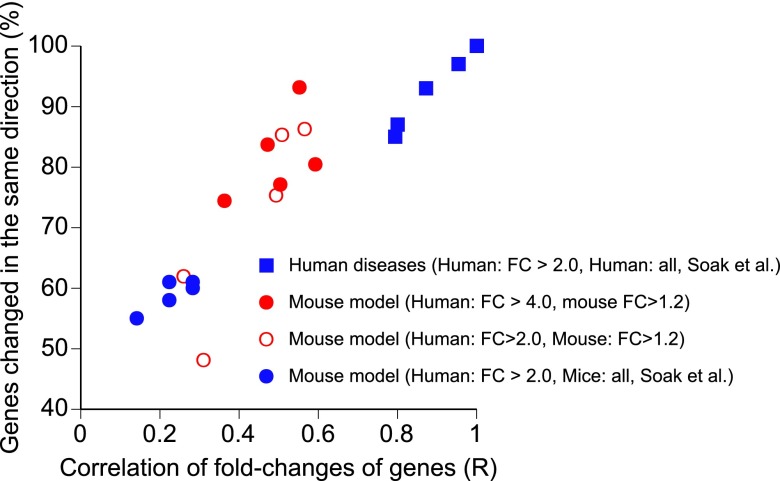
Comparison of the genomic response to severe acute inflammation from different etiologies in human and murine models. The datasets that were used in Seok et al. (1) and are registered in NextBio were reevaluated using the criteria of Seok et al. (1) to select the genes of interest. We chose genes with significant responses in both the human burn dataset and in the mouse dataset for comparison, whereas Seok et al. chose the 4,918 genes with significant responses in the human datasets regardless of the significance of the changes in the genes in mice. The datasets used here are listed in Table S2. Shown are Pearson’s correlations (R; x axis) and directionality (%; y axis) of the gene response from multiple published datasets in GEO compared with human burns. Note that R2 data taken from Seok et al. were recalculated to obtain the R values shown here for comparison (blue symbols). Most of the mouse models showed a high directionality score (random chance is 50%), indicating that their gene expression patterns are similar to the that in human burns, as long as stringent criteria are applied to the selection of the genes of interest.
Fig. 4.
Fig. 4.
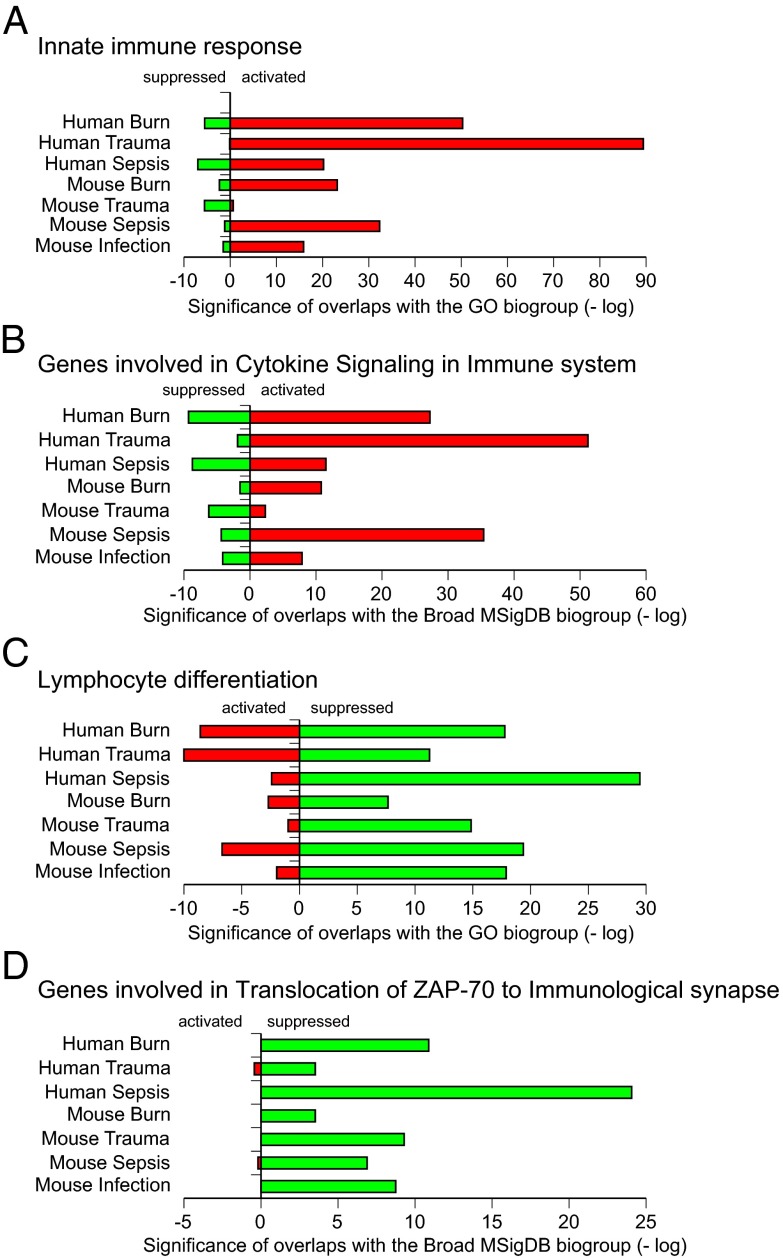
Representative pathways or biogroups shared by the human diseases and mouse models. (AD) Shown are bar graphs of statistical significance (−log 10 P value) for the representative pathways with significant regulation in the human and murine models. (A) Genes annotated as “innate immune response (GO)” significantly overlapped with genes up-regulated in the mouse models as well as in human diseases. (B) Significant overlap was also detected between “genes involved in cytokine signaling in immune system (canonical pathways, Broad MSigDB)” and genes up-regulated in both the mouse models and human diseases. (C) Genes annotated “lymphocyte differentiation (GO)” and genes down-regulated in the mouse models and human diseases significantly overlapped. (D) There was also significant overlap between “genes involved in translocation of ZAP-70 to immunological synapse (canonical pathways, Broad MSigDB).” As can be seen, in the pathways/biogroups shown here, the mouse models are comparable to the human conditions in the significance of enrichment between each condition and pathways/biogroups. For a complete list of pathways/biogroups shared by the human diseases and mouse models see Dataset S1.

Comment in

References

    1. Seok J, et al. Inflammation and Host Response to Injury, Large Scale Collaborative Research Program Genomic responses in mouse models poorly mimic human inflammatory diseases. Proc Natl Acad Sci USA. 2013;110(9):3507–3512. - PMC - PubMed
    1. Cauwels A, Vandendriessche B, Brouckaert P. Of mice, men, and inflammation. Proc Natl Acad Sci USA. 2013;110(34):E3150. - PMC - PubMed
    1. de Souza N. Model organisms: Mouse models challenged. Nat Methods. 2013;10(4):288. - PubMed
    1. Drake AC. Of mice and men: What rodent models don’t tell us. Cell Mol Immunol. 2013;10(4):284–285. - PMC - PubMed
    1. Leist M, Hartung T. Inflammatory findings on species extrapolations: Humans are definitely no 70-kg mice. ALTEX. 2013;30(2):227–230. - PubMed

Publication types