. 2014 Aug 22;451(2):314-8.
doi: 10.1016/j.bbrc.2014.07.124. Epub 2014 Aug 2.

Ancient origin of mast cells

Affiliations

Ancient origin of mast cells

G William Wong et al. Biochem Biophys Res Commun. .

Abstract

The sentinel roles of mammalian mast cells (MCs) in varied infections raised the question of their evolutionary origin. We discovered that the test cells in the sea squirt Ciona intestinalis morphologically and histochemically resembled cutaneous human MCs. Like the latter, C. intestinalis test cells stored histamine and varied heparin·serine protease complexes in their granules. Moreover, they exocytosed these preformed mediators when exposed to compound 48/80. In support of the histamine data, a C. intestinalis-derived cDNA was isolated that resembled that which encodes histidine decarboxylase in human MCs. Like heparin-expressing mammalian MCs, activated test cells produced prostaglandin D2 and contained cDNAs that encode a protein that resembles the synthase needed for its biosynthesis in human MCs. The accumulated morphological, histochemical, biochemical, and molecular biology data suggest that the test cells in C. intestinalis are the counterparts of mammalian MCs that reside in varied connective tissues. The accumulated data point to an ancient origin of MCs that predates the emergence of the chordates >500million years ago, well before the development of adaptive immunity. The remarkable conservation of MCs throughout evolution is consistent with their importance in innate immunity.

Keywords: Ciona intestinalis; Heparin; Histamine; Mast cell; Prostaglandin D(2); Serine protease.


Figures

Fig. 1
Fig. 1
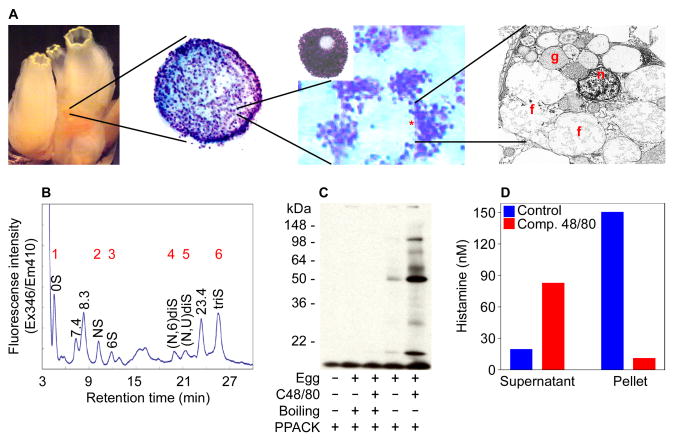
The test cells that surround the oocyte in C. intestinalis resemble the MCs that reside in the skin and other connective tissues of humans and mice. (A) Depicted are increasing magnifications of C. intestinalis test cells. The cells in the middle panels were stained with toluidine blue. The circled area corresponds to a test cell. At the electron microscopic level, these cells contained a non-segmented nucleus (n) and electron-dense granules (g). When activated, many of these intracellular granules fused (f) before their contents were exocytosed analogous to activated mammalian MCs. (B) High performance liquid chromatography was carried out on the disaccharides obtained when purified test cell-derived heparin was incubated with heparitinases I–III. Peaks 1 to 6 correspond to the 0S, NS, 6S, (N,6)diS, (N,U)diS, and triS uronic acid-glucosamine disaccharides, respectively, based on their elution positions relative to that of known standards. The peak at 23.4 min also is present in a heparitinase digest of porcine heparin. Although its structure has not yet been deduced, almost certainly it is a disulfated disaccharide. The unknown peaks at 7.4 and 8.3 min most likely are monosulfated disaccharides. (C–D) Compound 48/80-treated test cell-enriched oocytes also exocytose enzymatically active serine proteases (C) and histamine (D).
Fig. 2
Fig. 2
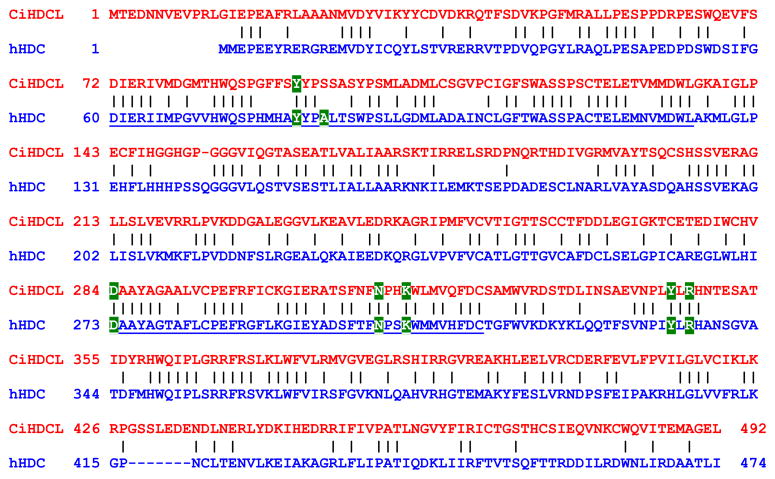
Isolation and characterization of a C. intestinalis transcript that encodes a HDC-like protein. A C. intestinalis cDNA was isolated (see GenBank accession number EF125183) that encoded a novel 492-mer protein that was ~50% identical to residues 1-474 of human histidine decarboxylase (hHDC). Additional information on this cDNA (accession number cidg826g09) can be found at http://ghost.zool.kyoto-u.ac.jp/. Shown is a comparison of the C. intestinalis HDC-like protein (CiHDCL) and hHDC. Using an expression/site-directed mutagenesis approach, two regions (corresponding to underlined residues 60-123 and 273-313 in hHDC) and seven amino acids (i.e., Y80, A83, D273, N302, K305, Y334, and R336) have been identified in hHDC that are important for the enzymatic activity of this decarboxylase. CiHDCL possesses those regions as well as the amino acids that are essential for histamine biosynthesis. hHDC is abundant in the gastric mucosa of humans as well as their tissue MCs. The fact that the CiHDCL cDNA was isolated from the sea squirt’s digestive gland is further evidence that it is the likely ortholog of hHDC. Only one CiHDCL EST was present in our library of ~600,000 C. intestinalis ESTs. Thus, CiHDCL is a highly restricted transcript in C. intestinalis as is HDC in humans.

References

    1. Galli SJ, Nakae S, Tsai M. Mast cells in the development of adaptive immune responses. Nat Immunol. 2005;6:135–142. - PubMed
    1. Huang C, De Sanctis GT, O’Brien PJ, Mizgerd JP, Friend DS, Drazen JM, Brass LF, Stevens RL. Evaluation of the substrate specificity of human mast cell tryptase β1 and demonstration of its importance in bacterial infections of the lung. J Biol Chem. 2001;276:26276–26284. - PubMed
    1. Thakurdas SM, Melicoff E, Sansores-Garcia L, Moreira DC, Petrova Y, Stevens RL, Adachi R. The mast cell-restricted tryptase mMCP-6 has a critical immunoprotective role in bacterial infections. J Biol Chem. 2007;282:20809–20815. - PubMed
    1. McNeil HP, Adachi R, Stevens RL. Mast cell-restricted tryptases: structure and function in inflammation and pathogen defense. J Biol Chem. 2007;282:20785–20789. - PubMed
    1. Shin K, Watts GF, Oettgen HC, Friend DS, Pemberton AD, Gurish MF, Lee DM. Mouse mast cell tryptase mMCP-6 is a critical link between adaptive and innate immunity in the chronic phase of Trichinella spiralis infection. J Immunol. 2008;180:4885–4891. - PMC - PubMed

Publication types

MeSH terms

Associated data

LinkOut - more resources