Effect of Dill (Anethum graveolens) on the severity of primary dysmenorrhea in compared with mefenamic acid: A randomized, double-blind trial
- PMID: 25097605
- PMCID: PMC4115348
Effect of Dill (Anethum graveolens) on the severity of primary dysmenorrhea in compared with mefenamic acid: A randomized, double-blind trial
Abstract
Background: Dysmenorrhea has negative effects on women's life. Due to side-effects of chemical drugs, there is growing trend toward herbal medicine. The aim of this study was to assess the effect of Dill compared to mefenamic acid on primary dysmenorrhea.
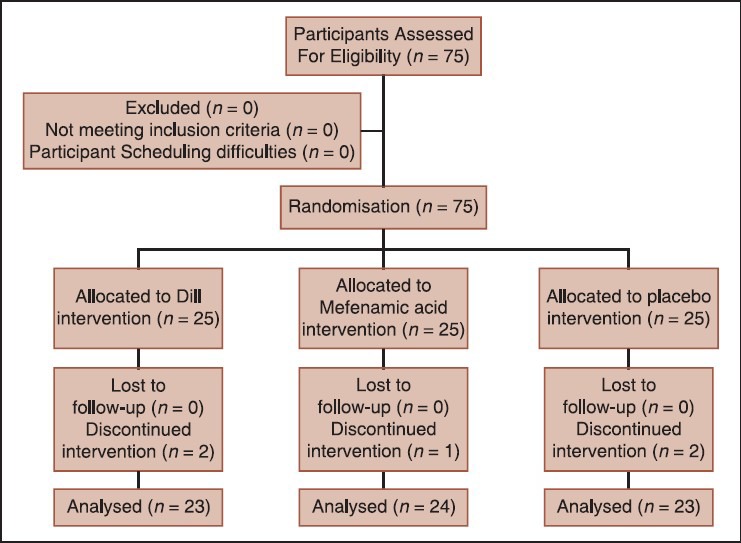
Materials and methods: This double-blind, randomized, clinical trial study was conducted on 75 single female students between 18 and 28 years old educating in Nursing and Midwifery School and Paramedical Faculty of Qom University of Medical Sciences of Iran in 2011. They were allocated randomly into one of the three groups: In Dill group, they took 1000 mg of Dill powder q12h for 5 days from 2 days before the beginning of menstruation for two cycles. Other groups received 250 mg mefenamic acid or 500 mg starch capsule as placebo, respectively. Dysmenorrhea severity was determined by a verbal multidimensional scoring system and a visual analog scale (VAS). Students with mild dysmenorrhea were excluded. Data were analyzed by SPSS using the descriptive statistic, paired-samples t-test, Wilcoxon signed-rank test, Mann-Whitney test, and Kruskal-Wallis test.
Results: There were no significant differences between three groups for demographic or descriptive variables. Comprising the VAS showed that the participants of Dill and mefenamic acid groups had lower significant pain in the 1(st) and the 2(nd) months after treatment, whereas in the placebo group this was only significant in the 2(nd) month (P < 0.05).
Conclusion: Dill was as effective as mefenamic acid in reducing the pain severity in primary dysmenorrhea. Further studies regarding side-effects of Dill and its interactivity are recommended.
Keywords: Dill (Anethum graveolens); dysmenorrhea; mefenamic acid; pain; placebo.
Conflict of interest statement
Figures
References
-
- French L. Dysmenorrhea. Am Fam Physician. 2005;71:285–91. - PubMed
-
- Scott J. Baltimore: Lippincott Williams and Wilkins; 2003. Danforth's Obstetrics and Gynecology; p. 523.
-
- Namavar Jahromi B, Tartifizadeh A, Khabnadideh S. Comparison of fennel and mefenamic acid for the treatment of primary dysmenorrhea. Int J Gynaecol Obstet. 2003;80:153–7. - PubMed
-
- Berek JS. Baltimore: Lippincott Williams and Wilkins; 2012. Berek & Novak's Gynecology; p. 484.
-
- Speroff L, Fritz MA. Philadelphia: Lippincott Williams and Wilkins; 2005. Clinical Gynecologic Endocrinology and Infertility; pp. 539–41.
LinkOut - more resources
Full Text Sources