


Suboptimal breastfeeding practices are associated with infant illness in Vietnam
- PMID: 25097662
- PMCID: PMC4121620
- DOI: 10.1186/1746-4358-9-12
Suboptimal breastfeeding practices are associated with infant illness in Vietnam
Abstract
Background: Despite evidence supporting the importance of breastfeeding to child health, breastfeeding practices remain suboptimal in Vietnam. There is currently little evidence on the importance of breastfeeding in the prevention of morbidity during infancy in Vietnam. In order to provide country specific data for policy makers to support breastfeeding friendly policies and programs, analysis was undertaken on a cross-sectional dataset to investigate the association between breastfeeding practices and prevalence of diarrhea and acute respiratory infection (ARI) among infants aged 0-5 months.
Methods: Data on socio-demographic characteristics, infant feeding practices and prevalence of diarrhea and ARI were obtained from 6,068 mother-child dyads in 11 provinces of Vietnam in 2011. Multivariate logistic regression was used to examine the associations between breastfeeding practices and child illnesses.
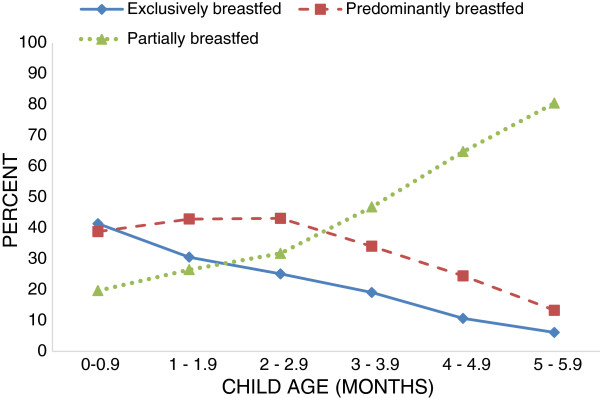
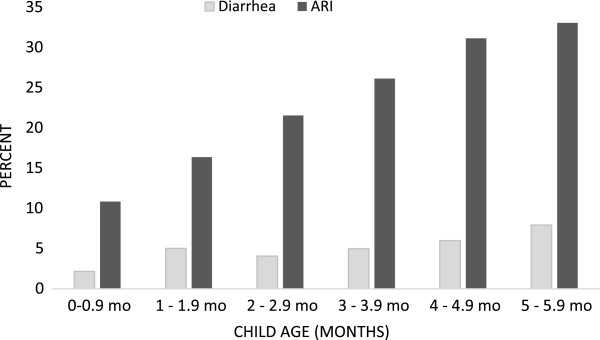
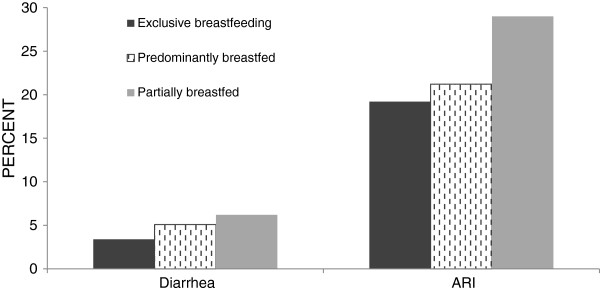
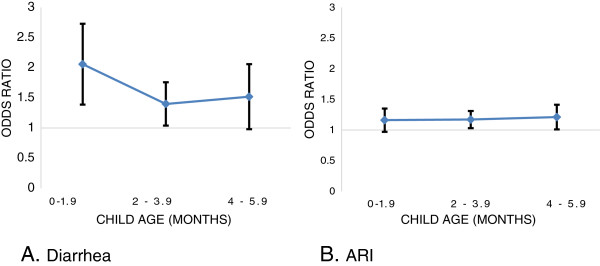
Results: On average, the prevalence of diarrhea and ARI among infants 0-5 months was 5.3% and 24.5%, respectively. Though half of all infants were breastfed within one hour of birth, 73.3% were given prelacteal foods in the first three days after birth. Only 20.2% of children 0-5 months old were exclusively breastfed, while 32.4% were predominantly breastfed and 47.4% partially breastfed. After adjusting for confounders, early initiation of breastfeeding was associated with lower prevalence of diarrhea [adjusted odds ratio (AOR) = 0.74 (95% CI 0.58, 0.93)], while prelacteal feeding was associated with higher prevalence [AOR = 1.53 (95% CI 1.15, 2.03)]. Compared to infants who were exclusively breastfed, infants who were predominantly [AOR = 1.52 (95% CI 1.05, 2.21)] or partially breastfed [AOR = 1.55 (95% CI 1.07, 2.24)] were more likely to have diarrhea. Prelacteal feeding [AOR = 1.16 (95% CI 1.01, 1.33)] and partial breastfeeding [AOR relative to exclusive breastfeeding = 1.24 (95% CI 1.03, 1.48)] were associated with higher prevalence of ARI. While the protective effects of exclusive breastfeeding against diarrhea declined with child age, this effect for ARI appears to have remained constant.
Conclusions: Early initiation and exclusive breastfeeding protects against diarrhea and ARI. Results confirm that interventions to improve early and exclusive breastfeeding would contribute to improving child health and nutrition in Vietnam.
Keywords: ARI; Breastfeeding; Diarrhea; Infant; Prelacteal feeding; Vietnam.
Figures
References
-
- Gartner LM, Morton J, Lawrence RA, Naylor AJ, O’Hare D, Schanler RJ, Eidelman AI. Breastfeeding and the use of human milk. Pediatrics. 2005;115(2):496–506. - PubMed
-
- Horta BL, Bahl R, Martines JC, Victora CG. Evidence on the long-term effects of breastfeeding: systematic reviews and meta-analysis. Geneva: World Health Organization; 2007.
-
- Morrow AL, Ruiz-Palacios GM, Jiang X, Newburg DS. Human-milk glycans that inhibit pathogen binding protect breast-feeding infants against infectious diarrhea. J Nutr. 2005;135(5):1304–1307. - PubMed
-
- Effect of breastfeeding on infant and child mortality due to infectious diseases in less developed countries: a pooled analysis. WHO Collaborative Study Team on the Role of Breastfeeding on the Prevention of Infant Mortality. Lancet. 2000;355(9202):451–455. - PubMed
LinkOut - more resources
Full Text Sources
Other Literature Sources
