


Influenza-like illness sentinel surveillance in one hospital in Medellin, Colombia. 2007-2012
- PMID: 25100179
- PMCID: PMC4280811
- DOI: 10.1111/irv.12271
Influenza-like illness sentinel surveillance in one hospital in Medellin, Colombia. 2007-2012
Abstract
Background: The city of Medellin in Colombia has almost no documentation of the causes of acute respiratory infections (ARIs). As part of an ongoing collaboration, we conducted an epidemiologic surveillance for influenza and other respiratory viruses. It described the influenza strains that were circulating in the region along with their distribution over time, and performing molecular characterization to some of those strains. This will contribute to the knowledge of local and national epidemiology.
Objectives: To analyze viral etiologic agents associated with influenza like illness (ILI) in participants reporting to one General hospital in Medelllin, Colombia.
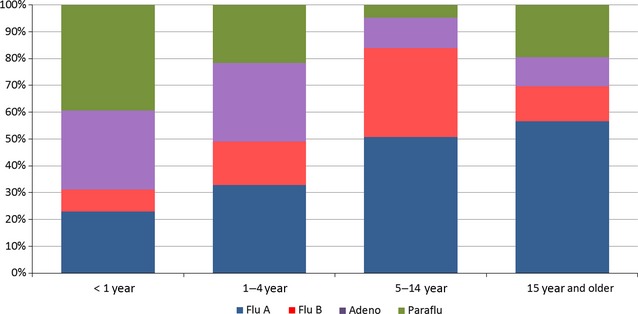
Results: From January 2007 to December 2012, a total of 2039 participants were enrolled. Among them, 1120 (54.9%) were male and 1364 (69%) were under the age of five. Only 124 (6%) were older than the age of 15. From all 2039 participants, 1040 samples were diagnosed by either isolation or RT-PCR. One or more respiratory viruses were found in 737 (36%) participants. Of those, 426 (57.8%) got influenza A or B. Adenoviral and parainfluenza infections represented 19.1% and 14.9% of viral infections, respectively. Influenza A was detected almost throughout the whole year except for the first quarter of 2010, right after the 2009 influenza A pandemic. Influenza B was detected in 2008, 2010, and 2012 with no pattern detected. During 2008 and 2010, both types circulated in about the same proportion. Unusually, in many months of 2012, the proportion of influenza B infections was higher than influenza A (ranging between 30% and 42%). The higher proportion of adenovirus was mainly detected in the last quarter of years 2007 and 2010. Adenoviral cases are more frequent in participants under the age of four.
Conclusions: The phylogenetic analysis of influenza viruses shows that only in the case of influenza A/H1N1, the circulating strains totally coincide with the vaccine strains each year.
Keywords: Influenza; Medellin; respiratory viruses; surveillance.
© 2014 The Authors. Influenza and Other Respiratory Viruses Published by John Wiley & Sons Ltd.
Figures



References
-
- Karaivanova GM. Viral respiratory infections and their role as public health problem in tropical countries (review) Afr J Med Med Sci. 1995;24:1–7. - PubMed
Publication types
MeSH terms
Substances
LinkOut - more resources
Full Text Sources
Other Literature Sources
Medical
Research Materials
