


Response to anticipated reward in the nucleus accumbens predicts behavior in an independent test of honesty
- PMID: 25100590
- PMCID: PMC6802594
- DOI: 10.1523/JNEUROSCI.0217-14.2014
Response to anticipated reward in the nucleus accumbens predicts behavior in an independent test of honesty
Abstract
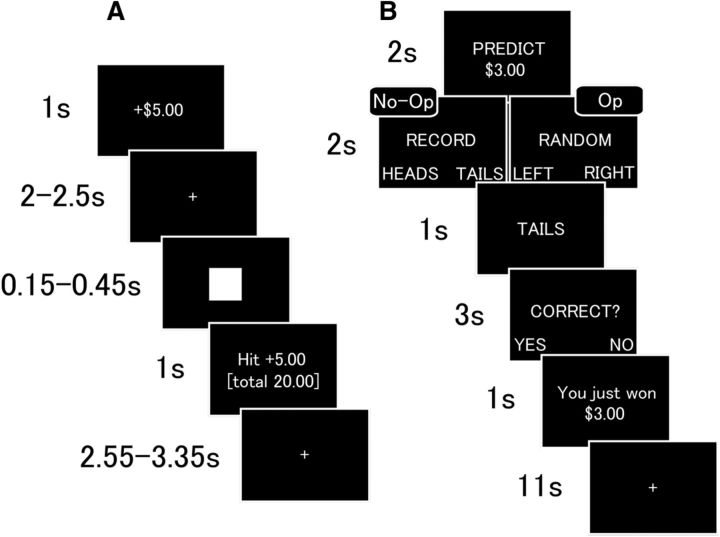
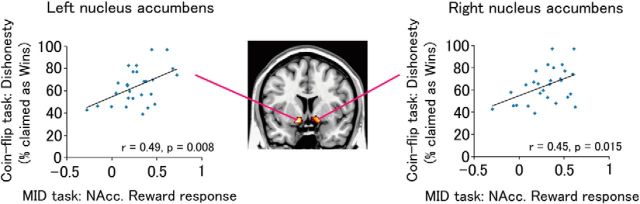
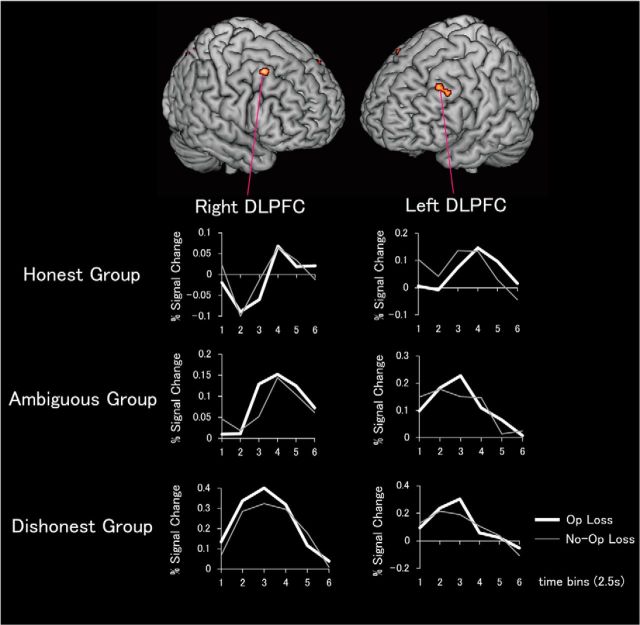
This study examines the cognitive and neural determinants of honesty and dishonesty. Human subjects undergoing fMRI completed a monetary incentive delay task eliciting responses to anticipated reward in the nucleus accumbens. Subjects next performed an incentivized prediction task, giving them real and repeated opportunities for dishonest gain. Subjects attempted to predict the outcomes of random computerized coin-flips and were financially rewarded for accuracy. In some trials, subjects were rewarded based on self-reported accuracy, allowing them to gain money dishonestly by lying. Dishonest behavior was indexed by improbably high levels of self-reported accuracy. Nucleus accumbens response in the first task, involving only honest rewards, accounted for ∼25% of the variance in dishonest behavior in the prediction task. Individuals showing relatively strong nucleus accumbens responses to anticipated reward also exhibited increased dorsolateral prefrontal activity (bilateral) in response to opportunities for dishonest gain. These results address two hypotheses concerning (dis)honesty. According to the "Will" hypothesis, honesty results from the active deployment of self-control. According to the "Grace" hypothesis, honesty flows more automatically. The present results suggest a reconciliation between these two hypotheses while explaining (dis)honesty in terms of more basic neural mechanisms: relatively weak responses to anticipated rewards make people morally "Graceful," but individuals who respond more strongly may resist temptation by force of Will.
Keywords: dishonesty; fMRI; moral; morality; nucleus accumbens; reward.
Copyright © 2014 the authors 0270-6474/14/3410564-09$15.00/0.
Figures
Comment in
-
Suboptimal dishonesty: rationality in the absence of strategic behavior in honesty experiments.J Neurosci. 2015 Feb 4;35(5):1817-8. doi: 10.1523/JNEUROSCI.4268-14.2015. J Neurosci. 2015. PMID: 25653342 Free PMC article. No abstract available.
References
-
- Alemán-Gómez Y, Melie-García L, Valdés-Hernandez P. IBASPM: toolbox for automatic parcellation of brain structures. Paper presented at 12th Annual Meeting of the Organization for Human Brain Mapping; June; Florence, Italy. 2006. Available on CD-Rom in Neuroimage 27.
-
- Bargh JA, Chartrand TL. The unbearable automaticity of being. Am Psychol. 1999;54:462–479. doi: 10.1037/0003-066X.54.7.462. - DOI
Publication types
MeSH terms
Substances
LinkOut - more resources
Full Text Sources
Other Literature Sources
