Review
. 2014 Sep;10(9):1487-94.
doi: 10.4161/auto.32183. Epub 2014 Aug 4.

ATG8 localization in apicomplexan parasites: apicoplast and more?

Affiliations
Review

ATG8 localization in apicomplexan parasites: apicoplast and more?

Noboru Mizushima et al. Autophagy. 2014 Sep.

Abstract

The ATG genes are highly conserved in eukaryotes including yeasts, plants, and mammals. However, these genes appear to be only partially present in most protists. Recent studies demonstrated that, in the apicomplexan parasites Plasmodium (malaria parasites) and Toxoplasma, ATG8 localizes to the apicoplast, a unique nonphotosynthetic plastid with 4 limiting membranes. In contrast to this established localization, it remains unclear whether these parasites can induce canonical macroautophagy and if ATG8 localizes to autophagosomes. Furthermore, the molecular function of ATG8 in its novel workplace, the apicoplast, is totally unknown. Here, we review recent studies on ATG8 in Plasmodium and Toxoplasma, summarize both consensus and controversial findings, and discuss its potential role in these parasites.

Keywords: ATG8; apicoplast; autophagy; plasmodium; toxoplasma.


Figures
None
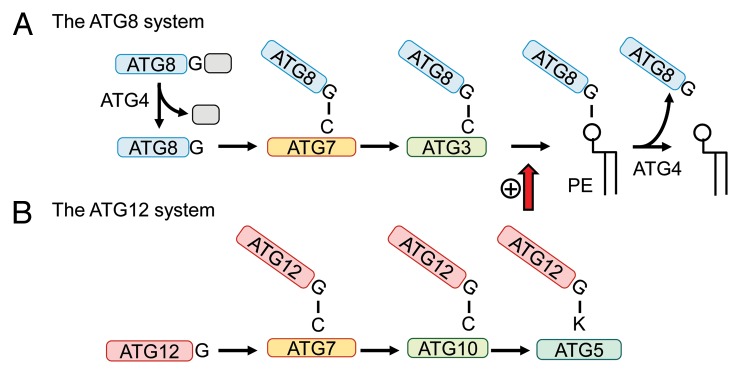
Figure 1. General model of the ATG8 and ATG12 conjugation systems. (A) The ATG8 conjugation system. Immediately after synthesis, the C-terminal extension of ATG8 is cleaved by ATG4 to expose a glycine residue, which is important for the subsequent reaction. After this processing, ATG8 is activated by the E1-like enzyme ATG7 in an ATP-dependent manner and forms a thioester bond between the C-terminal glycine of ATG8 and the active site cysteine of ATG7. Then, ATG8 is transferred to the E2-like enzyme ATG3. ATG8 is finally conjugated with phosphatidylethanolamine (PE). On autophagosomes or autolysosomes, ATG8–PE is deconjugated by ATG4. This system is highly conserved in apicomplexan parasites, but ATG8 in Plasmodium and Toxoplasma lacks the C-terminal extension sequence (shown in gray) and the glycine residue is already exposed without ATG4-mediated processing. (B) The ATG12 conjugation system. ATG12 has a C-terminal glycine and is activated by ATG7 as in the ATG8 system. Then, ATG12 is transferred to ATG10, another E2-like enzyme specific for ATG12, and finally conjugated to a lysine residue of ATG5 via an isopeptide bond. Although the ATG12 system is highly conserved in almost all eukaryotes, ATG10-like proteins have not been clearly identified in apicomplexan parasites. Potential ATG12 (but lacking the C-terminal glycine) and ATG5 proteins can be found in these organisms.
None
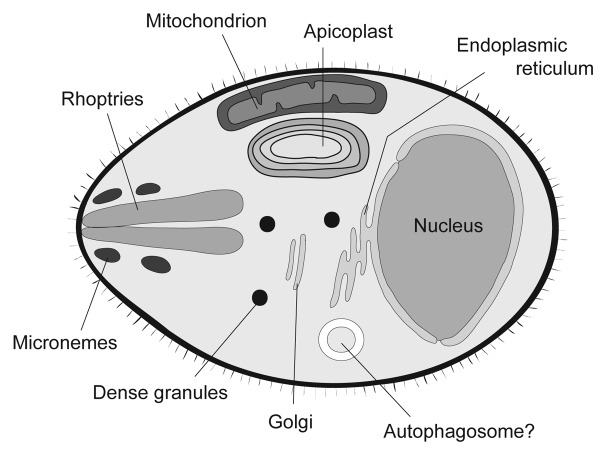
Figure 2. Intracellular organelles in the Plasmodium falciparum merozoite. The rhoptries, micronemes, and dense granules are secretory organelles at the apical pole, which are exocytosed upon host cell invasion. The apicoplast is a nonphotosynthetic plastid, which was acquired by secondary endosymbiosis. See the text for more details about the apicoplast.
None
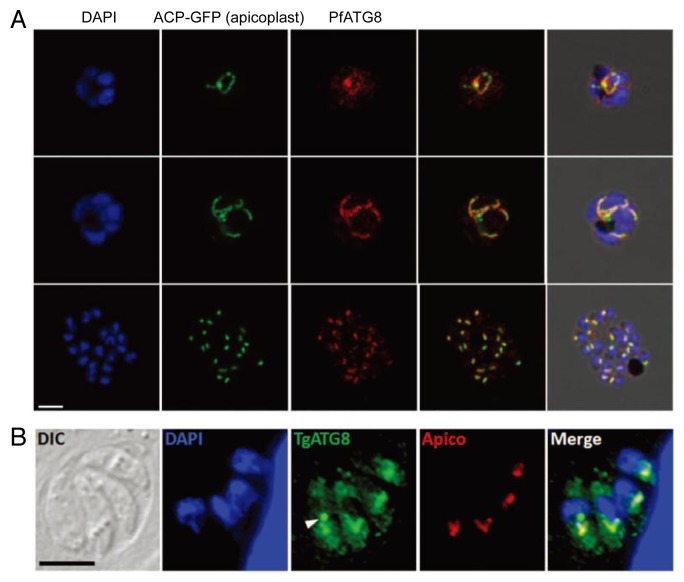
Figure 3. PfATG8 and TgATG8 localize to apicoplasts. Localization of PfATG8 in early schizonts (the multinucleated replicating form inside a host cell; upper), late schizonts (middle), and merozoites (daughter cells within the host formed by division of the schizont; lower) (A) and TgATG8 in tachyzoites (B) are shown together with apicoplast (Apico) markers. The arrowhead indicates a putative autophagosome. Scale bars: 5 μm. The images in (A and B) were published in references ,, respectively, with permission of the publisher.

References

    1. Tooze SA, Yoshimori T. The origin of the autophagosomal membrane. Nat Cell Biol. 2010;12:831–5. doi: 10.1038/ncb0910-831. - DOI - PubMed
    1. Mizushima N, Yoshimori T, Ohsumi Y. The role of Atg proteins in autophagosome formation. Annu Rev Cell Dev Biol. 2011;27:107–32. doi: 10.1146/annurev-cellbio-092910-154005. - DOI - PubMed
    1. Chen Y, Yu L. Autophagic lysosome reformation. Exp Cell Res. 2013;319:142–6. doi: 10.1016/j.yexcr.2012.09.004. - DOI - PubMed
    1. Cecconi F, Levine B. The role of autophagy in mammalian development: cell makeover rather than cell death. Dev Cell. 2008;15:344–57. doi: 10.1016/j.devcel.2008.08.012. - DOI - PMC - PubMed
    1. Mizushima N, Komatsu M. Autophagy: renovation of cells and tissues. Cell. 2011;147:728–41. doi: 10.1016/j.cell.2011.10.026. - DOI - PubMed

Substances

LinkOut - more resources