


Towards a psychosis risk blood diagnostic for persons experiencing high-risk symptoms: preliminary results from the NAPLS project
- PMID: 25103207
- PMCID: PMC4332942
- DOI: 10.1093/schbul/sbu099
Towards a psychosis risk blood diagnostic for persons experiencing high-risk symptoms: preliminary results from the NAPLS project
Abstract
Introduction: A barrier to preventative treatments for psychosis is the absence of accurate identification of persons at highest risk. A blood test that could substantially increase diagnostic accuracy would enhance development of psychosis prevention interventions.
Methods: The North American Prodrome Longitudinal Study project is a multisite endeavor that aims to better understand predictors and mechanisms for the development of psychosis. In this study, we measured expression of plasma analytes reflecting inflammation, oxidative stress, hormones, and metabolism. A "greedy algorithm" selected analytes that best distinguished persons with clinical high-risk symptoms who developed psychosis (CHR-P; n = 32) from unaffected comparison (UC) subjects (n = 35) and from those who did not develop psychosis during a 2-year follow-up (CHR-NP; n = 40).
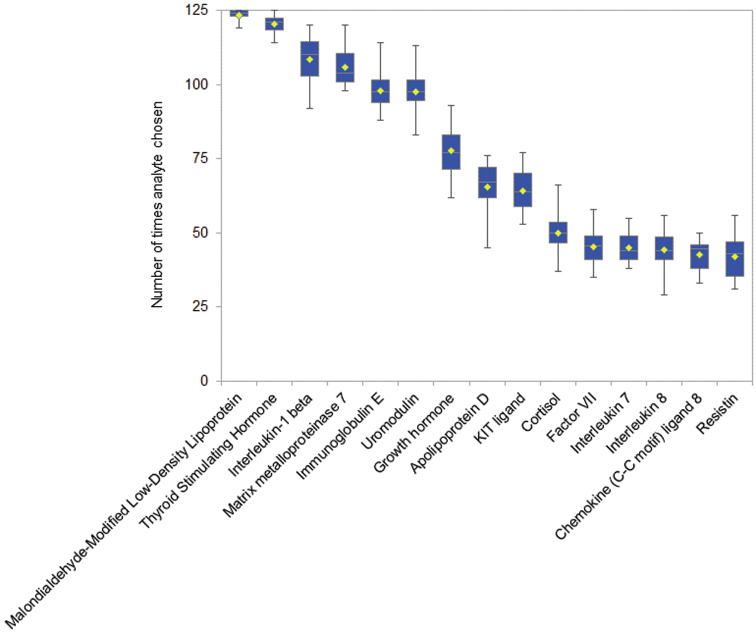
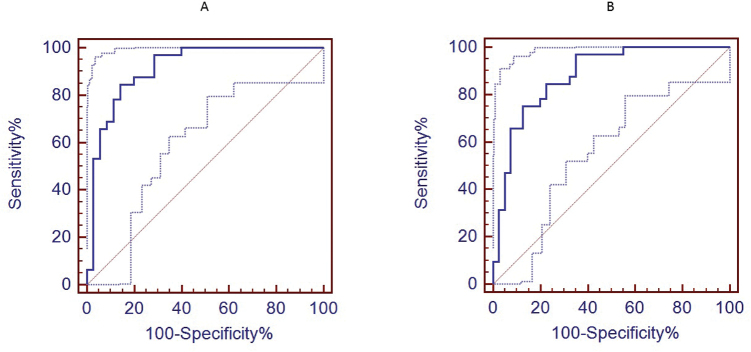
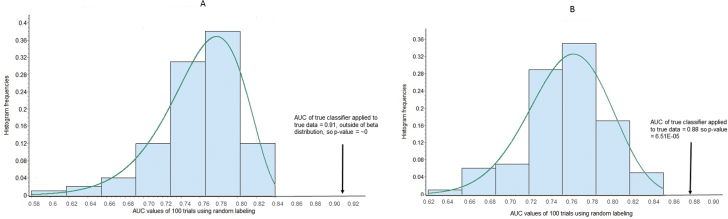
Results: The classifier included 15 analytes (selected from 117), with an area under the receiver operating curve for CHR-P vs UC of 0.91 and CHR-P vs CHR-NP of 0.88. Randomly scrambled group membership followed by reconstructions of the entire classifier method yielded consistently weak classifiers, indicating that the true classifier is highly unlikely to be a chance occurrence. Such randomization methods robustly imply the assays contain consistent information distinguishing the groups which was not obscured by the data normalization method and was revealed by classifier construction. These results support the hypothesis that inflammation, oxidative stress, and dysregulation of hypothalamic-pituitary axes may be prominent in the earliest stages of psychosis.
Conclusion: If confirmed in other groups of persons at elevated risk of psychosis, a multiplex blood assay has the potential for high clinical utility.
Keywords: clinical high risk; immune; inflammation; malondialdehyde-modified low-density lipoprotein (MDA-LDL); multiplex; oxidative stress; prodrome; psychosis; risk prediction.
© The Author 2014. Published by Oxford University Press on behalf of the Maryland Psychiatric Research Center.
Figures
References
-
- Perkins DO, Gu H, Boteva K, Lieberman JA. Relationship between duration of untreated psychosis and outcome in first-episode schizophrenia: a critical review and meta-analysis. Am J Psychiatry. 2005;162:1785–1804. - PubMed
-
- Fusar-Poli P, Bonoldi I, Yung AR, et al. Predicting psychosis: meta-analysis of transition outcomes in individuals at high clinical risk. Arch Gen Psychiatry. 2012;69:220–229. - PubMed
-
- American Psychiatric Association. Diagnostic and Statistical Manual of Mental Disorders. 5th ed. Washington, DC: American Psychiatric Association Press; 2013.
Publication types
MeSH terms
Grants and funding
- U01MH082004/MH/NIMH NIH HHS/United States
- U01MH081857/MH/NIMH NIH HHS/United States
- P50MH066286/MH/NIMH NIH HHS/United States
- U01MH0818902/MH/NIMH NIH HHS/United States
- U01MH082022/MH/NIMH NIH HHS/United States
- U01MH081928/MH/NIMH NIH HHS/United States
- U01MH081988/MH/NIMH NIH HHS/United States
- U01 MH076989/MH/NIMH NIH HHS/United States
- U01MH066160/MH/NIMH NIH HHS/United States
- U01MH081984/MH/NIMH NIH HHS/United States
- U01 MH081928/MH/NIMH NIH HHS/United States
- U01 MH082022/MH/NIMH NIH HHS/United States
- U01 MH081984/MH/NIMH NIH HHS/United States
- U01 MH082004/MH/NIMH NIH HHS/United States
- U01 MH081944/MH/NIMH NIH HHS/United States
LinkOut - more resources
Full Text Sources
Other Literature Sources
Medical
Miscellaneous
