Review
. 2014 Aug 7;4(10):a021105.
doi: 10.1101/cshperspect.a021105.

The mycobacterial cell envelope-lipids

Affiliations
Review

The mycobacterial cell envelope-lipids

Mary Jackson. Cold Spring Harb Perspect Med. .

Abstract

Mycobacterium tuberculosis (Mtb) lipids are indelibly imprinted in just about every key aspect of tuberculosis (TB) basic and translational research. Although the interest in these compounds originally stemmed from their abundance, structural diversity, and antigenicity, continued research in this field has been driven by their important contribution to TB pathogenesis and their interest from the perspective of drug, vaccine, diagnostic, and biomarker development. This article summarizes what is known of the roles of lipids in the physiology and pathogenicity of Mtb and the exciting developments that have occurred in recent years in identifying new lead compounds targeting their biogenesis.


Figures

Figure 1.
Figure 1.
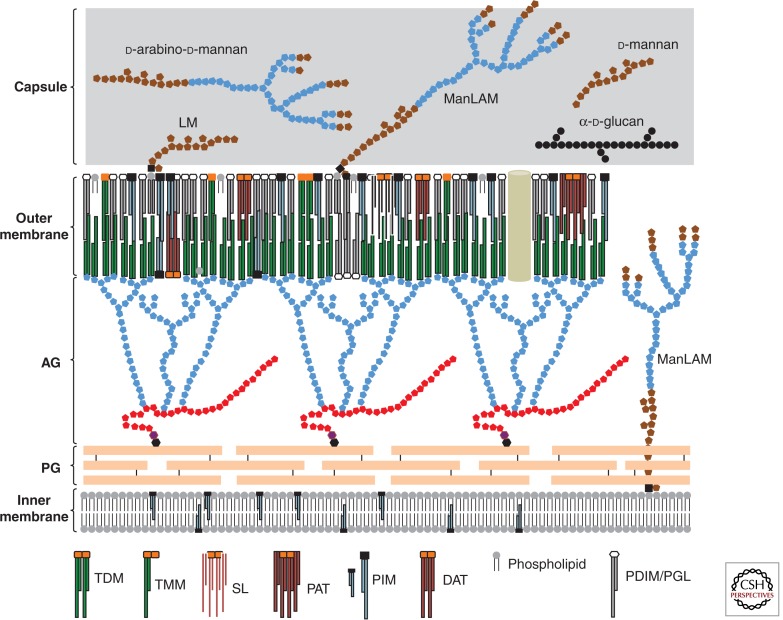
Schematic representation of the Mtb cell envelope. Many of the classes of (glyco)lipids discussed in the text are represented schematically and are shown in probable locations in the cell envelope. Light blue symbols represent arabinose residues, red symbols represent galactose residues, brown symbols represent mannose residues, and black circles represent glucose residues. d-arabino-d-mannan, d-glucan, and d-mannan are capsular polysaccharides. Mycolic acid chains are shown in dark green. LM, lipomannan; ManLAM, mannose-capped lipoarabinomannan; AG, arabinogalactan; PG, peptidoglycan.
Figure 2.
Figure 2.
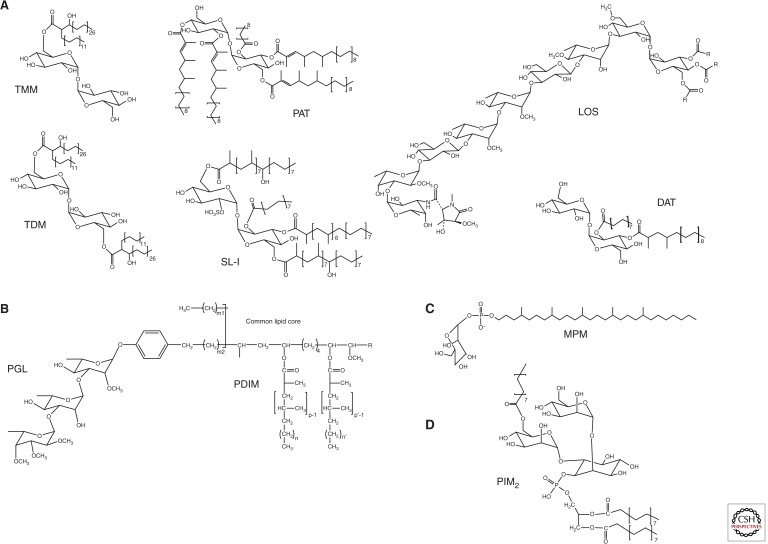
Structures of Mtb lipids. (A) Structures of acyltrehaloses: trehalose monomycolate (TMM); trehalose dimycolate (TDM); sulfolipid (SL-I); diacyltrehalose (DAT); polyacyltrehalose (PAT); and the lipooligosaccharide (LOS) of Mtb Canettii (R=Ac). The major sulfolipid SL-I (2,3,6,6′-tetraacyl α-α′-trehalose-2′-sulfate) is represented. In SL-I, trehalose is sulfated at the 2′ position and esterified with palmitic acid and the multimethyl-branched phthioceranic and hydroxyphthioceranic acids. In DAT (2,3-di-O-acyltrehalose), trehalose is esterified with palmitic acid and the multimethyl-branched mycosanoic acid. In PAT, trehalose is esterified with palmitic acid and the multimethyl-branched mycolipenic acids. (B) Structures of the phthiocerol dimycocerosate (PDIM) and phenolic glycolipid (PGL) of Mtb. p, p′ = 3–5; n, n′ = 16–18; m1 = 20–22; m2 = 15–17; R = CH2-CH3 or CH3. (C) Structure of the predominant mannosyl-β-1-phosphomycoketide (MPM) from Mtb H37Rv. (D) Structure of a triacylated phosphatidylinositol dimannoside (PIM2), one of the major forms of PIMs produced by Mtb.
Figure 3.
Figure 3.
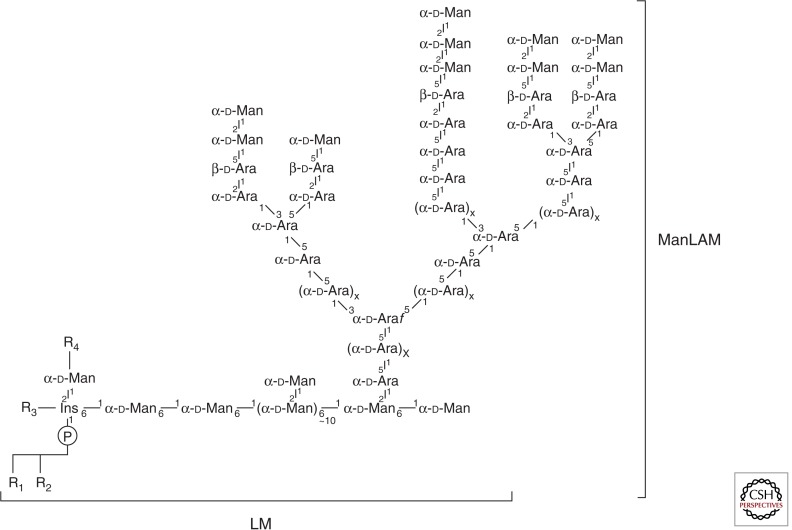
Structures of Mtb lipoglycans. Mannose-capped lipoarabinomannan (ManLAM); the mannan moiety of ManLAM consists of ∼20–30 Manp residues and the arabinan polymers of ∼60 Araf units; the precise number of arabinan chain(s) attached to mannan is still uncertain. Lipomannan (LM) is devoid of the arabinan chains of ManLAM. R1, R2, R3, R4 are tuberculostearic acid, oleic acid, or palmitic acid.
Figure 4.
Figure 4.
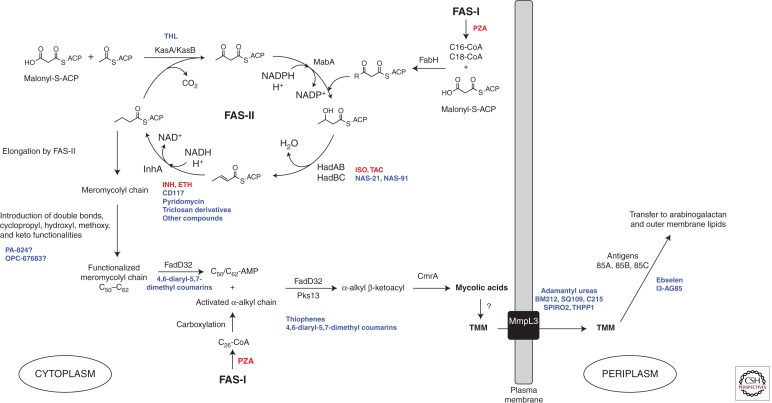
Biosynthetic pathway of mycolic acids in Mtb and site of action of anti-TB drugs. The saturated α-alkyl chain (C24 or C26 in Mtb) and the meromycoloyl chain (C50–C62) are synthesized by fatty-acid synthase-I (FAS-I) and fatty-acid synthase-II (FAS-II), respectively. The initial substrates of FAS-II are medium length keto-acyl-ACP resulting from the condensation by the Mtb FabH protein of the acyl-CoA products of FAS-I with malonyl-ACP. After reduction by the β-keto-acyl-ACP reductase MabA, dehydration by the (3R)-hydroxyl-dehydratases HadAB and HadBC and reduction by the enoyl-CoA reductase InhA, either the β-ketoacyl-ACP synthase KasA or KasB catalyzes the condensation of the resulting product with malonyl-ACP units, thereby initiating the next round of elongation. Methyltransferases and other as yet unknown enzymes modify the meromycolyl chain introducing double bonds, cyclopropyl, hydroxy, methoxy, and keto functionalities. These two chains are coupled together via Claisen condensation by the acyl-AMP ligase FadD32 and the polyketide synthase Pks13. Upon release from Pks13, reduction by CmrA yields mycolic acids, which are then translocated to the periplasm under the form of TMM by partially elucidated translocation machinery involving the essential integral membrane transporter, MmpL3, and attached to AG or another molecule of TMM to form TDM, by the antigen 85 complex. The sites of action of Mtb inhibitors are indicated. Drugs presently or formerly used in the clinical treatment of TB are in red; inhibitors under development are in blue (see Table 1). THL, thiolactomycin; PZA, pyrazinamide.

References

    1. Afonso-Barroso A, Clark SO, Williams A, Rosa GT, Nobrega C, Silva-Gomes S, Vale-Costa S, Ummels R, Stoker N, Movahedzadeh F, et al. 2012. Lipoarabinomannan mannose caps do not affect mycobacterial virulence or the induction of protective immunity in experimental animal models of infection and have minimal impact on in vitro inflammatory responses. Cell Microbiol 15: 660–674 - PubMed
    1. Alahari A, Trivelli X, Guerardel Y, Dover LG, Besra GS, Sacchettini JC, Reynolds RC, Coxon GD, Kremer L. 2007. Thiacetazone, an antitubercular drug that inhibits cyclopropanation of cell wall mycolic acids in mycobacteria. PLoS ONE 2: e1343. - PMC - PubMed
    1. Arora P, Foster EL, Porcelli SA. 2013. CD1d and natural killer T cells in immunity to Mycobacterium tuberculosis. Adv Exp Med Biol 783: 199–223 - PubMed
    1. Banerjee A, Dubnau E, Quémard A, Balasubramanian V, Um KS, Wilson T, Collins D, Lisle G, Jacobs WR Jr. 1994. inhA, a gene encoding a target for isoniazid and ethionamide in Mycobacterium tuberculosis. Science 263: 227–230 - PubMed
    1. Barry CE III, Lee RE, Mdluli K, Sampson AE, Schroeder BG, Slayden RA, Yuan Y. 1998. Mycolic acids: Structure, biosynthesis and physiological functions. Prog Lipid Res 37: 143–179 - PubMed

Publication types

MeSH terms