Myelodysplastic syndrome evolving from aplastic anemia treated with immunosuppressive therapy: efficacy of hematopoietic stem cell transplantation
- PMID: 25107891
- PMCID: PMC4258748
- DOI: 10.3324/haematol.2014.108977
Myelodysplastic syndrome evolving from aplastic anemia treated with immunosuppressive therapy: efficacy of hematopoietic stem cell transplantation
Abstract
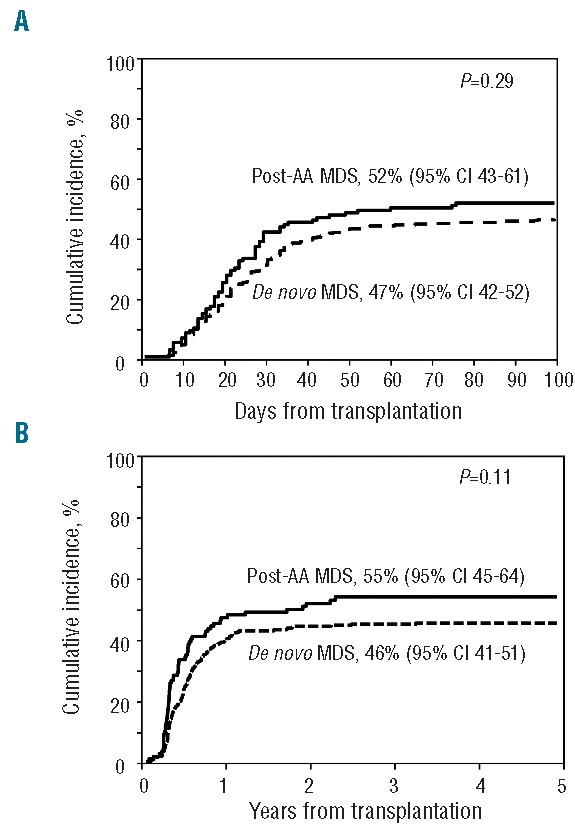
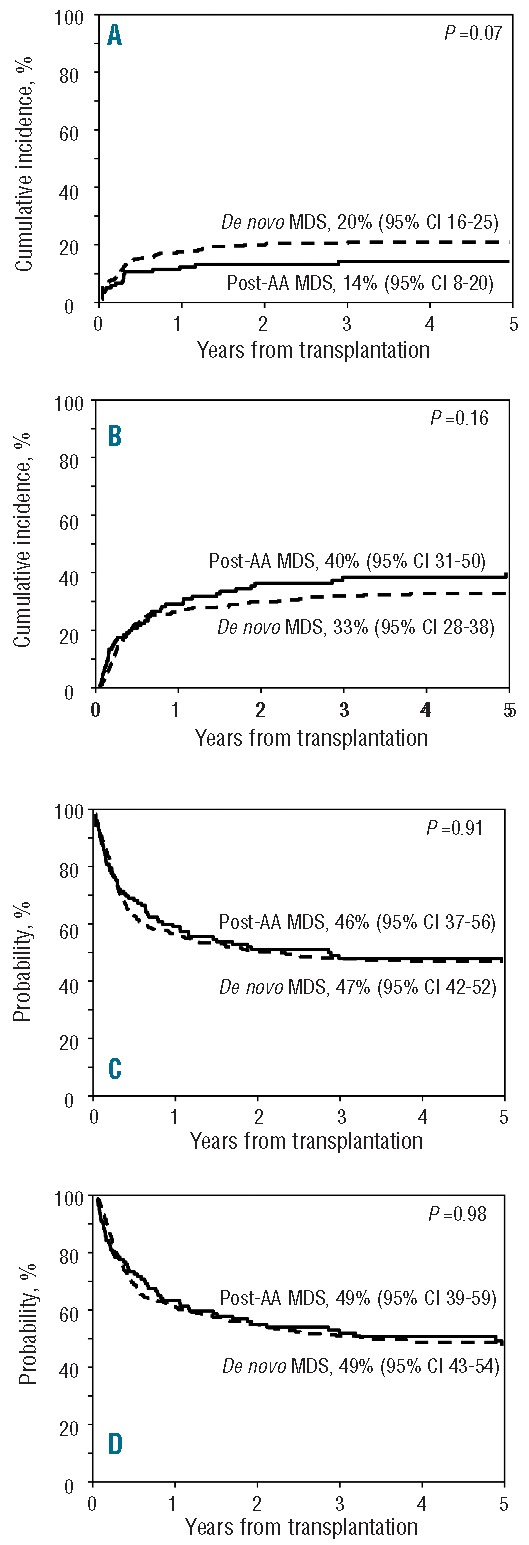
A proportion of patients with aplastic anemia who are treated with immunosuppressive therapy develop clonal hematologic disorders, including post-aplastic anemia myelodysplastic syndrome. Many will proceed to allogeneic hematopoietic stem cell transplantation. We identified 123 patients with post-aplastic anemia myelodysplastic syndrome who from 1991 through 2011 underwent allogeneic hematopoietic stem cell transplantation, and in a matched-pair analysis compared outcome to that in 393 patients with de novo myelodysplastic syndrome. There was no difference in overall survival. There were no significant differences with regard to 5-year probabilities of relapse, non-relapse mortality, relapse-free survival and overall survival; these were 14%, 40%, 46% and 49% for post-aplastic anemia myelodysplastic syndrome, and 20%, 33%, 47% and 49% for de novo myelodysplastic syndrome, respectively. In multivariate analysis, relapse (hazard ratio 0.71; P=0.18), non-relapse mortality (hazard ratio 1.28; P=0.18), relapse-free survival (hazard ratio 0.97; P=0.80) and overall survival (hazard ratio 1.02; P=0.88) of post-aplastic anemia myelodysplastic syndrome were similar to those of patients with de novo myelodysplastic syndrome. Cytogenetic risk was independently associated with overall survival in both groups. Thus, transplant success in patients with post-aplastic anemia myelodysplastic syndrome was similar to that in patients with de novo myelodysplastic syndrome, and cytogenetics was the only significant prognostic factor for post-aplastic anemia myelodysplastic syndrome patients.
Copyright© Ferrata Storti Foundation.
Figures
References
-
- Scheinberg P. Aplastic anemia: therapeutic updates in immunosuppression and transplantation. Hematology Am Soc Hematol Educ Program. 2012;292–300. - PubMed
-
- Frickhofen N, Heimpel H, Kaltwasser JP, Schrezenmeier H. Antithymocyte globulin with or without cyclosporine A: 11-year follow-up of a randomized trial comparing treatments of aplastic anemia. Blood. 2003; 101(4):1236–42. - PubMed
-
- Rosenfeld S, Follman D, Nunez O, Young NS. Antithymocyte globulin and cyclosporine for severe aplastic anemia: association between hematologic response and long-term outcomes. JAMA. 2003; 289(9):1130–5. - PubMed
-
- Osugi Y, Yagasaki H, Sako M, Kosaka Y, Taga T, Ito T, et al. Antithymocyte globulin and cyclosporine for treatment of 44 children with hepatitis associated aplastic anemia. Haematologica. 2007;92(12): 1687–90. - PubMed
Publication types
MeSH terms
Substances
Grants and funding
LinkOut - more resources
Full Text Sources
Other Literature Sources
Medical