Review
. 2014 Sep;24(3):300-12.
doi: 10.1007/s11065-014-9267-4. Epub 2014 Aug 10.

The relevance of beta-amyloid on markers of Alzheimer's disease in clinically normal individuals and factors that influence these associations

Affiliations
Review

The relevance of beta-amyloid on markers of Alzheimer's disease in clinically normal individuals and factors that influence these associations

Elizabeth C Mormino. Neuropsychol Rev. 2014 Sep.

Abstract

Aberrant accumulation of beta-amyloid (Aβ) is thought to be an early event in a biological cascade that eventually leads to Alzheimer's disease (AD). Along these lines, many clinically normal (CN) older individuals have evidence of beta-amyloid (Aβ) accumulation, which may be indicative of preclinical AD. However, relationships between Aβ and "downstream" AD markers are often inconsistent across studies. These inconsistencies may be due to the presence of other age-related processes that also influence AD markers, as well as additional risk factors that interact with Aβ to influence downstream changes. For instance, it is possible that the effect of Aβ is modified by neurodegeneration, genetics, sex-differences and cognitive reserve. Thus, a multivariate approach to determining risk of AD within CN participants may be more appropriate than reliance on Aβ status alone. An understanding of how additional risk factors interact with Aβ to influence an individual's trajectory towards AD is essential for characterizing preclinical AD and has implications for prevention trials.


Figures
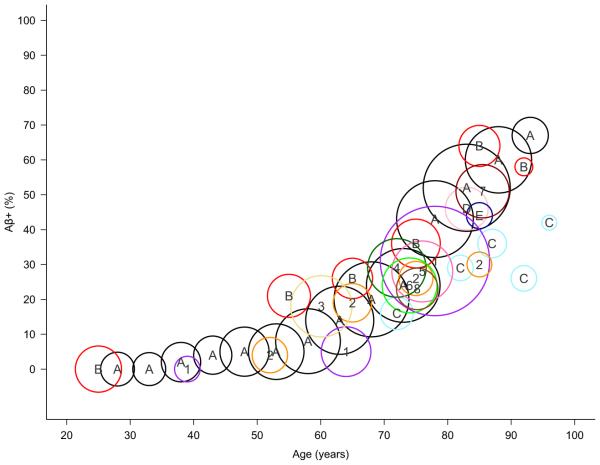
Fig. 1
Fig. 1
Prevalence of Aβ+ CNs across the lifespan. Data across multiple studies are plotted by sample age and percent classified as Aβ+ (a total of 3512 subjects from post-mortem studies and 2034 from amyloid-imaging studies are represented). The area of each bubble is scaled by group size, ranging from 12 to 639 CNs (for studies reporting Aβ+ prevalence across multiple age groups, multiple bubbles are used). Although Aβ+ classification is study specific, a consistent pattern emerges. These studies reveal a low proportion of Aβ+ CNs younger than 60, followed by a linear increase in the proportion of Aβ+ CNs after age 60 (~30 % of CNs are Aβ+ at age 75). Post-mortem studies and Aβ+ classification are as follows: A/black = Braak & Braak (CERAD B & C, N=2661) (Braak and Braak 1997); B/red = Kok et al. (CERAD moderate and frequent, N=534) (Kok et al. 2009); C/light blue = Savva et al. (CERAD moderate and severe, N=183) (Savva et al. 2009); D/pink = Bennett et al., Religious Orders Study (CERAD probable and definite, N=98) (Bennett et al. 2006); E/dark blue = Bennett et al., Memory and Aging Project (CERAD probable and definite, N=36) (Bennett et al. 2006). Amyloid PET studies and Aβ+ classification are as follows: 1/purple = Knopman et al. (>1.5 PIB SUVR with gray matter cerebellum, N=806) (Knopman et al. 2014); 2/orange = Morris et al. (>0.18 PIB Binding Potential with gray matter cerebellum, N=241) (Morris et al. 2010); 3/yellow = Johnson et al. 2014 (florbetapir qualitative read; N=201) (Johnson et al. 2014), 4/dark green = Rowe et al. (>1.5 PIB SUVR with gray matter cerebellum, N=183) (Rowe et al. 2013), 5/hot pink = Mormino et al. 2014, Alzheimer’s Disease Neuroimaging Initiative Phase 2 study (>1.126 florbetapir SUVR gray and white matter cerebellum, N = 198) (Mormino et al. 2014), 6/green = Mormino et al. 2014, Harvard Aging Brain Study (>1.196 PIB SUVR gray and white matter cerebellum, N=161) (Mormino et al. 2014); 7/dark red = Mathis et al. 2013 (>1.57 PIB SUVR gray matter cerebellum, N=152) (Mathis et al. 2013); 8/brown = Wirth et al. 2014 (>1.12 PIB DVR gray matter cerebellum, N=92) (Wirth et al. 2014)
Fig. 2
Fig. 2
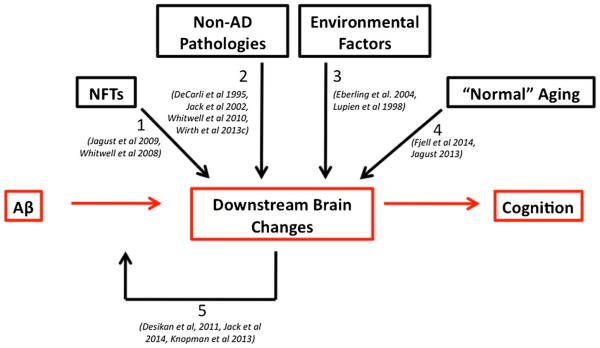
Multiple factors contribute to “downstream” brain changes in the trajectory towards Alzheimer’s disease. Although many models of AD suggest that Aβ is an initiating event in a cascade that triggers downstream brain changes and cognitive decline (as depicted by the red boxes and arrows), emerging evidence suggests that multiple non-Aβ factors influence these downstream brain changes. These additional factors include non-Aβ pathologies (arrows 1 & 2), environmental factors such as stress and estrogen replacement therapy (arrow 3) as well as “normal” aging processes (arrow 4). Regardless of which factors contribute to downstream brain changes, the convergence of these changes with Aβ accumulation has been shown to accelerate further downstream changes (arrow 5)
Fig. 3
Fig. 3
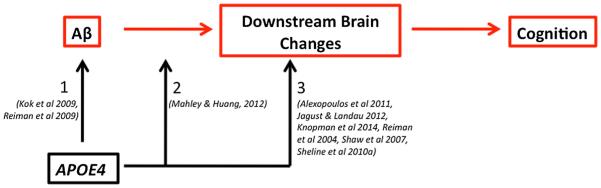
Influence of APOE4 status on the trajectory towards Alzheimer’s disease. The presence of the APOE4 allele may affect an individual’s risk of AD through multiple mechanisms. Specifically, the APOE4+ genotype is consistently associated with greater levels of Aβ accumulation (arrow 1), suggesting that this genotype increases the chance of an individual becoming Aβ+ and entering the AD trajectory. However, there is also evidence that APOE4 interacts with Aβ status to impart greater synaptic damage when these events co-occur (arrow 2). Finally, the APOE4 allele may exert detrimental effects by directly affecting downstream brain changes in the absence of Aβ (arrow 3), making the individual more susceptible to AD in late life when additionally confronted with elevated Aβ

References

    1. Aizenstein HJ, Nebes RD, Saxton JA, Price JC, Mathis CA, Tsopelas ND, et al. Frequent amyloid deposition without significant cognitive impairment among the elderly. Archives of Neurology. 2008;65:1509–1517. - PMC - PubMed
    1. Alexopoulos P, Richter-Schmidinger T, Horn M, Maus S, Reichel M, Sidiropoulos C, et al. Hippocampal volume differences between healthy young apolipoprotein E epsilon2 and epsilon4 carriers. Journal of Alzheimer's Disease. 2011;26:207–210. - PubMed
    1. Alz.org Alzheimer’s Disease Facts and Figures. 2014.
    1. Amir E, Freedman OC, Seruga B, Evans DG. Assessing women at high risk of breast cancer: a review of risk assessment models. Journal of the National Cancer Institute. 2010;102:680–691. - PubMed
    1. Andrews-Hanna JR, Reidler JS, Sepulcre J, Poulin R, Buckner RL. Functional-anatomic fractionation of the brain's default network. Neuron. 2010;65:550–562. - PMC - PubMed

Publication types

LinkOut - more resources