The validities and efficiencies of korean ADHD rating scale and korean child behavior checklist for screening children with ADHD in the community
- PMID: 25110498
- PMCID: PMC4124184
- DOI: 10.4306/pi.2014.11.3.258
The validities and efficiencies of korean ADHD rating scale and korean child behavior checklist for screening children with ADHD in the community
Abstract
Objective: The purpose of this study is to examine the validity of primary screening tools for attention deficit hyperactivity disorder (ADHD) in a community-based sample of children using the Korean version of the Child Behavior Checklist (K-CBCL) and the Korean version of the ADHD Rating Scale (K-ARS).
Methods: A large-scale community-based study for ADHD screening was conducted in the Jeollabuk province in the Republic of Korea. In 2010-2011, we surveyed a total of 49,088 first- and fourth-grade elementary school students. All of the participants in this study were assessed by the K-ARS-Parent version (K-ARS-P) and the K-ARS-Teacher version (K-ARS-T) as the primary screening instruments. The Diagnostic Interview Schedule for Children Version IV (DISC-IV) was used for confirming the diagnosis of ADHD. DISC-IV was administered to subjects who received top 10% scores in the K-ARS-P or K-ARS-T tests.
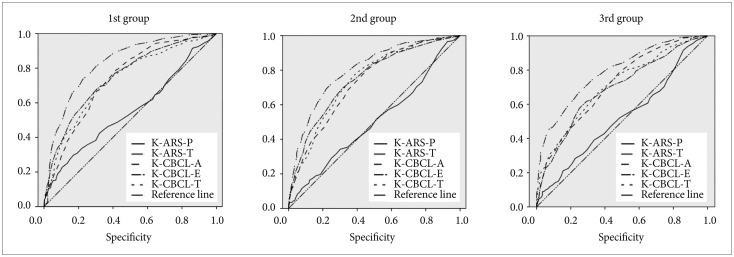
Results: Of the 3,085 subjects who completed the DISC-IV, 1,215 were diagnosed as having ADHD. A reasonable level of sensitivity, specificity, and negative predictive value were obtained when the total K-ARS-P scores were ≥90th percentile. The positive predictive value and specificity increased significantly when the total K-ARS-P scores were ≥90th percentile, T scores were ≥60 in the attention problems of K-CBCL, and T scores were ≥63 in the total problems of K-CBCL.
Conclusion: These results suggested that the K-ARS-P could effectively serve as a primary screening tool to identify elementary school children with ADHD in the community. Also, there might be some increment in the effectiveness of K-ARS-P when combined with K-CBCL-A and K-CBCL-T as a secondary screening tool.
Keywords: ADHD rating scale; Attention deficit hyperactivity disorder; Child Behavior Checklist; DISC-IV; Diagnostic Interview Schedule for Children Version IV.
Figures
References
-
- American Psychiatric Association. Diagnostic and Statistical Manual of Mental Disorders, Fourth Edition. Washington DC: American Psychiatric Association; 1994.
-
- Skounti M, Philalithis A, Galanakis E. Variations in prevalence of attention deficit hyperactivity disorder worldwide. Eur J Pediatr. 2007;166:117–123. - PubMed
-
- Yang SJ, Cheong S, Hong SD. Prevalence and correlates of attention deficit hyperactivity disorder: school-based mental health services in Seoul. J Korean Neuropsychiatr Assoc. 2006;45:69–76.
-
- Ghanizadeh A, Mohammadi MR, Moini R. Comorbidity of psychiatric disorders and parental psychiatric disorders in a sample of Iranian children with ADHD. J Atten Disord. 2008;12:149–155. - PubMed
-
- Kim JW, Park KH, Cheon KA, Kim BN, Cho SC, Hong KE. The child behavior checklist together with the ADHD rating scale can diagnose ADHD in Korean community-based samples. Can J Psychiatry. 2005;50:802–805. - PubMed
LinkOut - more resources
Full Text Sources
Other Literature Sources
Miscellaneous