


Peers promoting physical activity among breast cancer survivors: A randomized controlled trial
- PMID: 25110844
- PMCID: PMC4441331
- DOI: 10.1037/hea0000120
Peers promoting physical activity among breast cancer survivors: A randomized controlled trial
Abstract
Objective: Although studies have shown that physical activity (PA) can reduce some treatment-related side effects of breast cancer, there is a need to offer PA programs outside of research settings to reach more cancer survivors. We partnered with the American Cancer Society's Reach to Recovery (RTR) program to train their volunteers (breast cancer survivors) to deliver a 12-week PA intervention to other breast cancer survivors.
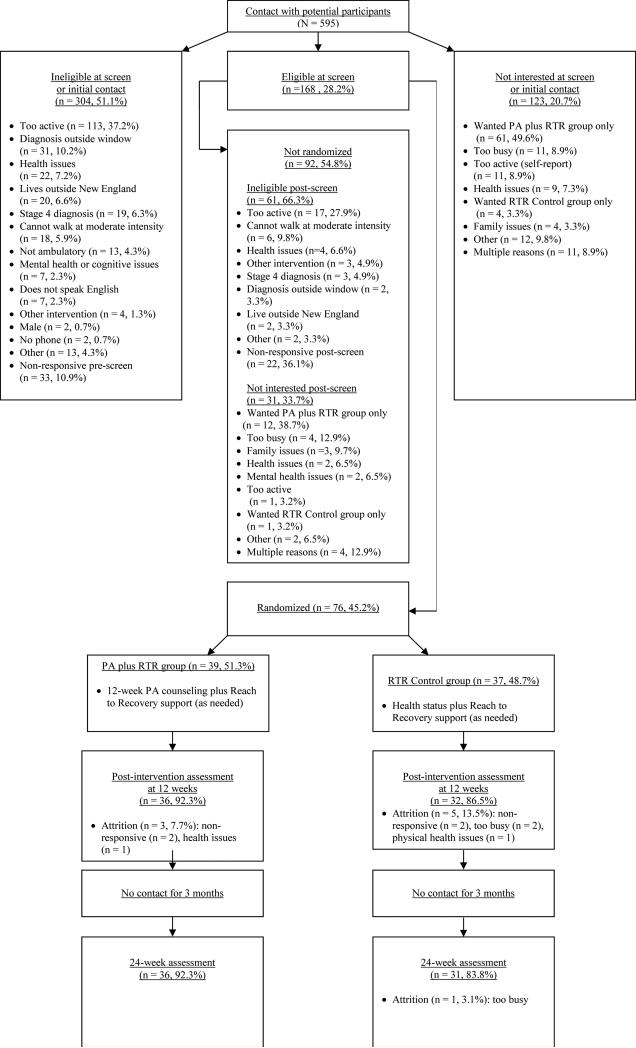
Method: We conducted a randomized controlled trial to compare the PA intervention delivered by RTR volunteers (PA plus RTR) with contact control (RTR control). Eighteen RTR volunteers/coaches (Mage = 54.9 years; Mtime since diagnosis = 7.0 years) delivered the contact control condition or the PA intervention. Seventy-six breast cancer survivors in New England (Mage = 55.6 years; Mtime since diagnosis = 1.1 years) were randomized to 1 of the 2 groups. At baseline, 12 weeks (postintervention), and at 24 weeks, participants wore an accelerometer for 7 days, were interviewed about their PA, and reported their motivational readiness for PA.
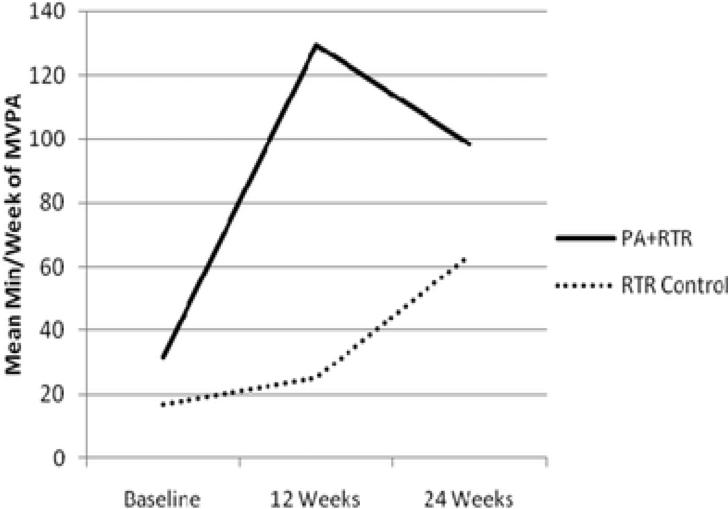
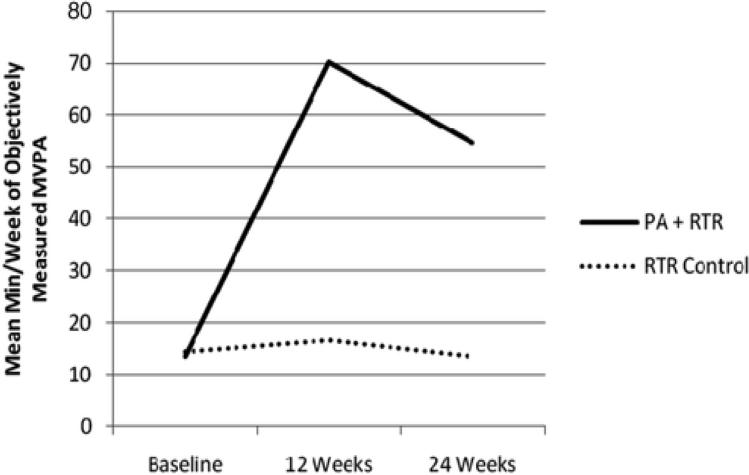
Results: Adjusted, mixed-effects longitudinal regression models showed significant group differences favoring the PA plus RTR group in minutes of moderate to vigorous PA at 12 weeks (Mdifference = 103 min/week, p < .001) and at 24 weeks (Mdifference = 34.7 min/week, p = .03). Results were corroborated with significant group differences in accelerometer data favoring the PA plus RTR group at both time points.
Conclusion: Peer volunteers were able to significantly increase PA among cancer survivors relative to contact control. Partnerships with existing volunteer programs can help to widen the reach of behavioral interventions among cancer survivors. (PsycINFO Database Record
(c) 2015 APA, all rights reserved).
Figures
References
-
- Bandura A. Social foundations of thought and action: A social cognitive theory. Prentice-Hall; Englewood Cliffs, NJ: 1986.
-
- Blair SN, Haskell WL, Ho P, Paffenbarger RS, Jr., Vranizan KM, Farquhar JW, Wood PD. Assessment of habitual physical activity by a seven-day recall in a community survey and controlled experiments. American Journal of Epidemiology. 1985;122(5):794–804. - PubMed
-
- Brown JC, Huedo-Medina TB, Pescatello LS, Pescatello SM, Ferrer RA, Johnson BT. Efficacy of exercise interventions in modulating cancer-related fatigue among adult cancer survivors: a meta-analysis. Cancer Epidemiology, Biomarkers and Prevention. 2011;20(1):123–133. doi: 10.1158/1055-9965.epi-10-0988. - PubMed
Publication types
MeSH terms
Grants and funding
LinkOut - more resources
Full Text Sources
Other Literature Sources
Medical
