Randomized Controlled Trial
. 2014 Sep:62:286-96.
doi: 10.1016/j.neuropsychologia.2014.07.034. Epub 2014 Aug 8.

Partial maintenance of auditory-based cognitive training benefits in older adults

Affiliations
Randomized Controlled Trial

Partial maintenance of auditory-based cognitive training benefits in older adults

Samira Anderson et al. Neuropsychologia. 2014 Sep.

Abstract

The potential for short-term training to improve cognitive and sensory functions in older adults has captured the public's interest. Initial results have been promising. For example, eight weeks of auditory-based cognitive training decreases peak latencies and peak variability in neural responses to speech presented in a background of noise and instills gains in speed of processing, speech-in-noise recognition, and short-term memory in older adults. But while previous studies have demonstrated short-term plasticity in older adults, we must consider the long-term maintenance of training gains. To evaluate training maintenance, we invited participants from an earlier training study to return for follow-up testing six months after the completion of training. We found that improvements in response peak timing to speech in noise and speed of processing were maintained, but the participants did not maintain speech-in-noise recognition or memory gains. Future studies should consider factors that are important for training maintenance, including the nature of the training, compliance with the training schedule, and the need for booster sessions after the completion of primary training.

Keywords: Aging; Auditory plasticity; Frequency-following response (FFR); Memory; Neural timing; Speech-in-noise recognition; Temporal processing; Training.


Figures

Figure 1
Figure 1
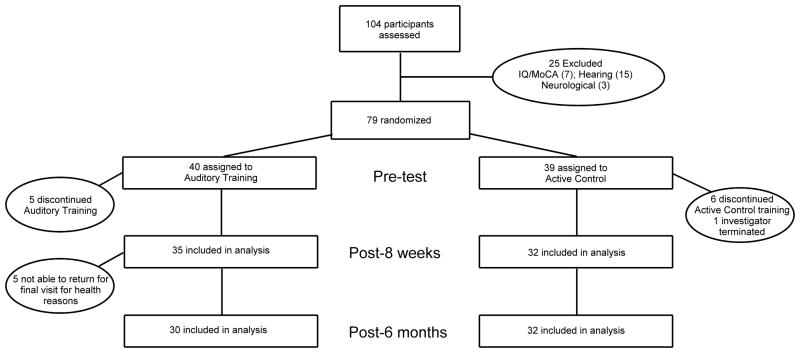
Flow of participants randomly assigned to auditory training or active control groups, with a total enrollment of 104 and a final number of 79 after participants were excluded for cognitive, hearing, or neurological reasons. The number of participants who returned for follow-up visits at 8 weeks was 67 and the number at 6 months was 62.
Figure 2
Figure 2
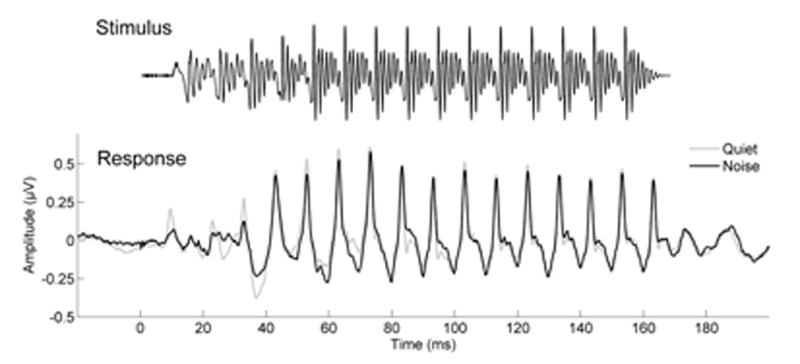
The periodicity of the evoking 170-ms stimulus [da] with a fundamental frequency of 100 Hz is represented in the grand average response obtained at the six-months post visit to the stimulus both in quiet (gray) and in noise (black), with peaks occurring at a frequency of every 10 ms.
Figure 3
Figure 3
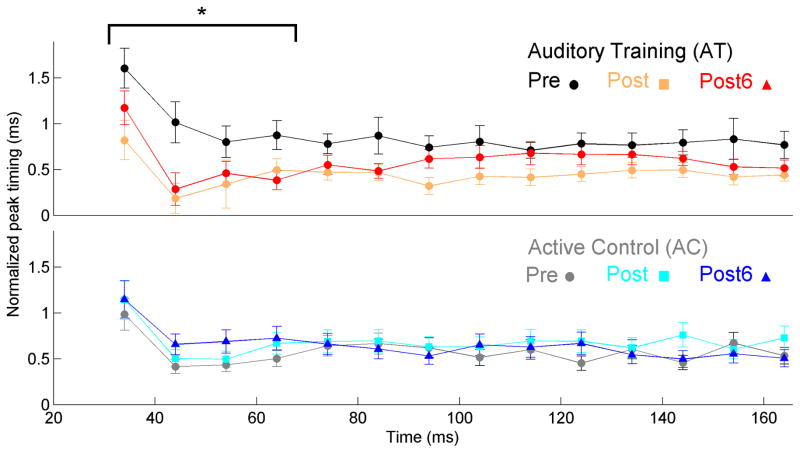
In noise, the reduction in peak latencies in the region corresponding to the consonant-vowel transition (20–60 ms, marked with brackets) that was found after 8 weeks of training was maintained at the six-month follow-up visit. To facilitate visualization of the data across time, peak latency values are normalized by subtracting individual absolute latencies from the expected response latencies for each peak based on average data in young adults, taking into account stimulus characteristics and neural lag (Anderson et al., 2012). Therefore, faster timing corresponds to smaller differences between actual and expected latency values. Expected latencies were 9 ms for the onset, and 34, 44, 54, 64, etc., until 164 ms for peaks during the transition and steady-state. No latency changes were seen in the active control group. *p < 0.05 – significance value for the pre to post-6 change in latency. Error bars = +/− 1 S.E.
Figure 4
Figure 4
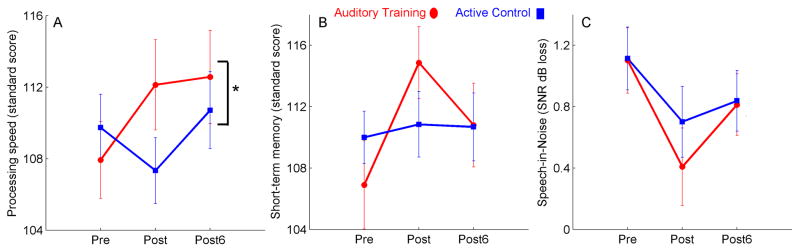
In the auditory training group (red circles), the increase in processing speed (standard score) seen at the post-training visit persisted for 6 months (A), but the training-induced enhancements in short-term memory (standard score; B) and sentence recognition in noise (dB SNR loss - lower scores indicate better performance; C) did not persist. There were no initial changes in processing speed or memory in the active control group (blue squares), and the initial change in speech-in-noise recognition did not persist. *p < 0.05 – significance value for the group × session interaction. Error bars = +/− 1 S.E.
Figure 5
Figure 5
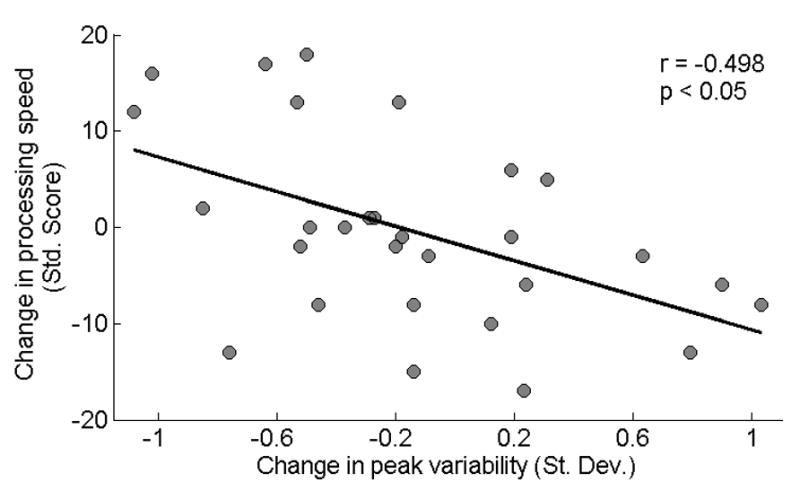
Changes in processing speed relate to changes in brainstem peak variability from pre to post6 in the auditory training group, such that individuals who experienced greater improvement in processing speed were more likely to have reduced peak variability.

References

    1. Anderson S, Parbery-Clark A, White-Schwoch T, Drehobl S, Kraus N. Effects of hearing loss on the subcortical representation of speech cues. The Journal of the Acoustical Society of America. 2013;133:3030–3038. - PMC - PubMed
    1. Anderson S, Parbery-Clark A, White-Schwoch T, Kraus N. Aging affects neural precision of speech encoding. The Journal of Neuroscience. 2012;32:14156–14164. - PMC - PubMed
    1. Anderson S, Parbery-Clark A, White-Schwoch T, Kraus N. Auditory brainstem response to complex sounds predicts self-reported speech-in-noise performance. Journal of Speech, Language & Hearing Research. 2013;56:31–43. - PMC - PubMed
    1. Anderson S, Skoe E, Chandrasekaran B, Kraus N. Neural timing is linked to speech perception in noise. The Journal of Neuroscience. 2010;30:4922–4926. - PMC - PubMed
    1. Anderson S, White-Schwoch T, Choi HJ, Kraus N. Training changes processing of speech cues in older adults with hearing loss. Frontiers in Systems Neuroscience. 2013:7. - PMC - PubMed

Publication types