


Tick surveillance for relapsing fever spirochete Borrelia miyamotoi in Hokkaido, Japan
- PMID: 25111141
- PMCID: PMC4128717
- DOI: 10.1371/journal.pone.0104532
Tick surveillance for relapsing fever spirochete Borrelia miyamotoi in Hokkaido, Japan
Abstract
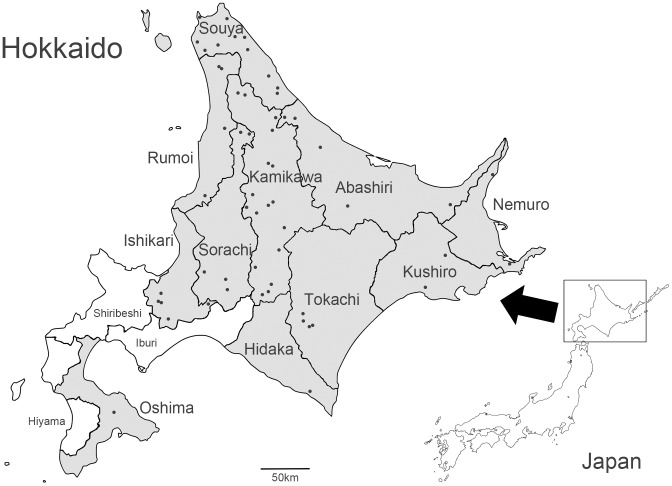
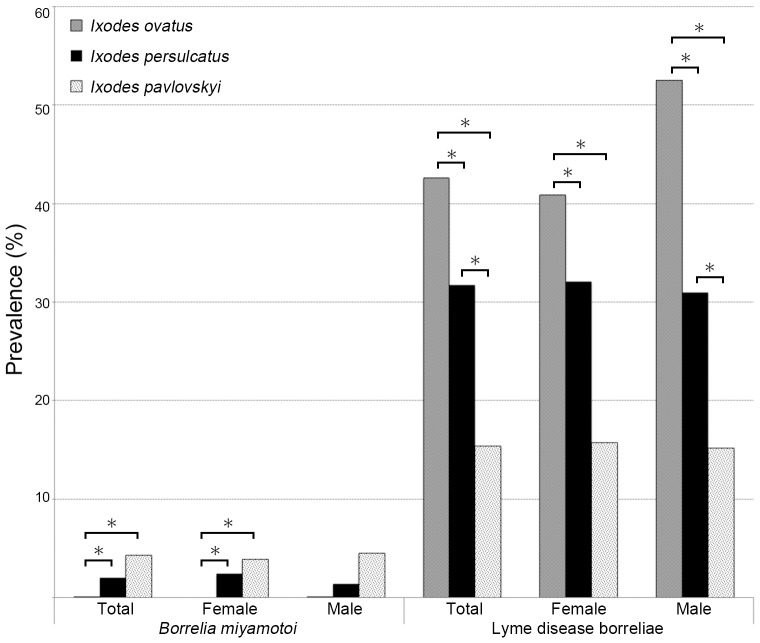
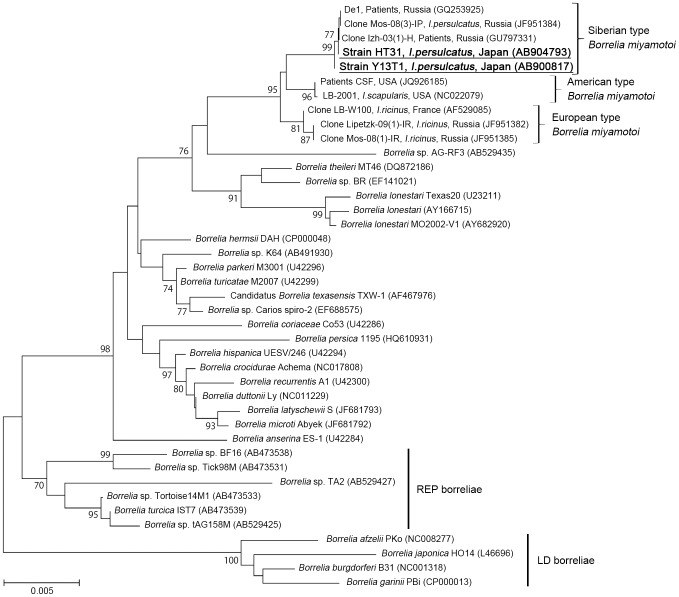
During 2012-2013, a total of 4325 host-seeking adult ticks belonging to the genus Ixodes were collected from various localities of Hokkaido, the northernmost island of Japan. Tick lysates were subjected to real-time PCR assay to detect borrelial infection. The assay was designed for specific detection of the Relapsing fever spirochete Borrelia miyamotoi and for unspecific detection of Lyme disease-related spirochetes. Overall prevalence of B. miyamotoi was 2% (71/3532) in Ixodes persulcatus, 4.3% (5/117) in Ixodes pavlovskyi and 0.1% (1/676) in Ixodes ovatus. The prevalence in I. persulcatus and I. pavlovskyi ticks were significantly higher than in I. ovatus. Co-infections with Lyme disease-related spirochetes were found in all of the tick species. During this investigation, we obtained 6 isolates of B. miyamotoi from I. persulcatus and I. pavlovskyi by culture in BSK-M medium. Phylogenetic trees of B. miyamotoi inferred from each of 3 housekeeping genes (glpQ, 16S rDNA, and flaB) demonstrated that the Hokkaido isolates were clustered with Russian B. miyamotoi, but were distinguishable from North American and European B. miyamotoi. A multilocus sequence analysis using 8 genes (clpA, clpX, nifS, pepX, pyrG, recG, rplB, and uvrA) suggested that all Japanese B. miyamotoi isolates, including past isolates, were genetically clonal, although these were isolated from different tick and vertebrate sources. From these results, B. miyamotoi-infected ticks are widely distributed throughout Hokkaido. Female I. persulcatus are responsible for most human tick-bites, thereby I. persulcatus is likely the most important vector of indigenous relapsing fever from tick bites in Hokkaido.
Conflict of interest statement
Figures
References
-
- Fukunaga M, Takahashi Y, Tsuruta Y, Matsushita O, Ralph D, et al. (1995) Genetic and phenotypic analysis of Borrelia miyamotoi sp. nov., isolated from the ixodid tick Ixodes persulcatus, the vector for Lyme disease in Japan. Int J Syst Bacteriol 45: 804–810. - PubMed
-
- Scoles GA, Papero M, Beati L, Fish D (2001) A relapsing fever group spirochete transmitted by Ixodes scapularis ticks. Vector Borne Zoonotic Dis 1: 21–34. - PubMed
-
- Mun J, Eisen RJ, Eisen L, Lane RS (2006) Detection of a Borrelia miyamotoi sensu lato relapsing-fever group spirochete from Ixodes pacificus in California. J Med Entomol 43: 120–123. - PubMed
Publication types
MeSH terms
Substances
LinkOut - more resources
Full Text Sources
Other Literature Sources
Molecular Biology Databases
Miscellaneous
