. 2014 Sep 5;15(13):1920-30.
doi: 10.1002/cbic.201400025. Epub 2014 Aug 8.

Chemical interrogation of the malaria kinome

Affiliations

Chemical interrogation of the malaria kinome

Emily R Derbyshire et al. Chembiochem. .

Abstract

Malaria, an infectious disease caused by eukaryotic parasites of the genus Plasmodium, afflicts hundreds of millions of people every year. Both the parasite and its host utilize protein kinases to regulate essential cellular processes. Bioinformatic analyses of parasite genomes predict at least 65 protein kinases, but their biological functions and therapeutic potential are largely unknown. We profiled 1358 small-molecule kinase inhibitors to evaluate the role of both the human and the malaria kinomes in Plasmodium infection of liver cells, the parasites' obligatory but transient developmental stage that precedes the symptomatic blood stage. The screen identified several small molecules that inhibit parasite load in liver cells, some with nanomolar efficacy, and each compound was subsequently assessed for activity against blood-stage malaria. Most of the screening hits inhibited both liver- and blood-stage malaria parasites, which have dissimilar gene expression profiles and infect different host cells. Evaluation of existing kinase activity profiling data for the library members suggests that several kinases are essential to malaria parasites, including cyclin-dependent kinases (CDKs), glycogen synthase kinases, and phosphoinositide-3-kinases. CDK inhibitors were found to bind to Plasmodium protein kinase 5, but it is likely that these compounds target multiple parasite kinases. The dual-stage inhibition of the identified kinase inhibitors makes them useful chemical probes and promising starting points for antimalarial development.

Keywords: Plasmodium; bioinformatics; chemical probes; high-throughput screening; kinases; malaria.


Figures

Figure 1
Figure 1
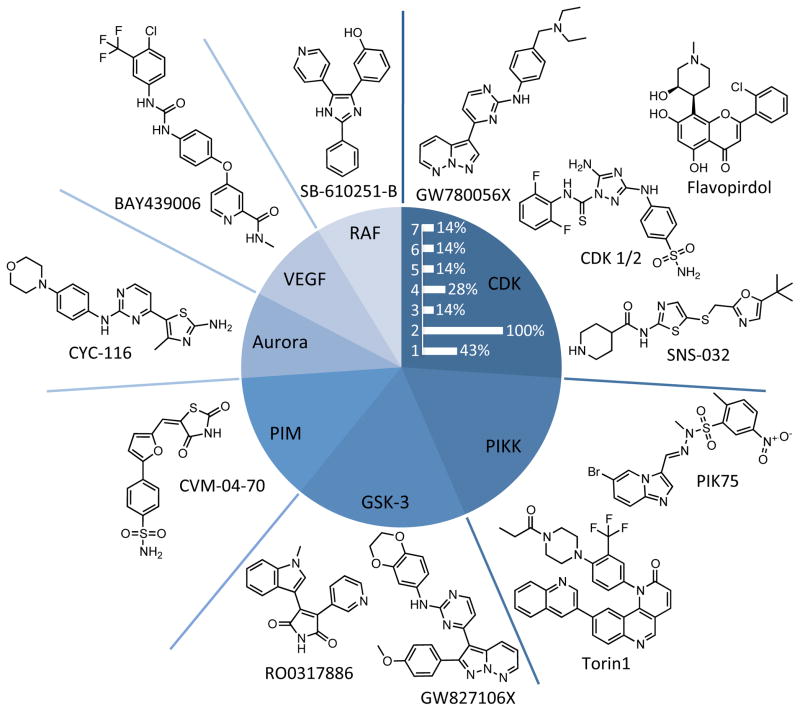
Target diversity of screening hits. Kinase families that are targeted by more than one library member are shown in the pie chart with the structures of representative inhibitors. Every kinase family shown except the PIM kinases was targeted by diverse chemotypes. Among the identified CDK inhibitors, the relative percent abundance of compounds with previously reported activity against specific human isoforms (CDK 1-7) is shown (white bars).
Figure 2
Figure 2
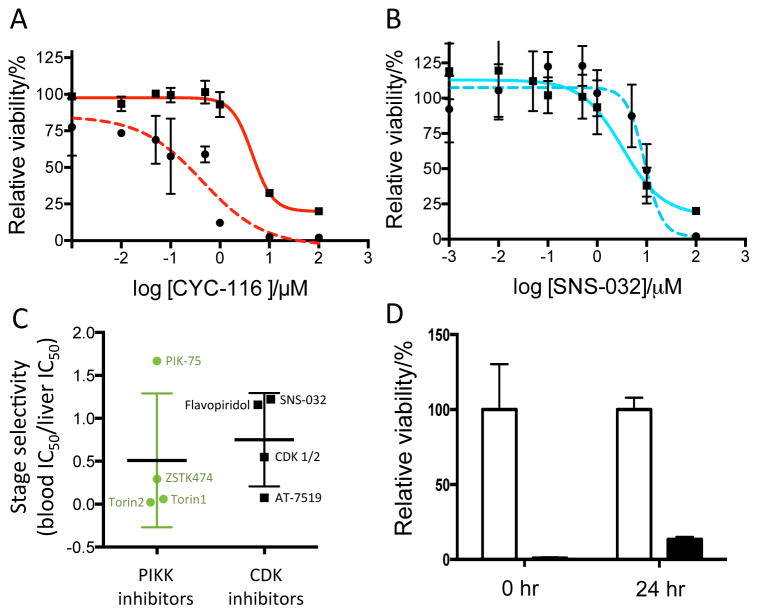
Characterization of screening hits. (A) Dose-response curves for P. berghei ANKA liver stage (dashed red curve) and P. falciparum 3D7 blood stage (solid red curve) are shown for CYC-116. (B) Dose-response curves for P. berghei ANKA liver stage (dashed blue curve) and P. falciparum 3D7 blood stage (solid blue curve) are shown for the CDK inhibitor SNS-032. Data in A and B were fit to a nonlinear regression equation (curves shown) to obtain IC50 values. (C) Stage selectivity of known human PIKK and CDK inhibitors for P. falciparum blood stage and P. berghei liver stage parasites determined by dividing the blood stage IC50 by the liver stage IC50. Values above 10 are selective for liver stage malaria and values below 0.1 are selective for blood stage malaria. All compounds that target these families inhibit both parasite stages. (D) Time dependence of CDK 1/2 inhibition. CDK 1/2 at 10 μM (black bars) or DMSO control (white bars) was added to P. berghei-infected liver cells 0 and 24 hours post infection. Parasite signal was read 36 hours post infection.
Figure 3
Figure 3
Binding to PfPK5. (A)Structure of CDK 1/2 docked onto the PfPK5 crystal structure (pdb 1V0O). The protein kinase (pink) and CDK 1/2 carbon (grey), hydrogen (grey), nitrogen (blue), sulfur (yellow) and oxygen (red) atoms are shown. Hydrogen bonds are predicted to form (black dotted lines) between the thioamide proton of CDK 1/2 and Gln 84, and between the primary amine proton on aminotriazole and Asp 85 (bond lengths < 2.5 Å). (B) Percent binding of commercially available kinase inhibitors to PfPK5 at 10 μM. Significant binding (> 50%) is only observed with the known CDK inhibitors, flavopiridol, SNS-032 and CDK 1/2, and the PIK inhibitor PIK-75. (C) Competitive binding plot of CDK 1/2 (red curve), flavopiridol (black curve) and SNS-032 (blue curve) to PfPK5 where decrease in relative signal correlates with compound binding. Data in C were fit to a nonlinear regression equation (curves shown) to obtain Kd values.
Figure 4
Figure 4
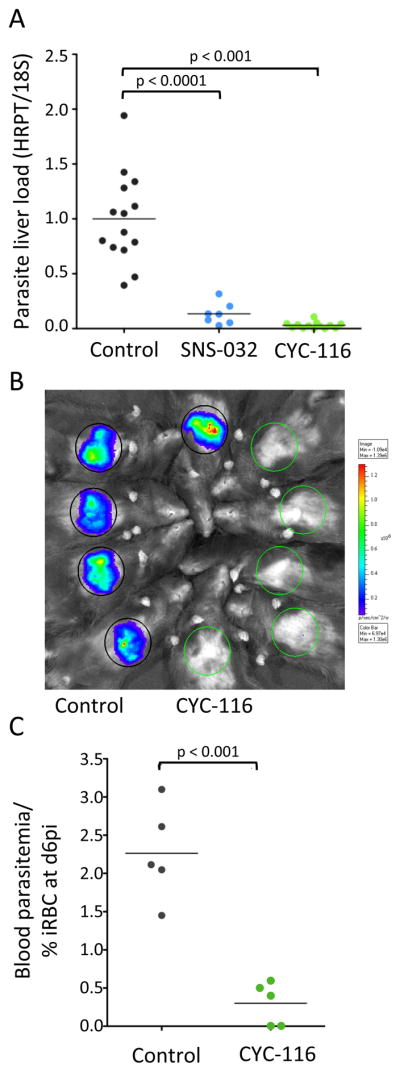
In vivo activity of SNS-032 and CYC-116. (A) Quantitation of relative parasite load in mouse livers after a single treatment by oral administration of 75 mg/kgb.w. SNS-032 (blue), 100 mg/kgb.w. CYC-116 (green), or equivalent amount of vehicle as a control (grey). (B) Whole-animal bioluminescence imaging of P. berghei infected mice livers with (green circles) or without (grey circles) treatment with 100 mg/kgb.w. CYC-116. (C) P.berghei parasitemia in mice after a single treatment by oral administration of 100 mg/kgb.w. CYC-116 (green) or equivalent amount of vehicle as a control (grey).
Figure 5
Figure 5
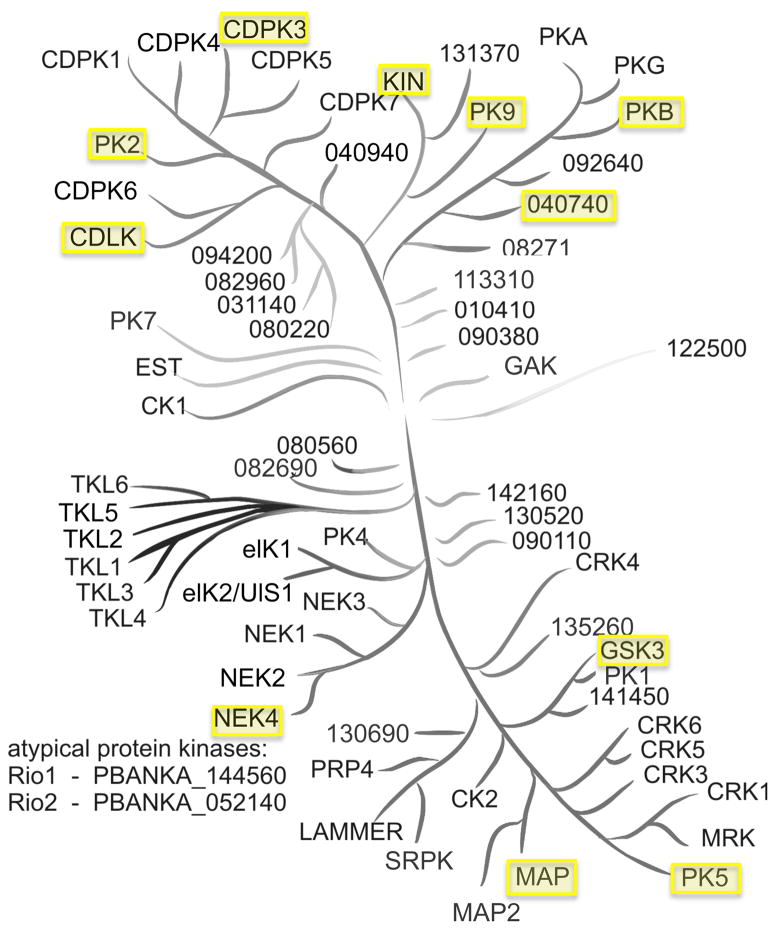
Phylogenetic tree of P. berghei kinases. Kinases with homology to human kinases targeted by screening hits are highlighted. Several compounds target human proteins that have no identifiable homolog in Plasmodium parasites based on sequence analysis. Kinase tree replicated with permission from Dr. Oliver Billker.[10]

References

    1. Wolrd Health Organization. World Malaria Report. 2013.
    1. Kappe SH, Vaughan AM, Boddey JA, Cowman AF. Science. 2010;328:862–866. - PubMed
    2. Mazier D, Renia L, Snounou G. Nat Rev Drug Discov. 2009;8:854–864. - PubMed
    1. White NJ. J Clin Invest. 2004;113:1084–1092. - PMC - PubMed
    1. Ariey F, Witkowski B, Amaratunga C, Beghain J, Langlois AC, Khim N, Kim S, Duru V, Bouchier C, Ma L, Lim P, Leang R, Duong S, Sreng S, Suon S, Chuor CM, Bout DM, Menard S, Rogers WO, Genton B, Fandeur T, Miotto O, Ringwald P, Le Bras J, Berry A, Barale JC, Fairhurst RM, Benoit-Vical F, Mercereau-Puijalon O, Menard D. Nature. 2014;505:50–55. - PMC - PubMed
    2. Dondorp AM, Nosten F, Yi P, Das D, Phyo AP, Tarning J, Lwin KM, Ariey F, Hanpithakpong W, Lee SJ, Ringwald P, Silamut K, Imwong M, Chotivanich K, Lim P, Herdman T, An SS, Yeung S, Singhasivanon P, Day NP, Lindegardh N, Socheat D, White NJ. N Engl J Med. 2009;361:455–467. - PMC - PubMed
    1. Derbyshire ER, Mota MM, Clardy J. PLoS Pathog. 2011;7:e1002178. - PMC - PubMed
    2. Flannery EL, Chatterjee AK, Winzeler EA. Nat Rev Microbiol. 2013;11:849–862. - PMC - PubMed

Publication types