. 2014 Dec;134(6):1394-1401.e4.
doi: 10.1016/j.jaci.2014.06.029. Epub 2014 Aug 10.

"Auto-anti-IgE": naturally occurring IgG anti-IgE antibodies may inhibit allergen-induced basophil activation

Affiliations

"Auto-anti-IgE": naturally occurring IgG anti-IgE antibodies may inhibit allergen-induced basophil activation

Yih-Chih Chan et al. J Allergy Clin Immunol. 2014 Dec.

Abstract

Background: Naturally occurring IgE-specific IgG autoantibodies have been identified in patients with asthma and other diseases, but their spectrum of functions is poorly understood.

Objective: Address the hypothesis that: (i) IgG anti-IgE autoantibodies are detectable in the serum of all subjects but elevated in asthmatic patients regardless of atopic status as compared with controls; (ii) some activate IgE-sensitized basophils; and (iii) some inhibit allergen-induced basophil activation.

Methods: IgE-specific IgG autoantibodies were detected and quantified in sera using ELISA. Sera were examined for their ability to activate IgE-sensitized human blood basophils in the presence and absence of allergen using a basophil activation test, and to inhibit allergen binding to specific IgE on a rat basophilic cell line stably expressing human FcεRI.

Results: IgG autoantibodies binding to both free and FcεRI-bound IgE were detected in patients with atopic and non-atopic asthma, as well as controls. While some were able to activate IgE-sensitised basophils, others inhibited allergen-induced basophil activation, at least partly by inhibiting binding of IgE to specific allergen.

Conclusion: Naturally occurring IgG anti-IgE autoantibodies may inhibit, as well as induce, basophil activation. They act in a manner distinct from therapeutic IgG anti-IgE antibodies such as omalizumab. They may at least partly explain why atopic subjects who make allergen-specific IgE never develop clinical symptoms, and why omalizumab therapy is of variable clinical benefit in severe atopic asthma.

Keywords: Asthma; IgE; autoantibodies; basophil activation; basophil inhibition.


Figures

Fig 1
Fig 1
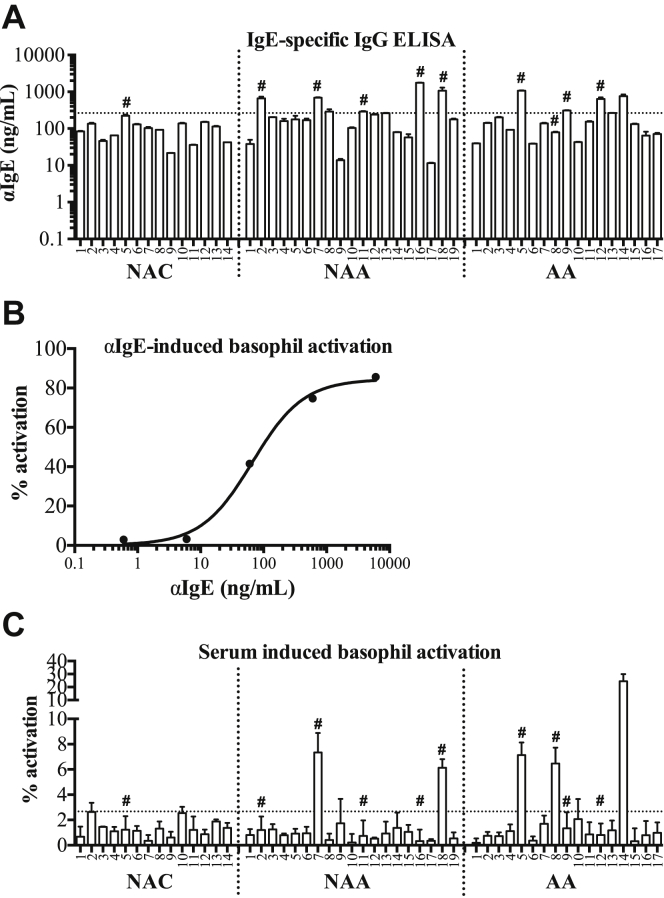
Concentrations of IgG anti-IgE autoantibodies in sera from non-atopic controls, non-atopic asthmatic subjects, and atopic asthmatic subjects (A). Dotted line shows 95% confidence limit of the range in controls. Response of blood basophils to polyclonal anti-IgE in vitro(B). Basophil-activating activity of sera (C). Dotted line shows detection threshold. Samples marked # were used for later experiments. Bars represent the mean/SD of at least 3 independent experiments.
Fig 2
Fig 2
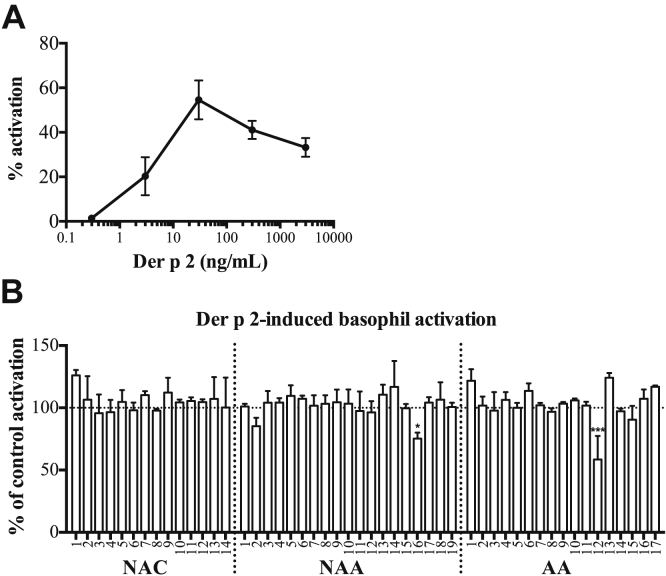
Concentration/response curve of blood basophils from a Der p 2–sensitized atopic donor to Der p 2 allergen in vitro(A). Response of the same basophils to Der p 2 30 ng/mL pre-incubated with all sera from Fig 1 normalized to baseline (pre-incubation of the cells with the donor's own serum) (B). Bars represent the mean/SD of at least 3 independent experiments.
Fig 3
Fig 3
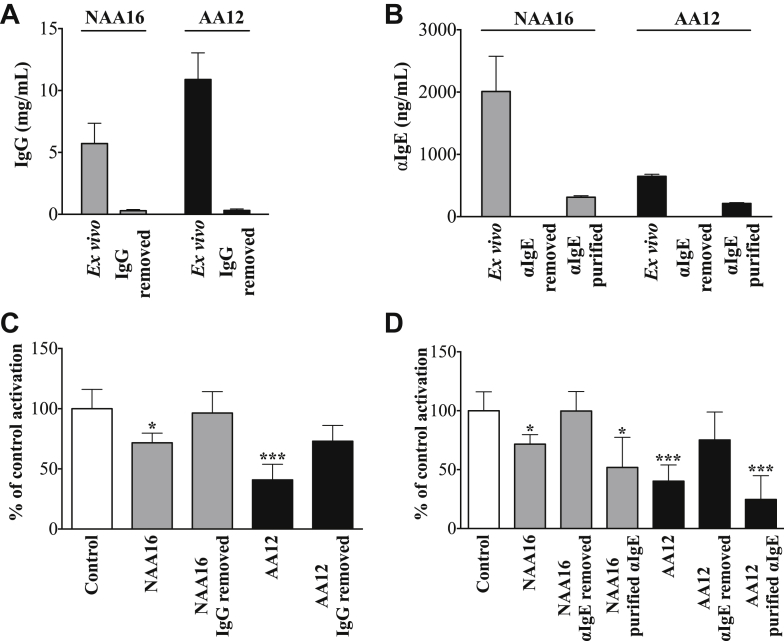
Total IgG concentrations in 2 test sera ex vivo and following protein G depletion (A). IgE-binding proteins ex vivo and following depletion and isolation of IgE binding proteins (B). Effects of sera ex vivo and following IgG depletion (C) and removal and purification of IgE binding proteins (D) on Der p 2 (30 ng/mL)–induced basophil activation normalized to baseline (using the donor's own serum). Bars represent the mean/SD of 3 independent experiments. ∗P < .05 and ∗∗∗P < .001.
Fig 4
Fig 4
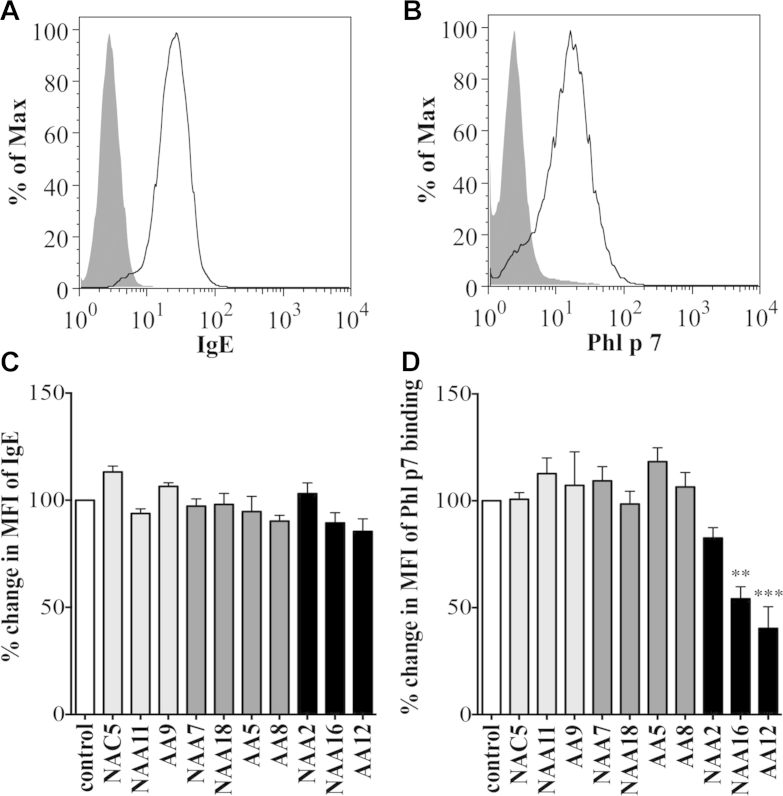
Binding of recombinant Phl p 7-specific IgE to FcεRI on RBL-SX38 cells (A). Phl p 7 binding following further incubation with specific allergen (representative of 3 independent experiments) (B). Changes in surface-bound IgE (C) and surface-bound Phl p 7(D) on RBL-SX38 cells pre-incubated with recombinant, anti-Phl p 7 IgE test sera then Phl p 7 compared with no serum control. Bars represent the mean/SD of 3 independent experiments. ∗∗P < .01 and ∗∗∗P < .001.
Fig E1
Fig E1
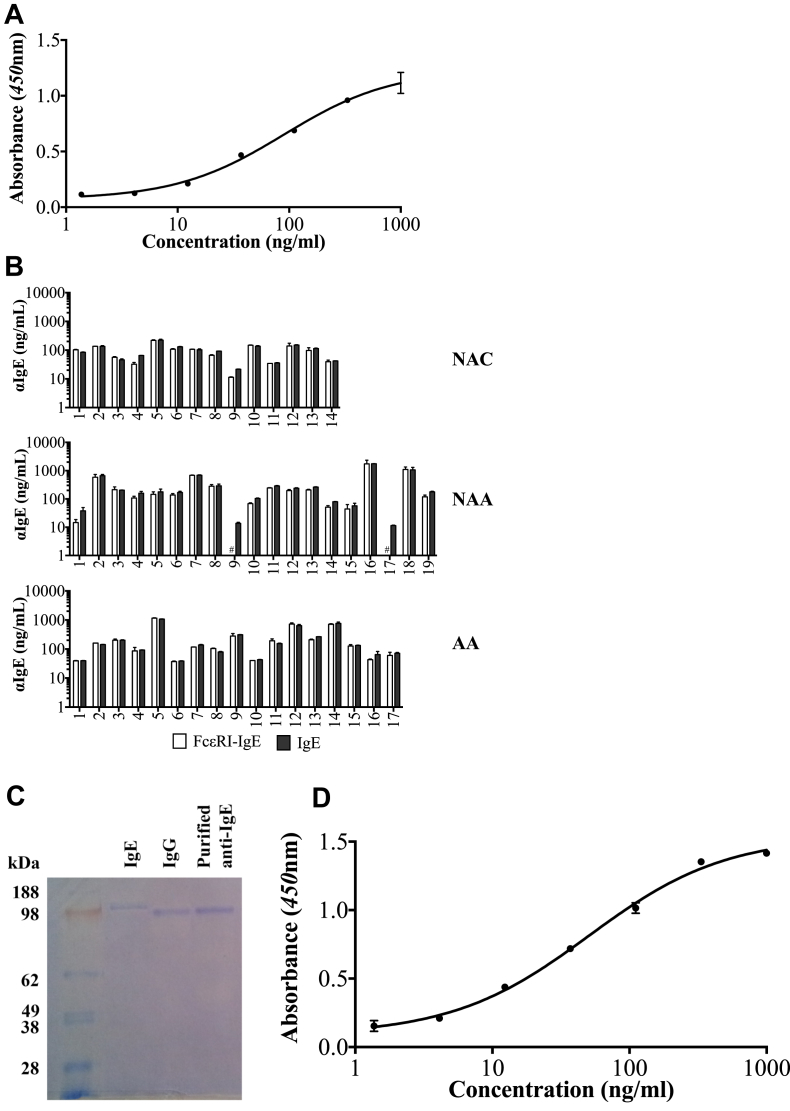
Representative standard concentration curve for the IgG anti-IgE ELISA using omalizumab (A). Comparison of the capacity of IgE-specific IgG autoantibodies to bind to “free” IgE (dark bars) and FcεRI-bound IgE (white bars) # analyte below detection limit of assay. Bars show mean/SD of 3 experiments using duplicate samples (B). SDS-PAGE showing the purified IgG anti-IgE from serum compared with recombinant IgE and IgG (C). Representative standard concentration curve for the IgG anti-FcεRI-bound ELISA using anti-IgE purified from human sera (D).
Fig E2
Fig E2
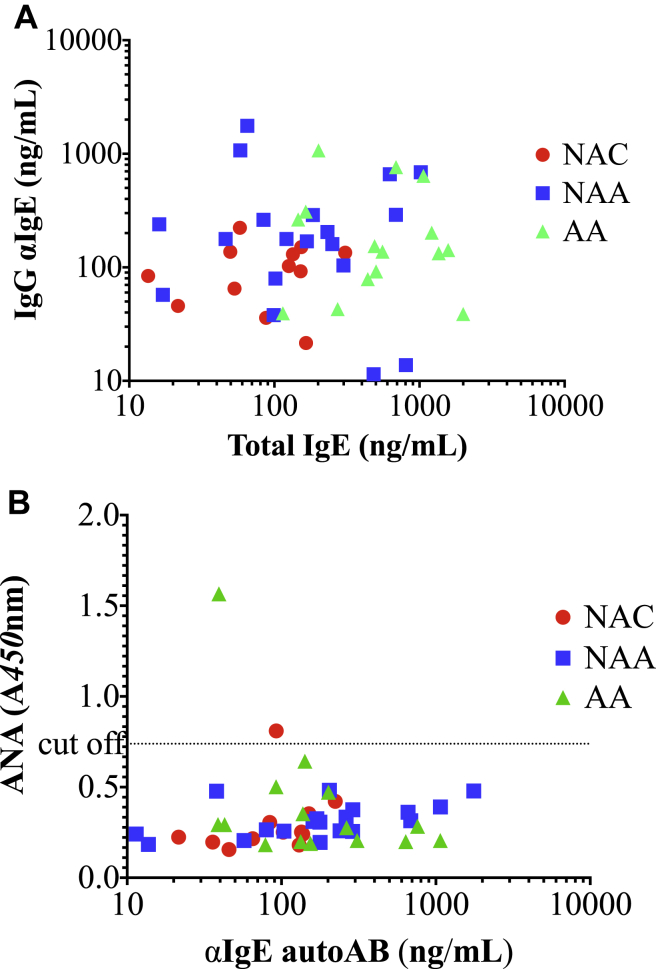
Comparison of serum total IgE and IgG anti-IgE autoantibody concentrations in all study subjects (A). Spearman r = 0.08578; P > .5. Comparison of serum concentrations of IgG anti-IgE antibodies with ANA in all study subjects (B). Dotted line shows the threshold for a positive ANA result. Spearman r = −0.02621; P > .5.
Fig E3
Fig E3
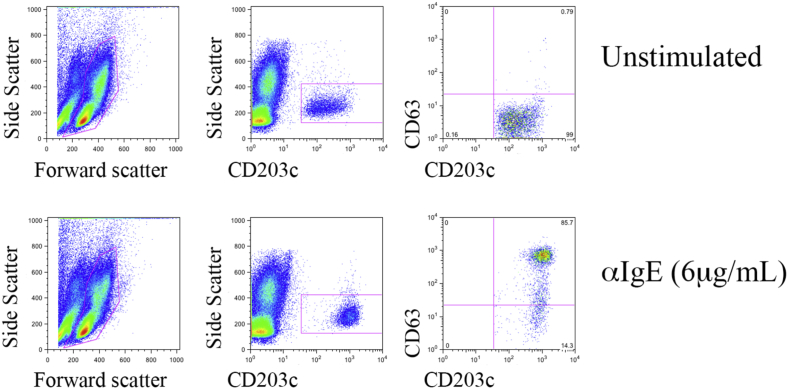
Gating strategy to determine basophil activation by flow cytometry, comparing unstimulated and anti-IgE–stimulated PBMC.
Fig E4
Fig E4
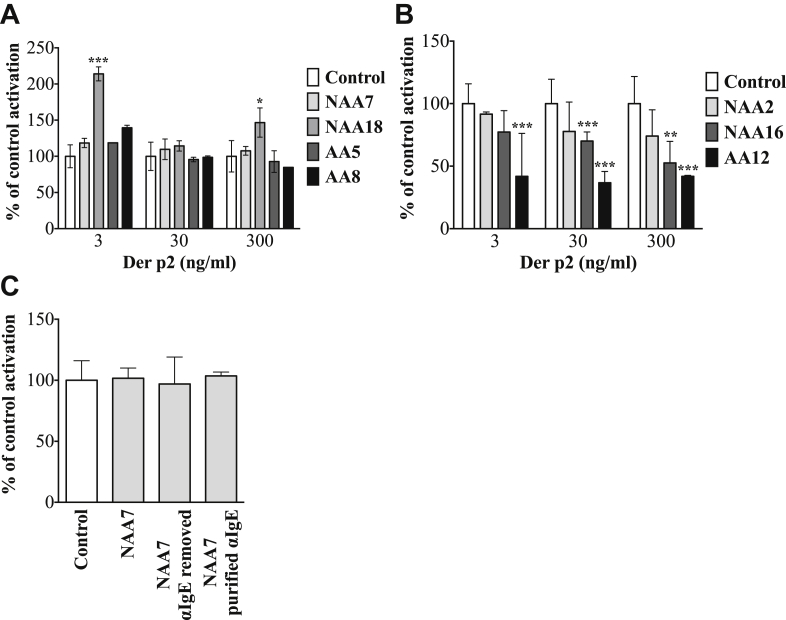
Response of blood basophils stimulated with Der p 2 (3 to 300 ng/mL), pre-incubated with 4 sera containing IgG anti-IgE autoantibodies and basophil-activating activity (A) and 3 sera containing IgG anti-IgE autoantibodies without basophil-activating activity normalized to baseline (pre-incubation of the cells with the donor's own serum) (B). Effects of the non-inhibitory serum NAA7 following the removal and purification of IgE binding proteins on Der p 2 (30 ng/mL)–induced basophil activation (C). Bars represent the mean/SD of 3 independent experiments. ∗P < .05, ∗∗P < .01, and ∗∗∗P < .001.

References

    1. Gould H.J., Sutton B.J. IgE in allergy and asthma today. Nat Rev Immunol. 2008;8:205–217. - PubMed
    1. Rajan T.V. The Gell-Coombs classification of hypersensitivity reactions: a re-interpretation. Trends Immunol. 2003;24:376–379. - PubMed
    1. Stone K.D., Prussin C., Metcalfe D.D. IgE, mast cells, basophils, and eosinophils. J Allergy Clin Immunol. 2010;125:S73–S80. - PMC - PubMed
    1. Marone G., Spadaro G., Palumbo C., Condorelli G. The anti-IgE/anti-FcεRIα autoantibody network in allergic and autoimmune diseases. Clin Exp Allergy. 1999;29:17–27. - PubMed
    1. Grattan C.E., Francis D.M., Hide M., Greaves M.W. Detection of circulating histamine releasing autoantibodies with functional properties of anti-IgE in chronic urticaria. Clin Exp Allergy. 1991;21:695–704. - PubMed

Publication types