. 2014 Nov;13(8):812-20.
doi: 10.1111/gbb.12172. Epub 2014 Oct 14.

Walking deficits and centrophobism in an α-synuclein fly model of Parkinson's disease

Affiliations
Free PMC article

Walking deficits and centrophobism in an α-synuclein fly model of Parkinson's disease

A Y Chen et al. Genes Brain Behav. 2014 Nov.
Free PMC article

Abstract

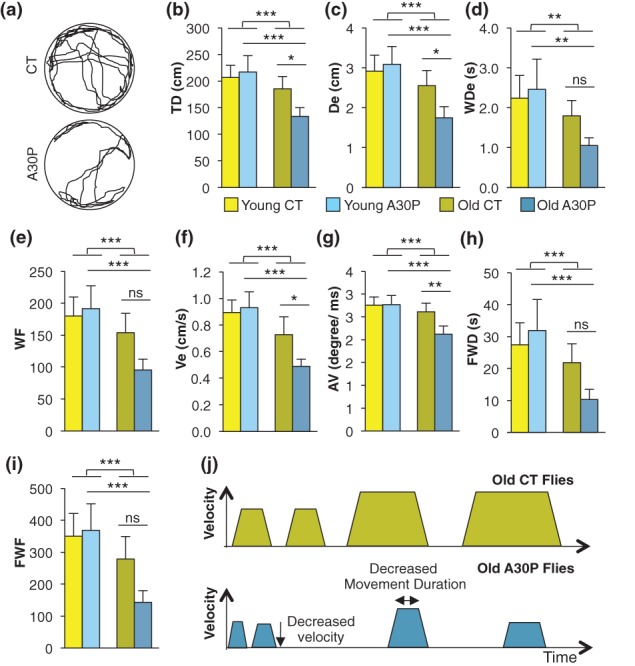
Parkinson's disease (PD) is a movement neurodegenerative disorder, characterized by bradykinesia, rigidity and tremor, constituting difficulties in walking and abnormal gait. Previous research shows that Drosophila expressing human α-synuclein A30P (A30P) develop deficits in geotaxis climbing; however, geotaxis climbing is a different movement modality from walking. Whether A30P flies would exhibit abnormal walking in a horizontal plane, a measure more relevant to PD, is not known. In this study, we characterized A30P fly walking using a high-speed camera and an automatic behavior tracking system. We found that old but not young A30P flies exhibited walking abnormalities, specifically decreased total moving distance, distance per movement, velocity, angular velocity and others, compared with old control flies. Those features match the definition of bradykinesia. Multivariate analysis further suggested a synergistic effect of aging and A30P, resulting in a distinct pattern of walking deficits, as seen in aged A30P flies. Psychiatric problems are common in PD patients with anxiety affecting 40-69% of patients. Central avoidance is one assessment of anxiety in various animal models. We found old but not young A30P flies exhibited increased centrophobism, suggesting possible elevated anxiety. Here, we report the first quantitative measures of walking qualities in a PD fly model and propose an alternative behavior paradigm for evaluating motor functions apart from climbing assay.

Keywords: A30P; Drosophila; Parkinson's disease; bradykinesia; centrophobism; multivariate analysis; neurodegenerative diseases; open field; walking deficits; α-synuclein.


Figures

Figure 1
Figure 1
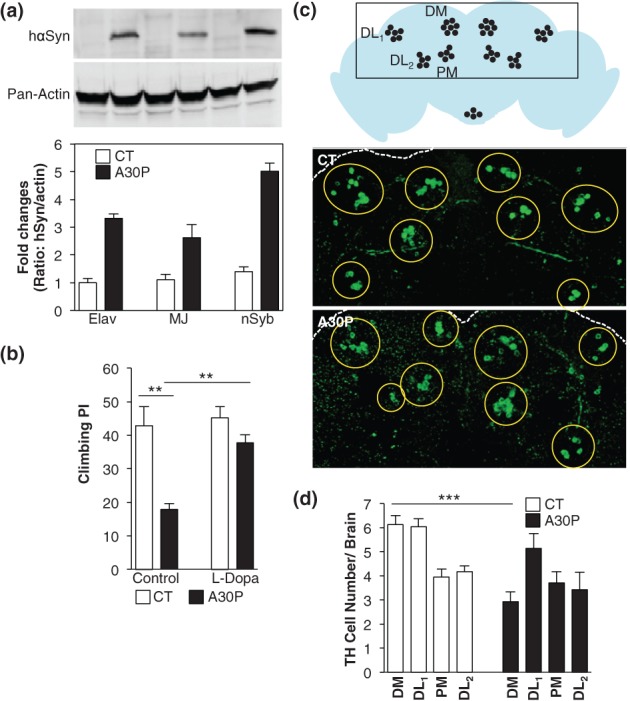
Properties of A30P transgenic flies. (a) Promoter strength of pan-neural GAL4 drivers. A30P expression was driven by Elav, MJ-85b (MJ) or nSyb GAL4 drivers. Protein extracts from adult heads, age 1–5 days, were probed with specific anti-human αSyn antibody (upper panel). The A30P-specific signal was normalized to its actin signal and then further normalized as ratios to Elav/CT controls for four independent blots (lower panel). Elav/CT is Elav/+; +/+. Elav/A30P is Elav/+; A30P/+. MJ/CT is MJ-85b/+; +/+. MJ/A30P is MJ-85b/+; A30P/+. nSyb/CT is nSyb/+; +/+. nSyb/A30P is nSyb/+; A30P/+. n = 4. (b) Climbing PI showed l-Dopa reversible motor deficit in A30P flies. Flies were 15 days old, treated with (l-Dopa) or without l-Dopa (control). See Materials and methods for PI calculation. The CT is nSyb/+; +/+; A30P is nSyb/+; A30P/+. Both transgenic flies were used hereafter in all figures. n = 4 per group. Comparisons between CT and A30P of the control group and between l-Dopa-treated and not treated A30P were made using unpaired and paired Student's t-test, respectively. (c) Diagram showing four major clusters of dopamine neuron in an adult fly brain. DM, dorsal medial cluster; DL1, dorsal lateral 1; DL2, dorsal lateral 2; PM, posterior medial (upper panel). Anti-TH was used to identify dopamine neurons in 30-day-old CT and A30P fly brains using immunostaining (lower panel). (d) Quantification of TH-stained cells in (c). 8 < n < 25. Comparisons between TH-stained cell number from the same cluster of CT and of A30P were made using unpaired Student's t-test. All data represented means ± SEM; **P < 0.01; ***P < 0.01.
Figure 2
Figure 2
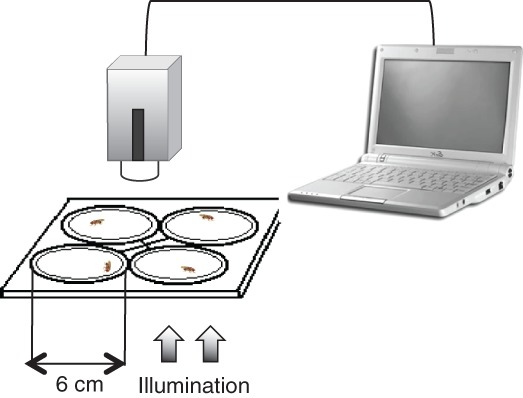
Open-field assay for flies. Transparent acrylic plates were illuminated by 300 lux of white light from beneath to elevate basal locomotive activity and to provoke center-avoidance behavior. A panel of four arenas, 6 cm in diameter, was used, allowing a simultaneous recording of four flies.
Figure 3
Figure 3
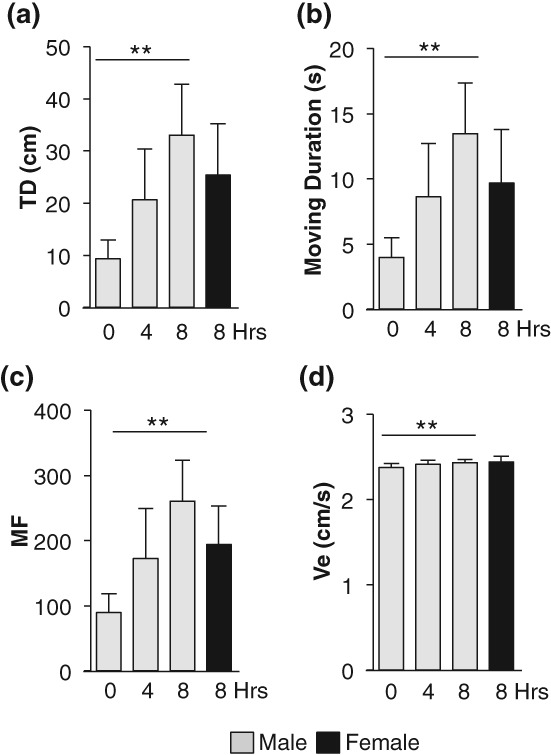
Starvation induced hyperactivity without affecting Ve. A 2-min walking was measured in 2- to 3-day-old wild-type male flies after 0, 4 or 8 h of food depletion and in the same-aged female flies after 8 h of food depletion. Starvation consistently increased the locomotive activity of male. (a) Total distance moved (TD; cm). (b) Moving duration (seconds). (c) Mean MF. (d) Moving velocity (cm/second). Data present mean ± 95% confidence interval of the mean (1.96 SEM). 10 < n < 13. One-way anova with Tukey post hoc was used for within-male comparisons. Student's t-test was used to compare 8-h-starved male to 8-h-starved female. *P < 0.05; **P < 0.01.
Figure 4
Figure 4
Age-dependent walking deficits in A30P flies. The trial is 5 min. (a) Sample tracings of old CT and A30P flies' walking pattern. (b) Total distance moved (TD; cm). (c) Distance per episode (De; cm). (d) Walking Distance per episode (WDe; second). (e) Walking frequency (WF). (f) Velocity (Ve; cm/s). (g) Angular velocity (degree/millisecond). (h) Fast walking duration (FWD; second). (i) Fast walking frequency (FWF). Fast walking was defined as walking at Ve above 1 cm/second. (j) A summary of multiple walking deficits identified in old A30P files. Data present mean ± 95% confidence interval of the mean (1.96 SEM). nYoung = 23; nold = 20. Student's t-test was used for comparisons between mixed young vs. old. Two-way anova with Tukey post hoc was used for comparisons between four groups. *P < 0.05; **P < 0.01; ***P < 0.001.
Figure 5
Figure 5
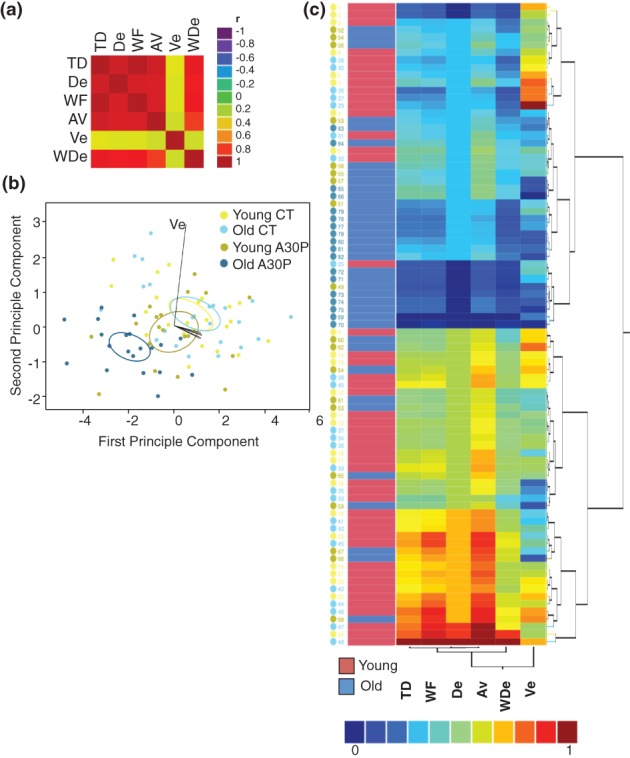
Distinct walking pattern of aged A30P flies. (a) Correlation heat map. Five walking qualities (TD, De, WF, AV and WDe) are highly correlated with each other [the correlation coefficients (Rs) range from 0.79 to 0.99], but not with Ve (Rs range from 0.267 to 0.298). The inputs are data of all flies from Fig. 4. (b) Biplot of a discriminative analysis. Each point is data of one fly. Each linear trajectory represents one variable. Each ellipse corresponds to a 95% confidence limit for a mean. Discriminative analysis was constructed using ‘quadratic method’. A summary of discrimination power was tabulated in Table2. (c) Clusters of fly walking, based on the measurements of TD, MF, De, AV, Ade and Ve, and ages, young or old. For multivariate analysis, all data were scaled linearly between 0 and 1.
Figure 6
Figure 6
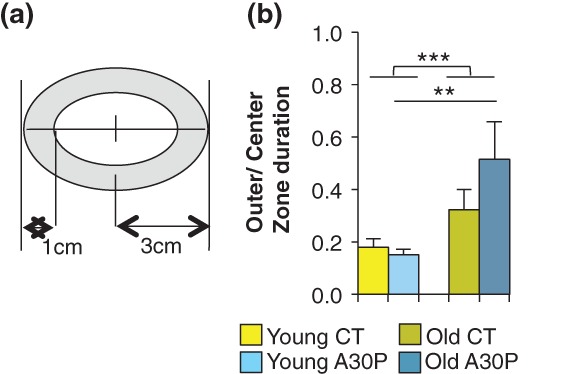
Age-dependent anxiety-like phenotype in A30P flies. (a) The outer zone is 1-cm wide of ring area in the area. (b) Old A30P flies showed increased movement duration in the outer zone, shown as an increase in the ratio of the outer to center zone duration. Each trial is 2 min. Data present mean ± 95% confidence interval of the mean (1.96 SEM). nYoung = 23; nold = 16. Student's t-test. ***P < 0.001. **P < 0.01.

References

    1. Almeida QJ. Lebold CA. Freezing of gait in Parkinson's disease: a perceptual cause for a motor impairment? J Neurol Neurosurg Psychiatry. 2010;81:513–518. - PubMed
    1. Auluck PK. Bonini NM. Pharmacological prevention of Parkinson disease in Drosophila. Nat Med. 2002;8:1185–1186. - PubMed
    1. Auluck PK, Chan HY, Trojanowski JQ, Lee VM. Bonini NM. Chaperone suppression of alpha-synuclein toxicity in a Drosophila model for Parkinson's disease. Science. 2002;295:865–868. - PubMed
    1. Benzer S. Genetic dissection of behavior. Sci Am. 1973;229:24–37. - PubMed
    1. Besson M. Martin JR. Centrophobism/thigmotaxis, a new role for the mushroom bodies in Drosophila. J Neurobiol. 2005;62:386–396. - PubMed

Publication types

Substances

LinkOut - more resources