


Brain damage in commercial breath-hold divers
- PMID: 25115903
- PMCID: PMC4130625
- DOI: 10.1371/journal.pone.0105006
Brain damage in commercial breath-hold divers
Abstract
Background: Acute decompression illness (DCI) involving the brain (Cerebral DCI) is one of the most serious forms of diving-related injuries which may leave residual brain damage. Cerebral DCI occurs in compressed air and in breath-hold divers, likewise. We conducted this study to investigate whether long-term breath-hold divers who may be exposed to repeated symptomatic and asymptomatic brain injuries, show brain damage on magnetic resonance imaging (MRI).
Subjects and methods: Our study subjects were 12 commercial breath-hold divers (Ama) with long histories of diving work in a district of Japan. We obtained information on their diving practices and the presence or absence of medical problems, especially DCI events. All participants were examined with MRI to determine the prevalence of brain lesions.
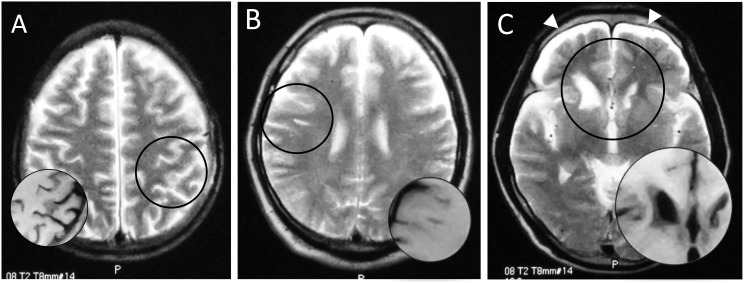
Results: Out of 12 Ama divers (mean age: 54.9±5.1 years), four had histories of cerebral DCI events, and 11 divers demonstrated ischemic lesions of the brain on MRI studies. The lesions were situated in the cortical and/or subcortical area (9 cases), white matters (4 cases), the basal ganglia (4 cases), and the thalamus (1 case). Subdural fluid collections were seen in 2 cases.
Conclusion: These results suggest that commercial breath-hold divers are at a risk of clinical or subclinical brain injury which may affect the long-term neuropsychological health of divers.
Conflict of interest statement
Figures
References
-
- Vann RD, Butler FK, Mitchell SJ, Moon RE (2011) Decompression illness. Lancet 377: 153–164. - PubMed
-
- Hong SK, Rahn H (1967) The diving women of Korea and Japan. Sci Am 216: 34–43. - PubMed
-
- Kohshi K, Kinoshita Y, Abe H, Okudera T (1998) Multiple cerebral infarction in Japanese breath-hold divers: two case reports. Mt Sinai J Med 65: 280–283. - PubMed
-
- Mango L, Lundgren CEG, Ferringo M (1999) Neurological problems after breath-hold dives. Undersea Hyperb Med 26 (suppl): 28–29.
-
- Kohshi K, Katoh T, Abe H, Okudera T (2000) Neurological accidents caused by repetitive breath-hold dives: two case reports. J Neurol Sci 178: 66–69. - PubMed
MeSH terms
LinkOut - more resources
Full Text Sources
Other Literature Sources
