. 2015 Feb;17(1):81-98.
doi: 10.1007/s10126-014-9595-7. Epub 2014 Aug 13.

High conopeptide diversity in Conus tribblei revealed through analysis of venom duct transcriptome using two high-throughput sequencing platforms

Affiliations

High conopeptide diversity in Conus tribblei revealed through analysis of venom duct transcriptome using two high-throughput sequencing platforms

Neda Barghi et al. Mar Biotechnol (NY). 2015 Feb.

Abstract

The venom of each species of Conus contains different kinds of pharmacologically active peptides which are mostly unique to that species. Collectively, the ~500-700 species of Conus produce a large number of these peptides, perhaps exceeding 140,000 different types in total. To date, however, only a small fraction of this diversity has been characterized via transcriptome sequencing. In addition, the sampling of this chemical diversity has not been uniform across the different lineages in the genus. In this study, we used high-throughput transcriptome sequencing approach to further investigate the diversity of Conus venom peptides. We chose a species, Conus tribblei, as a representative of a poorly studied clade of Conus. Using the Roche 454 and Illumina platforms, we discovered 136 unique and novel putative conopeptides belonging to 30 known gene superfamilies and 6 new conopeptide groups, the greatest diversity so far observed from a transcriptome. Most of the identified peptides exhibited divergence from the known conopeptides, and some contained cysteine frameworks observed for the first time in cone snails. In addition, several enzymes involved in posttranslational modification of conopeptides and also some proteins involved in efficient delivery of the conopeptides to prey were identified as well. Interestingly, a number of conopeptides highly similar to the conopeptides identified in a phylogenetically distant species, the generalist feeder Conus californicus, were observed. The high diversity of conopeptides and the presence of conopeptides similar to those in C. californicus suggest that C. tribblei may have a broad range of prey preferences.


Figures
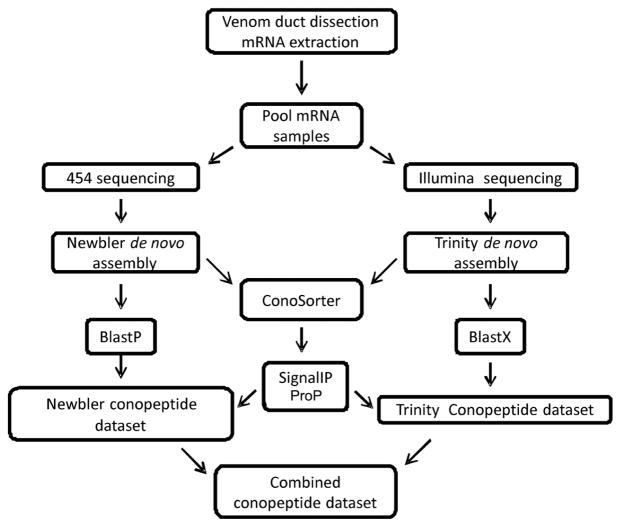
Fig. 1
Fig. 1
Sample preparation, sequencing and transcriptome analysis workflow. 1) mRNA extraction and sequencing using Illumina hi-seq 2000 and Roche 454 technologies, 2) de novo assembly using Trinity and Newbler, 3) conopeptide identification using BLAST, 4) putative conopeptide identification using ConoSorter, signal validation using SignalIP and propeptide cleavage site prediction using ProP, 5) pooling the conopeptide precursors in the ‘Combined conopeptide dataset’ (for details refer to Materials and Methods).
Fig. 2
Fig. 2
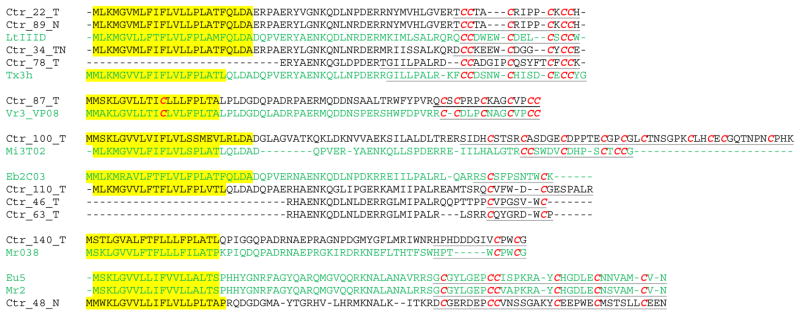
The putative conopeptide precursors of M superfamily. The conopeptides identified in C. tribblei are shown in black and the conopeptide nomenclature is described in Materials and Methods. The reference sequences are shown in green and cysteine residues are shown in bold italic red. The names of the reference sequences are derived from the ConoServer database unless noted otherwise. The signal regions are highlighted and the mature regions are underlined.
Fig. 3
Fig. 3
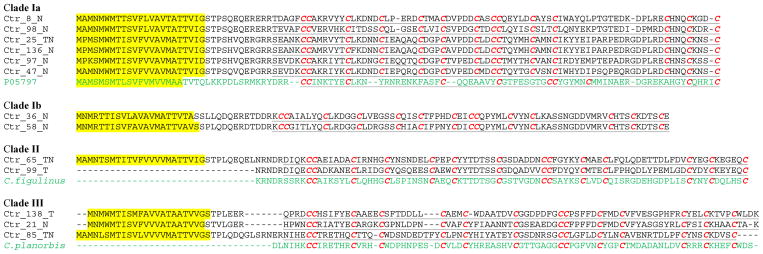
The putative conopeptide precursors of con-ikot-ikot family. The notes are indicated in Fig 2. C.figulinus and C. planorbis sequences are from Mariq et al. (2009).
Fig. 4
Fig. 4
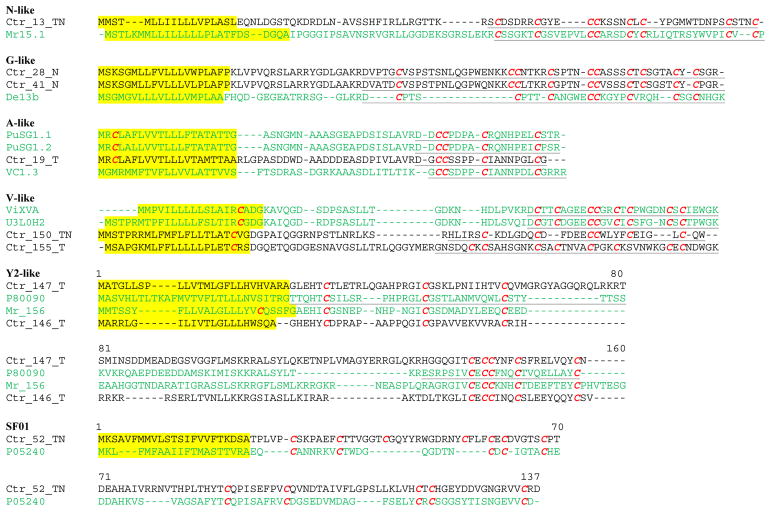
The putative conopeptide precursors of the new conopeptide groups. The notes are indicated in Fig. 2. Uniprot ID P80090 is molluscan insulin-related peptide 3 from Lymnaea stagnalis; Chain B (30–66 residues) and chain A (99–122 residues) of P80090 are underlined. Uniprot ID U3L0H2 from Conus flavidus. Mr_156 with Genbank accession number AB850850 from Conus marmoreus.
Fig. 5
Fig. 5
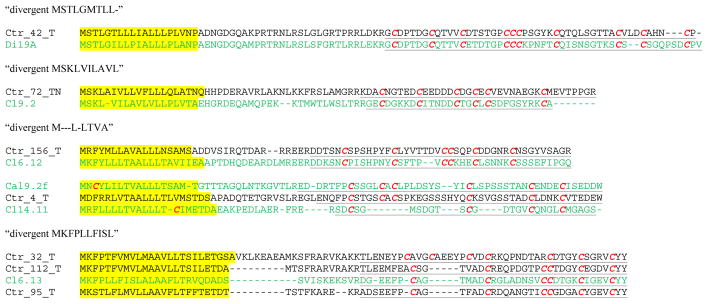
The putative conopeptide precursors of ‘divergent MSTLGMTLL-’, ‘divergent MSKLVILAVL’, ‘divergent M---L-LTVA’ and ‘divergent MKFPLLFISL’ superfamilies. The notes are indicated in Fig. 2.
Fig. 6
Fig. 6
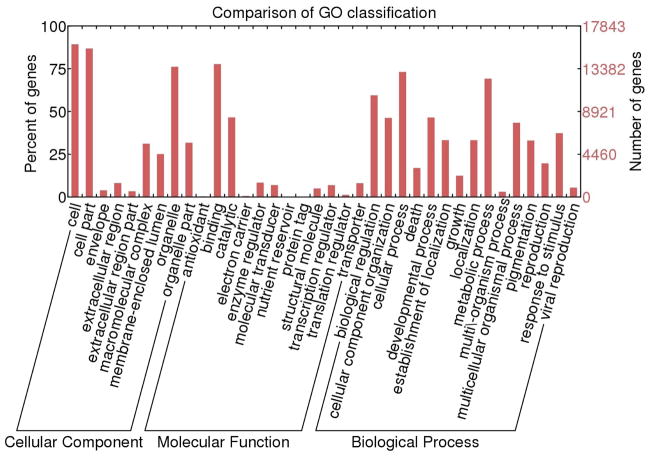
GO annotations of the venom duct transcripts of C. tribblei
Fig. 7
Fig. 7
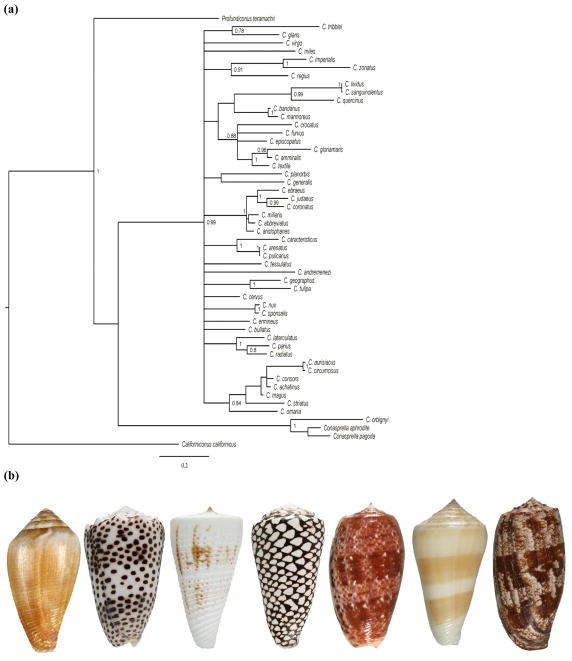
The phylogenetic relationship of Conus species (a) Shells of the cone snails in table 6: (left to right): Conus californicus, Conus pulicarius, Conus tribblei, Conus marmoreus, Conus bullatus, Conus consors and Conus geographus. The phylogenetic tree is inferred from the partial cytochrome oxidase I sequences using Bayesian analysis. Posterior probabilities are indicated for each node. Conasprella, Profundiconus and Californiconus have recently been classified as separate genera in the family Conidae (Olivera et al. 2014). Conus californicus is now Californiconus californicus.

References

    1. Aguilar MB, Zugasti-Cruza A, Falcóna A, Batista CVF, Olivera BM, Heimer de la Coter EP. A novel arrangement of Cys residues in a paralytic peptide of Conus cancellatus (jr. syn.: Conus austini), a worm-hunting snail from the Gulf of Mexico. Peptides. 2013;41:38–44. - PMC - PubMed
    1. Altschul SF, Gish W, Miller W, Myers EW, Lipman DJ. Basic local alignment search tool. J Mol Biol. 1990;215:403–410. - PubMed
    1. Apweiler R, Bairoch A, Wu CH. Protein sequence databases. Curr Opin Chem Biol. 2004;8:76–80. - PubMed
    1. Bayrhuber M, Vijayan V, Ferber M, Graf R, Korukottu J, Imperial J, Garrett JE, Olivera BM, Terlau H, Zweckstetter M, Becker S. Conkunitzin-S1 is the first member of a new kunitz-type neurotoxin family, structural and functional characterization. J Biol Chem. 2005;280:23766–23770. - PubMed
    1. Biggs JS, Olivera BM, Kantor YI. α-conopeptides specifically expressed in the salivary gland of Conus pulicarius. Toxicon. 2008;52:101–105. - PMC - PubMed

Publication types

LinkOut - more resources