


An exploratory spatial analysis of geographical inequalities of birth intervals among young women in the Democratic Republic of Congo (DRC): a cross-sectional study
- PMID: 25117879
- PMCID: PMC4139614
- DOI: 10.1186/1471-2393-14-271
An exploratory spatial analysis of geographical inequalities of birth intervals among young women in the Democratic Republic of Congo (DRC): a cross-sectional study
Abstract
Background: The length of time between two successive live births (birth interval), is associated with child survival in the developing world. Short birth intervals (<24 months) contribute to infant and child mortality risks. Contraceptive use contributes to a reduction in short birth intervals, but evidence is lacking in the DRC. We aimed to investigate the proportion of short birth intervals at the provincial level among young women in the DRC.
Methods: Data from the Demographic and Health Survey undertaken in the DRC in 2007 were analyzed. Logistic regression and Bayesian geo-additive models were used to explain provincial inequalities in short birth intervals among women of reproductive age and young women. Posterior odds ratio (OR) and 95% credible region (CR) were estimated via Markov chain Monte Carlo (MCMC) techniques. Posterior spatial effects and the associated posterior probability maps were produced at the provincial-level to highlight provinces with a significant higher risk of short birth interval.
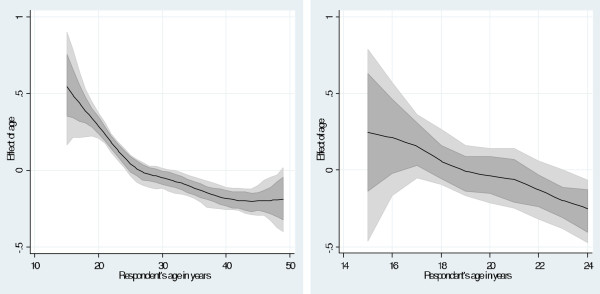
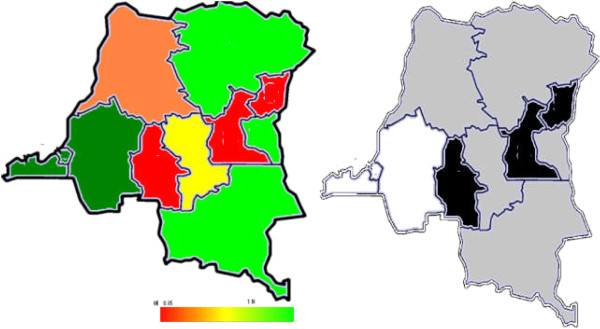
Results: The overall proportion of short birth intervals among all women of reproductive age (15-49 years) and young women (15-24 years) were 30.2% and 38.7% respectively. In multivariate Bayesian geo-additive regression analyses, among the whole sample of women, living in rural areas [OR = 1.07, 95% CR: (0.97, 1.17)], exclusive breastfeeding [1.08 (1.00, 1.17)] and women with primary education [1.06 (1.00, 1.16)], were consistently associated with a higher risk of short birth intervals. For the young women, none of the factors considered were associated with the risk of short birth interval except a marginal effect from the lack of education. There was a spatial variation in the proportion of women reporting short birth intervals and among all women of reproductive age across provinces, with Nord-Kivu [1.12 (1.02, 1.24)], Sud Kivu [1.17 (1.05, 1.29)] and Kasai Occidental [1.18 (1.06, 1.32)] reporting a higher risk of short birth intervals. For young women, the higher risk provinces were Nord-Kivu [1.22 (1.00, 1.54)] and Sud Kivu [1.34 (1.14, 1.63)].
Conclusions: This study suggests distinct geographic patterns in the proportion of short birth intervals among Congolese women, as well as the potential role of demographic and geographic location factors driving the ongoing higher youth fertility, higher childhood and maternal mortality in the DRC.
Figures


References
-
- Rutstein SO. Demography and health research. 2008. Further Evidence of the Effects of Preceding Birth Intervals on Neonatal, Infant, and Under-Five-Years Mortality and Nutritional Status in Developing Countries: Evidence from the Demographic and Health Surveys. - PubMed
Pre-publication history
-
- The pre-publication history for this paper can be accessed here:http://www.biomedcentral.com/1471-2393/14/271/prepub
Publication types
MeSH terms
Grants and funding
LinkOut - more resources
Full Text Sources
Other Literature Sources
Medical
