


Bystander activation and anti-tumor effects of CD8+ T cells following Interleukin-2 based immunotherapy is independent of CD4+ T cell help
- PMID: 25119341
- PMCID: PMC4131875
- DOI: 10.1371/journal.pone.0102709
Bystander activation and anti-tumor effects of CD8+ T cells following Interleukin-2 based immunotherapy is independent of CD4+ T cell help
Abstract
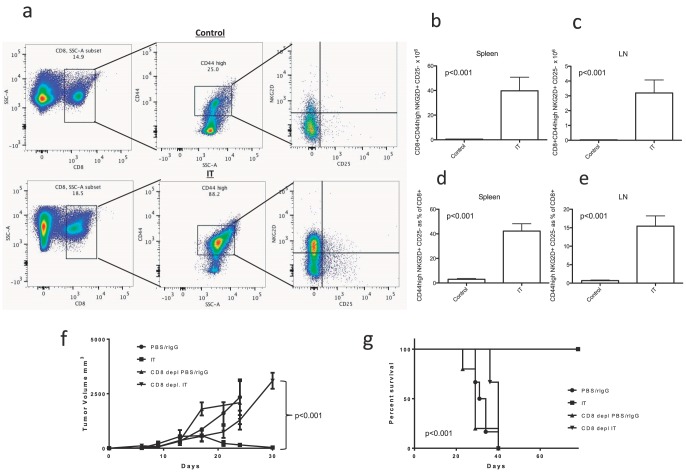
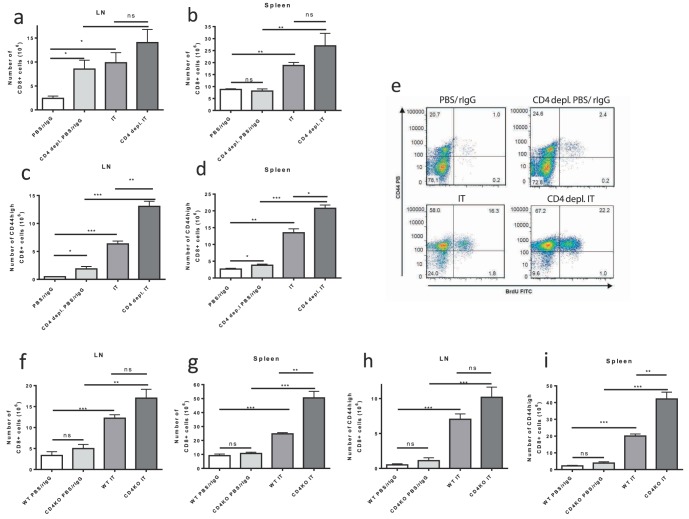
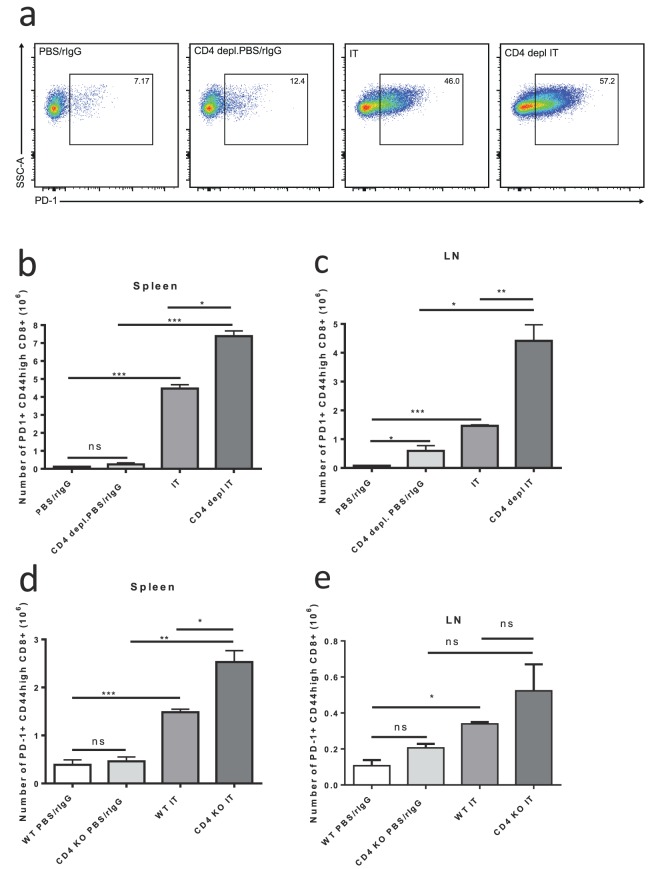
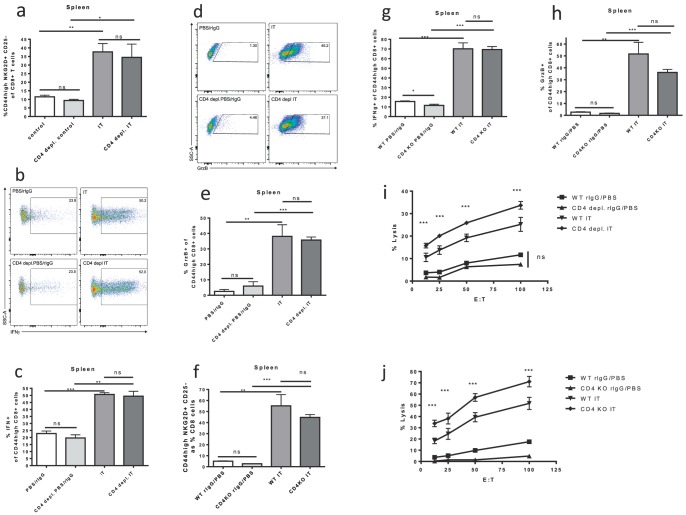
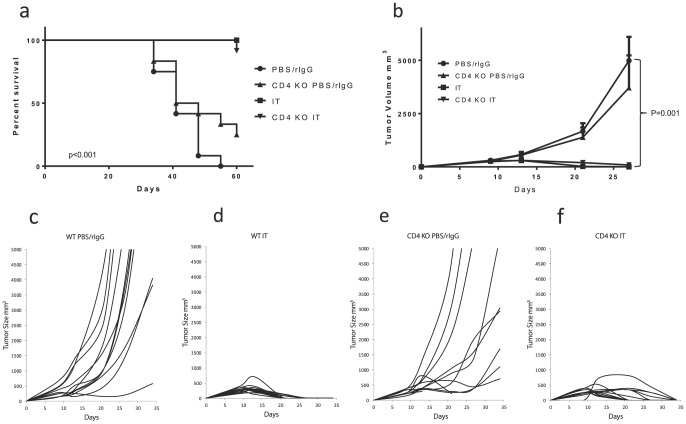
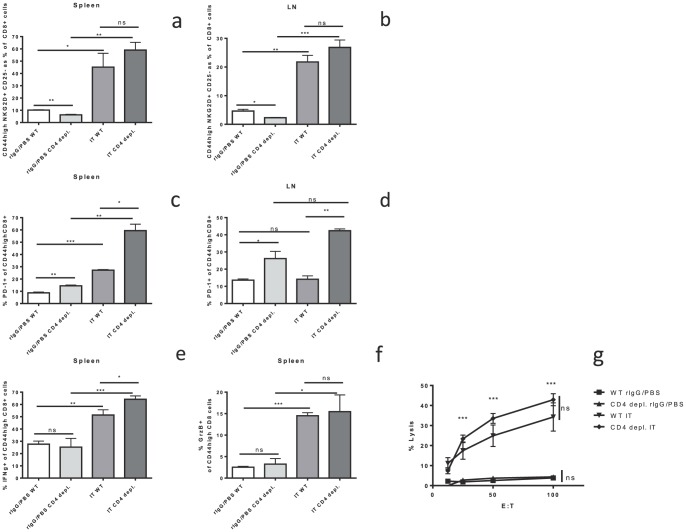
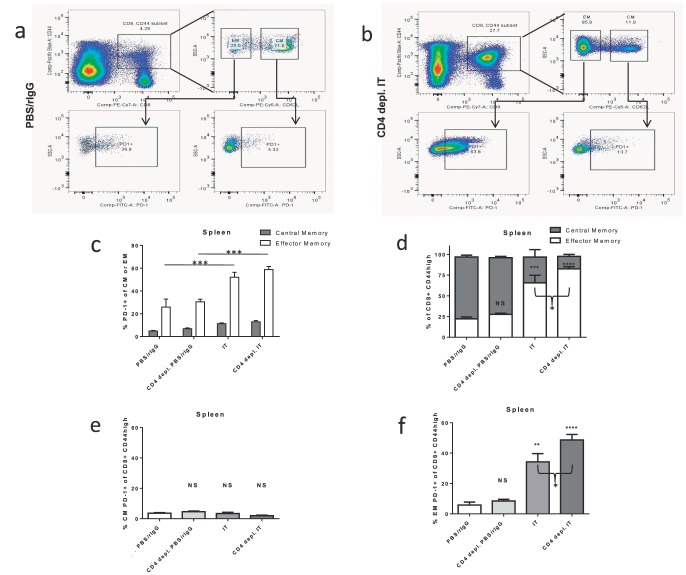
We have previously demonstrated that immunotherapy combining agonistic anti-CD40 and IL-2 (IT) results in synergistic anti-tumor effects. IT induces expansion of highly cytolytic, antigen-independent "bystander-activated" (CD8(+)CD44high) T cells displaying a CD25(-)NKG2D(+) phenotype in a cytokine dependent manner, which were responsible for the anti-tumor effects. While much attention has focused on CD4(+) T cell help for antigen-specific CD8(+) T cell expansion, little is known regarding the role of CD4(+) T cells in antigen-nonspecific bystander-memory CD8(+) T cell expansion. Utilizing CD4 deficient mouse models, we observed a significant expansion of bystander-memory T cells following IT which was similar to the non-CD4 depleted mice. Expanded bystander-memory CD8(+) T cells upregulated PD-1 in the absence of CD4(+) T cells which has been published as a hallmark of exhaustion and dysfunction in helpless CD8(+) T cells. Interestingly, compared to CD8(+) T cells from CD4 replete hosts, these bystander expanded cells displayed comparable (or enhanced) cytokine production, lytic ability, and in vivo anti-tumor effects suggesting no functional impairment or exhaustion and were enriched in an effector phenotype. There was no acceleration of the post-IT contraction phase of the bystander memory CD8(+) response in CD4-depleted mice. The response was independent of IL-21 signaling. These results suggest that, in contrast to antigen-specific CD8(+) T cell expansion, CD4(+) T cell help is not necessary for expansion and activation of antigen-nonspecific bystander-memory CD8(+) T cells following IT, but may play a role in regulating conversion of these cells from a central memory to effector phenotype. Additionally, the expression of PD-1 in this model appears to be a marker of effector function and not exhaustion.
Conflict of interest statement
Figures
References
-
- Murali-Krishna K, Altman JD, Suresh M, Sourdive DJ, Zajac AJ, et al. (1998) Counting antigen-specific CD8 T cells: a reevaluation of bystander activation during viral infection. Immunity 8: 177–187. - PubMed
-
- Tough DF, Borrow P, Sprent J (1996) Induction of bystander T cell proliferation by viruses and type I interferon in vivo. Science 272: 1947–1950. - PubMed
-
- Dhanji S, Teh SJ, Oble D, Priatel JJ, Teh HS (2004) Self-reactive memory-phenotype CD8 T cells exhibit both MHC-restricted and non-MHC-restricted cytotoxicity: a role for the T-cell receptor and natural killer cell receptors. Blood 104: 2116–2123. - PubMed
Publication types
MeSH terms
Substances
Grants and funding
LinkOut - more resources
Full Text Sources
Other Literature Sources
Research Materials
