Cut-off point for WHOQOL-bref as a measure of quality of life of older adults
- PMID: 25119934
- PMCID: PMC4203073
- DOI: 10.1590/s0034-8910.2014048004912
Cut-off point for WHOQOL-bref as a measure of quality of life of older adults
Abstract
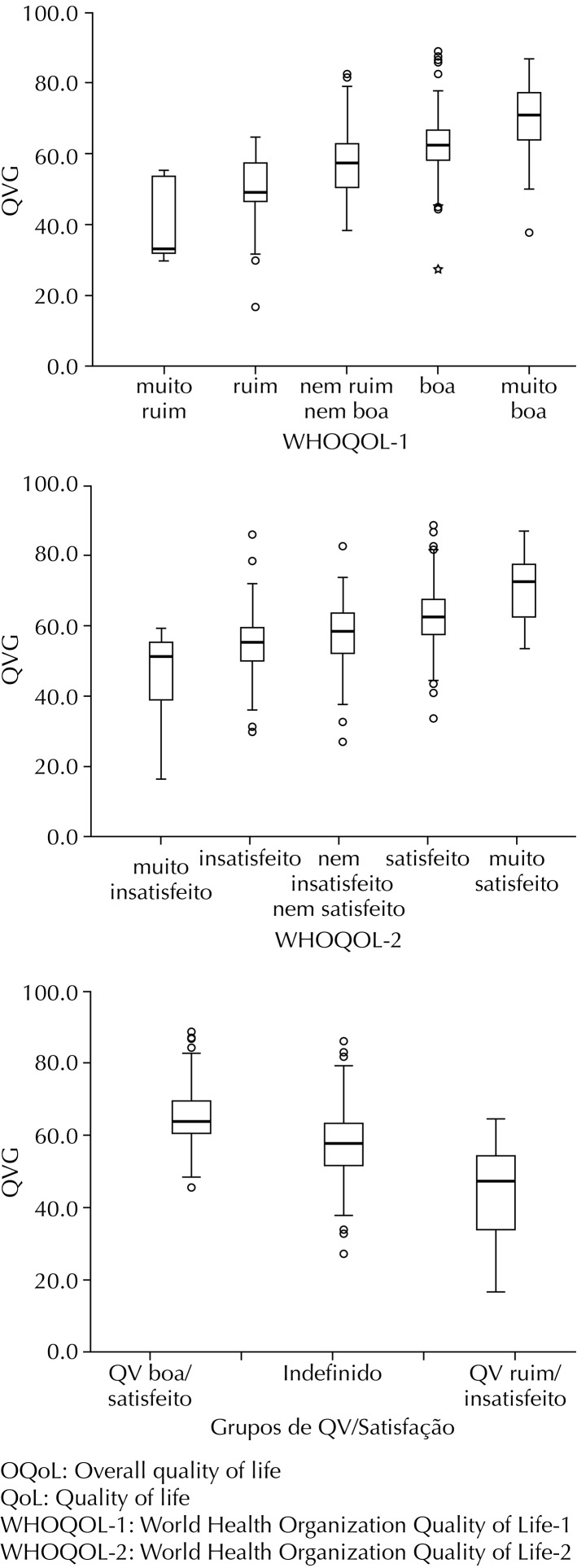
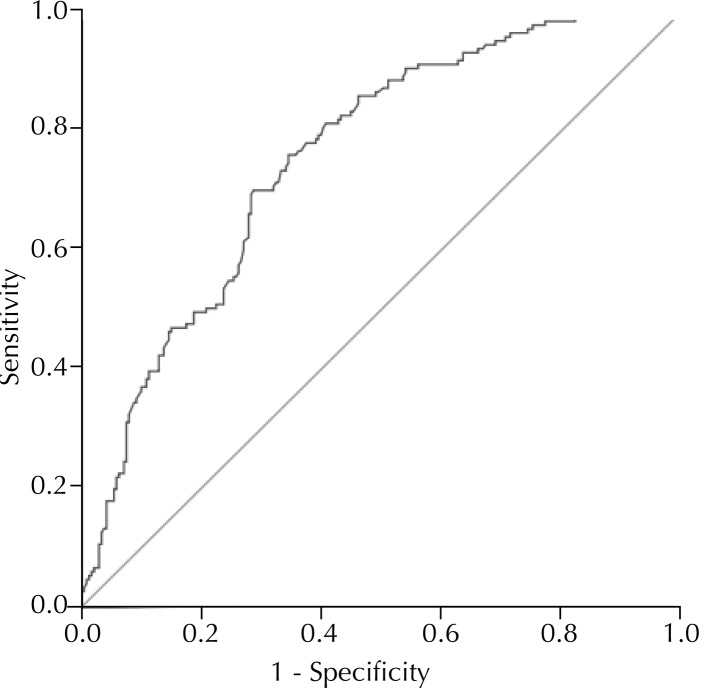
OBJECTIVE To propose a cut-off for the World Health Organization Quality of Life-Bref (WHOQOL-bref) as a predictor of quality of life in older adults.METHODS Cross-sectional study with 391 older adults registered in the Northwest Health District in Belo Horizonte, MG, Southeastern Brazil, between October 8, 2010 and May 23, 2011. The older adults' quality of life was measured using the WHOQOL-bref. The analysis was rationalized by outlining two extreme and simultaneous groups according to perceived quality of life and satisfaction with health (quality of life good/satisfactory - good or very good self-reported quality of life and being satisfied or very satisfied with health - G5; and poor/very poor quality of life - poor or very poor self-reported quality of life and feeling dissatisfied or very dissatisfied with health - G6). A Receiver-Operating Characteristic curve (ROC) was created to assess the diagnostic ability of different cut-off points of the WHOQOL-bref.RESULTS ROC curve analysis indicated a critical value 60 as the optimal cut-off point for assessing perceived quality of life and satisfaction with health. The area under the curve was 0.758, with a sensitivity of 76.8% and specificity of 63.8% for a cut-off of ≥ 60 for overall quality of life (G5) and sensitivity 95.0% and specificity of 54.4% for a cut-off of < 60 for overall quality of life (G6).CONCLUSIONS Diagnostic interpretation of the ROC curve revealed that cut-off < 60 for overall quality of life obtained excellent sensitivity and negative predictive value for tracking older adults with probable worse quality of life and dissatisfied with health.
OBJETIVO:: Estimar o ponto de corte para o World Health Organization Quality of Life-Bref (WHOQOL-bref) como preditor da qualidade de vida de idosos.
MÉTODOS:: Estudo transversal com 391 idosos registrados no Distrito Sanitário Noroeste, Belo Horizonte, MG, de 8 de outubro de 2010 a 23 de maio de 2011. O instrumento WHOQOL-bref foi utilizado para avaliação da qualidade de vida dos idosos. A análise foi racionalizada por meio da definição de dois grupos extremos e simultâneos em relação à percepção da qualidade de vida e satisfação com a saúde (qualidade de vida boa/satisfeito – autorrelato de qualidade de vida boa ou muito boa e se sentem satisfeitos ou muito satisfeitos com sua saúde – G5; e qualidade de vida ruim/insatisfeito – autorrelato de qualidade de vida ruim ou muito ruim e se sentem insatisfeitos ou muito insatisfeitos com sua saúde – G6). A curva Receiver-Operating Characteristic (ROC) foi construída para avaliar a capacidade diagnóstica de diferentes pontos de corte do instrumento WHOQOL-bref.
RESULTADOS:: A análise da curva ROC indicou valor crítico 60 como o melhor ponto de corte para avaliação da percepção de qualidade de vida e satisfação com a saúde. A área sob a curva foi 0,758, com sensibilidade de 76,8% e especificidade de 63,8% para o ponto de corte de qualidade de vida geral ≥ 60 (G5); e sensibilidade de 95,0% e especificidade de 54,4% para o ponto de corte de qualidade de vida geral < 60 (G6).
CONCLUSÕES:: O ponto de corte qualidade de vida geral <60 obteve excelente sensibilidade e valor preditivo negativo para rastreamento de idosos comprovável pior qualidade de vida e insatisfação com a saúde.
Conflict of interest statement
The authors declare that there is no conflict of interest.
Figures
References
-
- Fleck MPA, Leal OF, Louzada S, Xavier M, Chachamovich E, Vieira G, et al. Desenvolvimento da versão em português do instrumento de avaliação de qualidade de vida da OMS (WHOQOL-100) Rev Bras Psiquiatr. 1999;21(1):19–28. doi: 10.1590/S1516-44461999000100006. - DOI
-
- Fleck MPA. O instrumento de avaliação de qualidade de vida da Organização Mundial da Saúde (WHOQOL-100): características e perspectivas. Cienc Saude Coletiva. 2000;5(1):33–38. doi: 10.1590/S1413-81232000000100004. - DOI
Publication types
MeSH terms
LinkOut - more resources
Full Text Sources
Other Literature Sources
Research Materials
Miscellaneous