


The absence of human papillomavirus in esophageal squamous cell carcinoma in East China
- PMID: 25120798
- PMCID: PMC4129033
The absence of human papillomavirus in esophageal squamous cell carcinoma in East China
Abstract
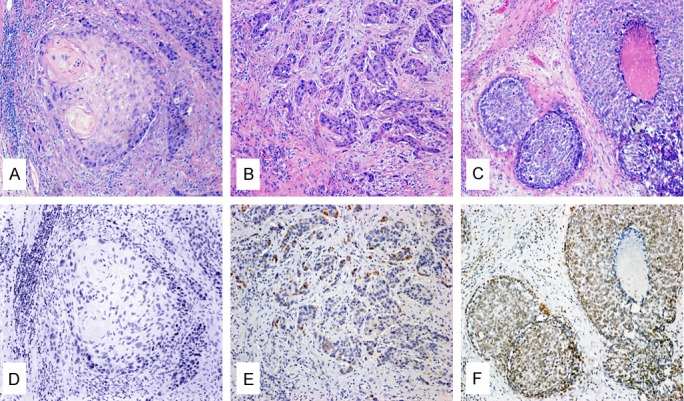
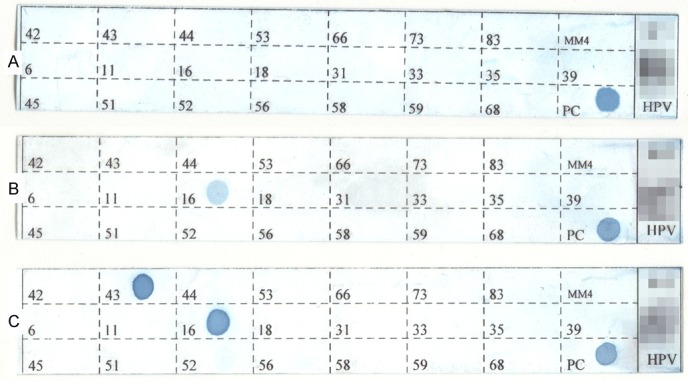
Esophageal squamous cell carcinoma (ESCC) is one of the most common types of tumors worldwide, particularly in China, and human papillomavirus (HPV) is thought to be a potential risk factor for this cancer. To determine whether this is true, we collected 177 formalin-fixed and paraffin-embedded ESCC samples from two hospitals. We screened for 23 different HPV genotypes using a human papillomavirus genotyping kit, which allowed us to amplify the L1 gene by polymerase chain reaction (PCR) and test for 23 HPV subtypes by reverse dot blot (RDB) on a single membrane. We also used immunohistochemistry (IHC) to detect the P16(INK4a) protein, the expression of which is linked to HPV E7 activity and which is used to diagnose cervical intraepithelial neoplasia. The genotyping results showed that only six samples were weakly positive for HPV: two for HPV16, two for HPV11 and two for HPV35, with no samples showing strong positive signals. The IHC results showed only five samples with diffuse positive staining, with the other samples being completely negative or having only focal positive signals, which were considered as negative. This study demonstrates that the HPV infection rate in ESCC samples is very low, suggesting that HPV is not the etiological cause of ESCC.
Keywords: Human papillomavirus; P16INK4a; PCR; RBD; esophageal squamous cell carcinoma.
Figures
Similar articles
-
No evidence of HPV DNA in esophageal squamous cell carcinoma in a population of Southern Brazil.World J Gastroenterol. 2013 Oct 21;19(39):6598-603. doi: 10.3748/wjg.v19.i39.6598. World J Gastroenterol. 2013. PMID: 24151387 Free PMC article.
-
No role for human papillomavirus in esophageal squamous cell carcinoma in China.Int J Cancer. 2010 Jul 1;127(1):93-100. doi: 10.1002/ijc.25023. Int J Cancer. 2010. PMID: 19918949 Free PMC article.
-
Detection of HPV16 in Esophageal Cancer in a High-Incidence Region of Malawi.Int J Mol Sci. 2018 Feb 12;19(2):557. doi: 10.3390/ijms19020557. Int J Mol Sci. 2018. PMID: 29439548 Free PMC article.
-
Detection of human papillomavirus in esophageal and gastroesophageal junction tumors: A retrospective study by real-time polymerase chain reaction in an instutional experience from Turkey and review of literature.Pathol Res Pract. 2016 Feb;212(2):77-82. doi: 10.1016/j.prp.2015.10.007. Epub 2015 Oct 23. Pathol Res Pract. 2016. PMID: 26608416 Review.
-
Human papillomavirus infection in esophageal carcinomas: a study of 121 lesions using multiple broad-spectrum polymerase chain reactions and literature review.Hum Pathol. 1998 Mar;29(3):266-71. doi: 10.1016/s0046-8177(98)90046-6. Hum Pathol. 1998. PMID: 9496830 Review.
Cited by
-
Early esophageal squamous cell carcinoma in a western series is not associated with active HPV infection.Virchows Arch. 2020 Nov;477(5):697-704. doi: 10.1007/s00428-020-02860-2. Epub 2020 Jun 10. Virchows Arch. 2020. PMID: 32524184
-
Abnormal p16 expression and prognostic significance in esophageal squamous cell carcinoma.Histol Histopathol. 2024 Feb;39(2):201-209. doi: 10.14670/HH-18-619. Epub 2023 Apr 12. Histol Histopathol. 2024. PMID: 37132443
-
Human papillomavirus and gastrointestinal cancer: A review.World J Gastroenterol. 2016 Sep 7;22(33):7415-30. doi: 10.3748/wjg.v22.i33.7415. World J Gastroenterol. 2016. PMID: 27672265 Free PMC article. Review.
-
HIPK3 Promotes Growth and Metastasis of Esophageal Squamous Cell Carcinoma via Regulation of miR-599/c-MYC Axis.Onco Targets Ther. 2020 Mar 6;13:1967-1978. doi: 10.2147/OTT.S217087. eCollection 2020. Onco Targets Ther. 2020. PMID: 32189968 Free PMC article.
-
Synergistic Carcinogenesis of HPV18 and MNNG in Het-1A Cells through p62-KEAP1-NRF2 and PI3K/AKT/mTOR Pathway.Oxid Med Cell Longev. 2020 Oct 9;2020:6352876. doi: 10.1155/2020/6352876. eCollection 2020. Oxid Med Cell Longev. 2020. PMID: 33123313 Free PMC article.
References
-
- Jemal A, Bray F, Center MM, Ferlay J, Ward E, Forman D. Global cancer statistics. CA Cancer J Clin. 2011;61:69–90. - PubMed
-
- Wu M, Liu AM, Kampman E, Zhang ZF, Van’T VP, Wu DL, Wang PH, Yang J, Qin Y, Mu LN, Kok FJ, Zhao JK. Green tea drinking, high tea temperature and esophageal cancer in high- and low-risk areas of Jiangsu Province, China: a population-based case-control study. Int J Cancer. 2009;124:1907–1913. - PubMed
-
- Syrjanen KJ. Histological changes identical to those of condylomatous lesions found in esophageal squamous cell carcinomas. Arch Geschwulstforsch. 1982;52:283–292. - PubMed
Publication types
MeSH terms
Substances
LinkOut - more resources
Full Text Sources
Medical