Review
. 2015 Jan;8(1):52-64.
doi: 10.1111/1751-7915.12146. Epub 2014 Aug 13.

Synthetic biology approaches to improve biocatalyst identification in metagenomic library screening

Affiliations
Review

Synthetic biology approaches to improve biocatalyst identification in metagenomic library screening

María-Eugenia Guazzaroni et al. Microb Biotechnol. 2015 Jan.

Abstract

There is a growing demand for enzymes with improved catalytic performance or tolerance to process-specific parameters, and biotechnology plays a crucial role in the development of biocatalysts for use in industry, agriculture, medicine and energy generation. Metagenomics takes advantage of the wealth of genetic and biochemical diversity present in the genomes of microorganisms found in environmental samples, and provides a set of new technologies directed towards screening for new catalytic activities from environmental samples with potential biotechnology applications. However, biased and low level of expression of heterologous proteins in Escherichia coli together with the use of non-optimal cloning vectors for the construction of metagenomic libraries generally results in an extremely low success rate for enzyme identification. The bottleneck arising from inefficient screening of enzymatic activities has been addressed from several perspectives; however, the limitations related to biased expression in heterologous hosts cannot be overcome by using a single approach, but rather requires the synergetic implementation of multiple methodologies. Here, we review some of the principal constraints regarding the discovery of new enzymes in metagenomic libraries and discuss how these might be resolved by using synthetic biology methods.


Figures

Fig 1
Fig 1
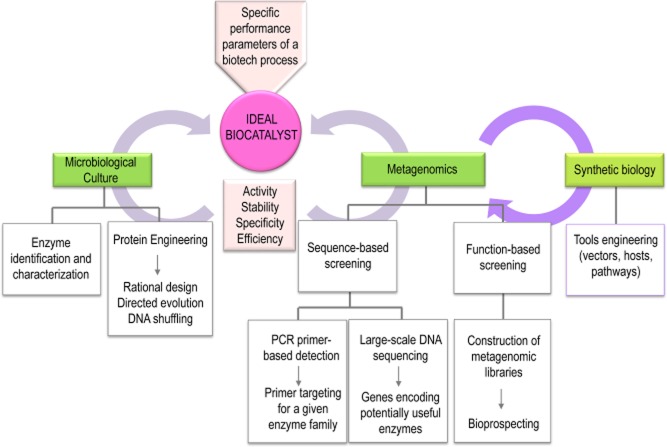
Overall diagram for the identification strategy of an ideal biocatalyst. The identification of enzymes from cultured microorganisms and metagenomics are the two principal approaches currently employed for recovering of genes encoding the desired enzymatic activity for industrial processes. The genes encoding enzymes identified from cultured microorganisms may be cloned and expressed, and parameters such as activity, stability, specificity and efficiency improved using protein rational design and in vitro evolution techniques. Metagenomics strategies are based on either activity-based approaches, which involve the construction of expression libraries and its posterior activity screening, or sequence-based approaches. Sequence-based approaches involve either the design of DNA primers for conserved regions of known protein families or data mining of genes encoding potential biocatalysts identified in sequences from next generation sequencing projects. Synthetic biology can provide solutions to the current limitations in activity-based metagenomic approaches. Development of methods for the engineering of new bacterial hosts and molecular biology tools promise to increase the efficiency of discovery of biotechnologically relevant enzymes.
Fig 2
Fig 2
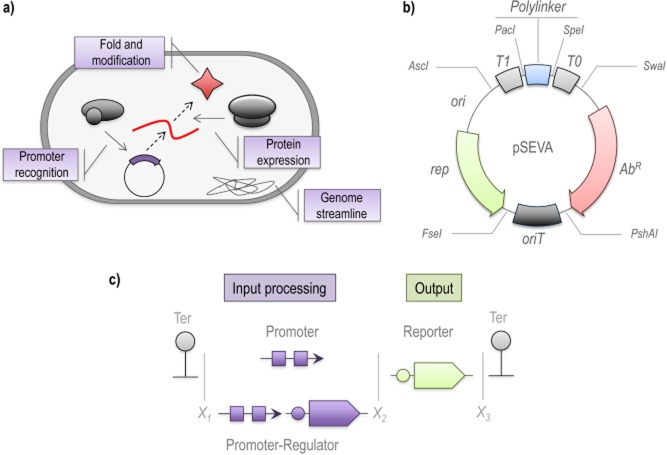
Synthetic Biology may overcome limiting steps in activity-based metagenomic library screening. Current bottlenecks in functional metagenomics are related to (A) limitations in the host capabilities, (B) the performance of the genetic tools and (C) the availability of efficient screening methods.A. In the case of the host, critical steps related to the recognition of transcriptional and translational signals, as well as the folding and modification of the expressed enzyme need to be enhanced. Host performance might be improved by reducing the metabolic burden related to the expression of unnecessary genes.B. The use of semi-synthetic, high-efficiency genetic tools is essential for the construction of metagenomic libraries that can be maintained and screened in a wide number of microorganisms. The example shows the pSEVA bacterial vector, which is endowed with several functional features such as terminators, origin for transfer and an extensive polylinker optimized for use in several bacterial hosts.C. Genetic circuits constructed by combining input modules (e.g. promoters and regulators) and output devices (such as reporter proteins) assembled with a standard format that uses the same sets of restriction enzymes (represented by X1, X2, etc.). Such circuits facilitate the screening of enzymatic activities in metagenomic libraries. The standardization of the assembly process facilitates the combination of several independent modules to construct sophisticated activity-trigged biosensors.

References

    1. Alcaide M, Tornes J, Stogios PJ, Xu X, Gertler C, Di Leo R, et al. Single residues dictate the co-evolution of dual esterases: MCP hydrolases from the alpha/beta hydrolase family. Biochem J. 2013;454:157–166. - PubMed
    1. Andrianantoandro E, Basu S, Karig DK. Weiss R. Synthetic biology: new engineering rules for an emerging discipline. Mol Syst Biol. 2006;2 2006. 0028. - PMC - PubMed
    1. Arkin A. Setting the standard in synthetic biology. Nat Biotechnol. 2008;26:771–774. - PubMed
    1. Aurilia V, Parracino A. D'Auria S. Microbial carbohydrate esterases in cold adapted environments. Gene. 2008;410:234–240. - PubMed
    1. Bartossek R, Nicol GW, Lanzen A, Klenk HP. Schleper C. Homologues of nitrite reductases in ammonia-oxidizing archaea: diversity and genomic context. Environ Microbiol. 2010;12:1075–1088. - PubMed

Publication types

LinkOut - more resources