Randomized Controlled Trial
. 2015 Mar;172(3):760-8.
doi: 10.1111/bjd.13350. Epub 2015 Feb 5.

A multicentre randomized trial of the treatment of patients with pemphigus vulgaris with infliximab and prednisone compared with prednisone alone

Affiliations
Randomized Controlled Trial

A multicentre randomized trial of the treatment of patients with pemphigus vulgaris with infliximab and prednisone compared with prednisone alone

R P Hall 3rd et al. Br J Dermatol. 2015 Mar.

Abstract

Background: Pemphigus vulgaris (PV) is a blistering disease and tumour necrosis factor-α has a role in its pathogenesis.

Objectives: To evaluate the safety of infliximab (IFX) with prednisone compared with prednisone alone in the treatment of PV. In addition, treatment response was assessed and mechanistic studies were performed.

Methods: Subjects with PV who had ongoing disease activity while being maintained on prednisone were randomized to receive either IFX or placebo in addition to prednisone. Response status and immunoglobulin (Ig) G anti-desmoglein (Dsg)1 and Dsg3 antibodies were assessed at 18 and 26 weeks.

Results: Ten subjects were randomized to each group. There were no safety signals during the course of the study. At week 18, one subject in each group had responded. At week 26, three IFX-treated subjects vs. none in the placebo group had responded (P = 0·21). At weeks 18 and 26, the median IgG anti-Dsg1 and anti-Dsg3 levels were lower in the IFX-treated patients [IgG anti-Dsg-1 (week 18, P = 0·035; week 26, P = 0·022); IgG anti-Dsg3 (week 18, P = 0·035; week, 26 P = 0·05)].

Conclusions: This study is limited by the relatively small sample size. There was no significant difference between study arms in the proportion of subjects with treatment-related adverse events > grade 3. IFX therapy was not shown to be effective for the treatment of patients with PV in this randomized, placebo-controlled trial, although IFX treatment may be associated with a decrease in anti-Dsg1 and Dsg3 antibodies.

Trial registration: ClinicalTrials.gov NCT00283712.


Conflict of interest statement

Conflicts of interest: None declared

Figures
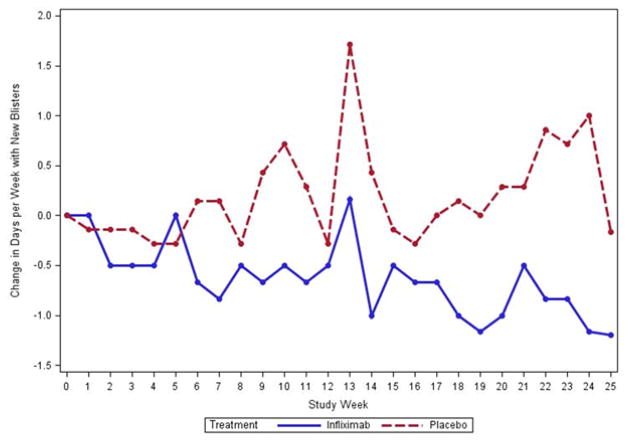
Figure 1
Figure 1
Change in the number of days per week with new blisters in subjects treated with infliximab compared to placebo. Subjects in the per-protocol group treated with infliximab exhibited a decrease in the number of new blisters per week during the study whereas subjects treated with placebo showed an increase in the number of new blisters per week. (p= 0.037)
Figure 2
Figure 2
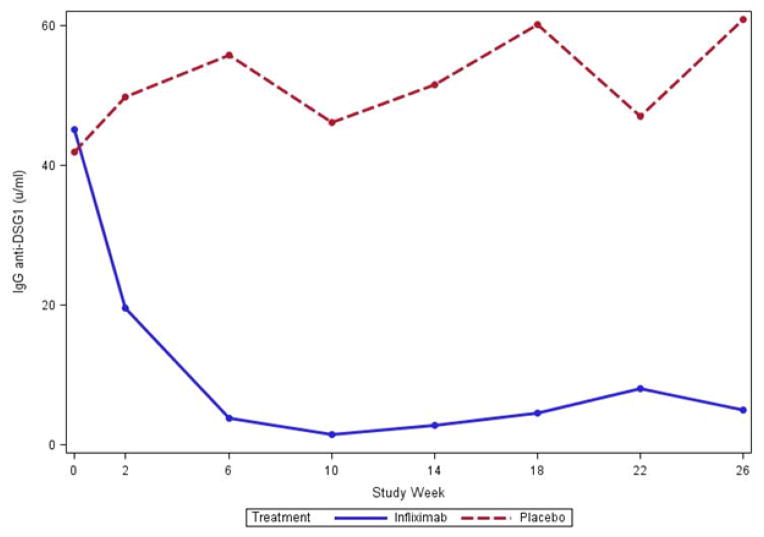
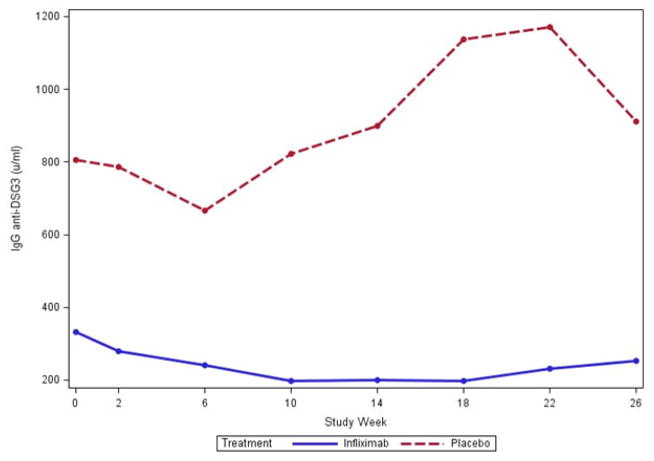
IgG anti – desmoglein 1(A) and anti –desmoglein 3 (B) values. Median IgG anti- DSG1 (A) levels in the per-protocol population were lower in subjects treated with infliximab (N = 6) when compared to subjects treated with placebo (N=7) (week 0 = NS; week 26, p = 0.022). Median IgG anti DSG3 (B) levels were also lower at week 0 and week 26 in infliximab treated subjects (week 0 = NS; Week 26 p = 0.051).
Figure 2
Figure 2
IgG anti – desmoglein 1(A) and anti –desmoglein 3 (B) values. Median IgG anti- DSG1 (A) levels in the per-protocol population were lower in subjects treated with infliximab (N = 6) when compared to subjects treated with placebo (N=7) (week 0 = NS; week 26, p = 0.022). Median IgG anti DSG3 (B) levels were also lower at week 0 and week 26 in infliximab treated subjects (week 0 = NS; Week 26 p = 0.051).
Figure 3
Figure 3
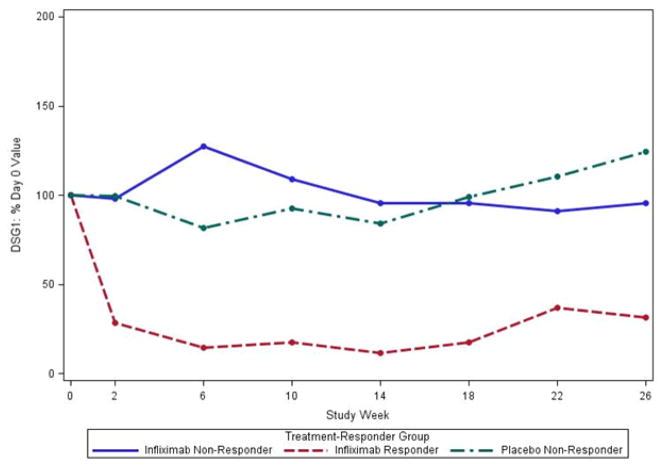
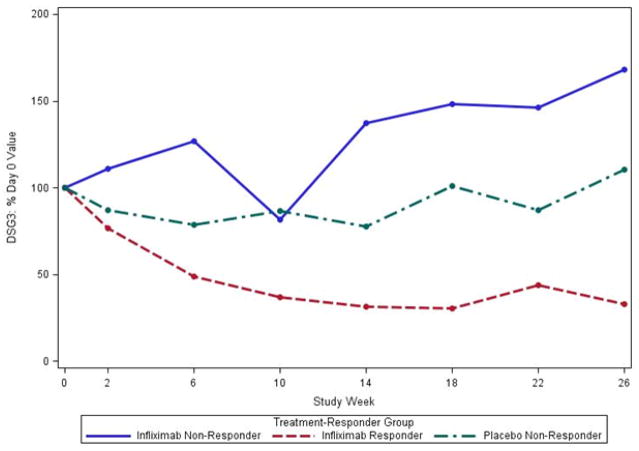
Median % change in IgG anti-DSG1 (A) and IgG anti –DSG3 (B) levels compared to baseline in the per-protocol population. IgG anti-DSG1 (A) levels at week 26 were decreased in the 3 subjects treated with infliximab that met responder criteria compared to the 3 non-responders treated with infliximab and to placebo treated subjects (N=7). IgG anti-DSG3 (B) levels also decreased in the 3 subjects treated with infliximab that met responder status but increased in infliximab treated non-responders (N=3) and showed little change in placebo treated subjects (N=7).
Figure 3
Figure 3
Median % change in IgG anti-DSG1 (A) and IgG anti –DSG3 (B) levels compared to baseline in the per-protocol population. IgG anti-DSG1 (A) levels at week 26 were decreased in the 3 subjects treated with infliximab that met responder criteria compared to the 3 non-responders treated with infliximab and to placebo treated subjects (N=7). IgG anti-DSG3 (B) levels also decreased in the 3 subjects treated with infliximab that met responder status but increased in infliximab treated non-responders (N=3) and showed little change in placebo treated subjects (N=7).
Figure 4
Figure 4
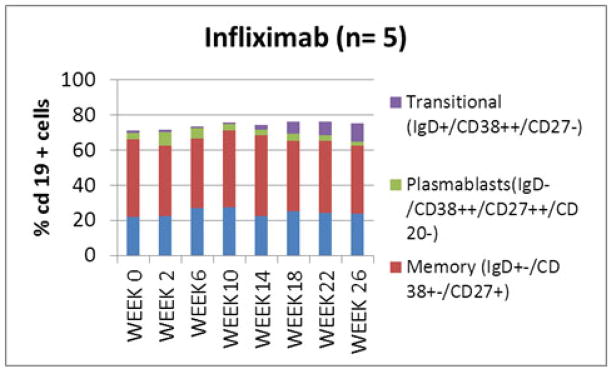
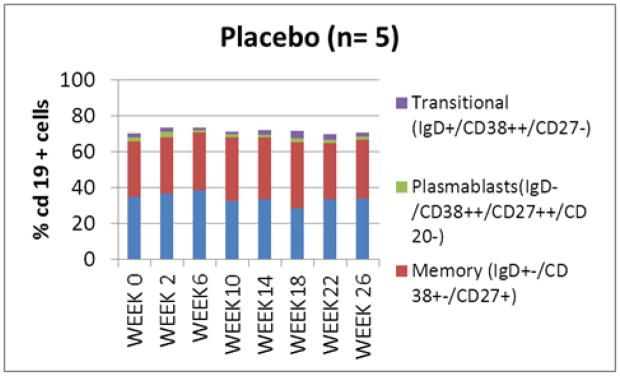
B (CD19+) cell subpopulations in subjects treated with infliximab(A) and placebo (B). No significant difference in B cell subpopulations between the study groups was seen at week 0. An increase in proportion of transitional (IgD+/CD38++/CD27−) cells was noted in the infliximab treated subjects at week 26.
Figure 4
Figure 4
B (CD19+) cell subpopulations in subjects treated with infliximab(A) and placebo (B). No significant difference in B cell subpopulations between the study groups was seen at week 0. An increase in proportion of transitional (IgD+/CD38++/CD27−) cells was noted in the infliximab treated subjects at week 26.
Figure 5
Figure 5
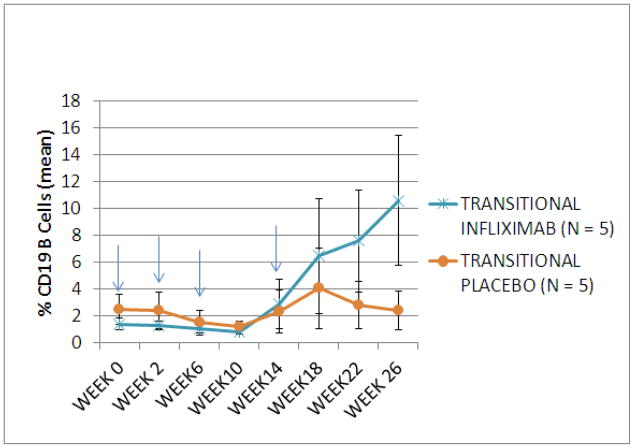
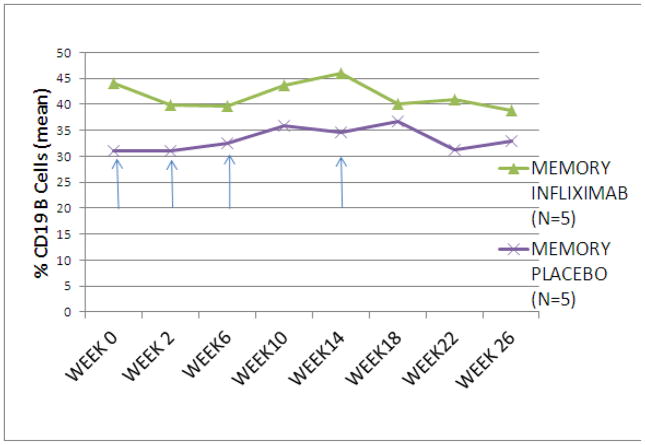
Proportion of transitional (IgD+/CD38++/CD27−) and memory (IgD+/CD38+-/CD27+) B cells in subjects treated with infliximab or placebo. Subjects treated with infliximab showed an increase in transitional B cells from week 18 thru week 26 compared to those treated with placebo (mean +/− SEM) (A). No change was seen in the mean proportion of memory B cells (B) during the study. Arrows signify infliximab or placebo infusion.
Figure 5
Figure 5
Proportion of transitional (IgD+/CD38++/CD27−) and memory (IgD+/CD38+-/CD27+) B cells in subjects treated with infliximab or placebo. Subjects treated with infliximab showed an increase in transitional B cells from week 18 thru week 26 compared to those treated with placebo (mean +/− SEM) (A). No change was seen in the mean proportion of memory B cells (B) during the study. Arrows signify infliximab or placebo infusion.

Comment in

References

    1. Risser J, Lewis K, Weinstock MA. Mortality of bullous skin disorders from 1979 through 2002 in the United States. Archives Dermatology. 2009;145(9):1005–1008. - PubMed
    1. Langan SM, Smeeth L, Hubbard R, Fleming K, Smith C, West J. Incidence and mortality of bullous pemphigoid and pemphigus vulgaris in the UK. Br Med J. 2008;337:a180. doi:10:1136bmja180. - PMC - PubMed
    1. Martin LK, Werth VP, Villaneuva EV, et al. A systematic review of randomized controlled trials for pemphigus vulgaris and pemphigus foliaceus. JAAD. 2011;64:903–8. - PMC - PubMed
    1. Pardo J, Mercader P, Mahiques L, et al. Infliximab in the management of severe pemphigus vulgaris. BJD. 2005;153:222–3. - PubMed
    1. Jacobi A, Schuler G, Hertl M. Rapid control of therapy-refractory pemphigus vulgaris by treatment with the tumour necrosis factor-alpha inhibitor infliximab. BJD. 2005;153:448–9. - PubMed

Publication types

Associated data