Review
. 2014 Aug 13;6(8):2393-423.
doi: 10.3390/toxins6082393.

Molecular approaches to improve the insecticidal activity of Bacillus thuringiensis Cry toxins

Affiliations
Review

Molecular approaches to improve the insecticidal activity of Bacillus thuringiensis Cry toxins

Wagner A Lucena et al. Toxins (Basel). .

Abstract

Bacillus thuringiensis (Bt) is a gram-positive spore-forming soil bacterium that is distributed worldwide. Originally recognized as a pathogen of the silkworm, several strains were found on epizootic events in insect pests. In the 1960s, Bt began to be successfully used to control insect pests in agriculture, particularly because of its specificity, which reflects directly on their lack of cytotoxicity to human health, non-target organisms and the environment. Since the introduction of transgenic plants expressing Bt genes in the mid-1980s, numerous methodologies have been used to search for and improve toxins derived from native Bt strains. These improvements directly influence the increase in productivity and the decreased use of chemical insecticides on Bt-crops. Recently, DNA shuffling and in silico evaluations are emerging as promising tools for the development and exploration of mutant Bt toxins with enhanced activity against target insect pests. In this report, we describe natural and in vitro evolution of Cry toxins, as well as their relevance in the mechanism of action for insect control. Moreover, the use of DNA shuffling to improve two Bt toxins will be discussed together with in silico analyses of the generated mutations to evaluate their potential effect on protein structure and cytotoxicity.


Figures
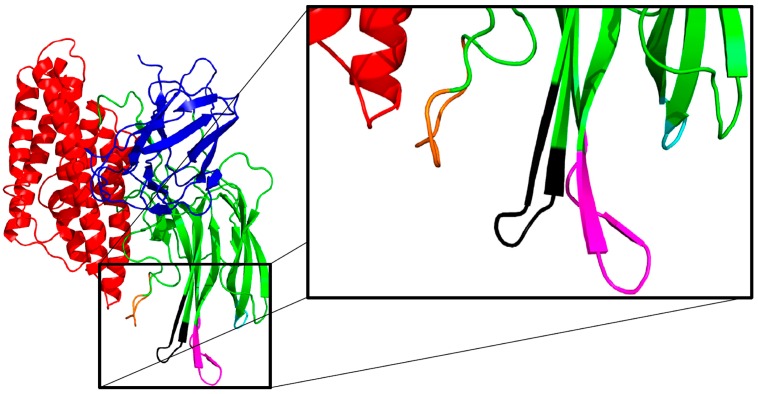
Figure 1
Figure 1
Structure of an activated Cry1Ab toxin. The three Domains are colored as follows: Domain I (red), Domain II (green), and Domain III (blue). Loop 1 is shown in cyan, loop 2 is shown in magenta, loop 3 is shown in black and loop α8 is shown in orange.
Figure 2
Figure 2
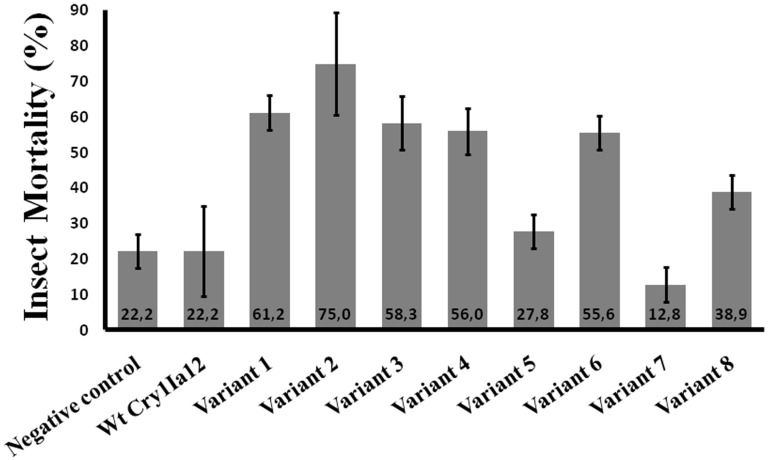
Mortality of T. l. licus following ingestion of Cry1Ia12 toxin and its variants (3 µg each). The results represent insect mortality after 5 days of a diet containing each of the respective proteins.
Figure 3
Figure 3
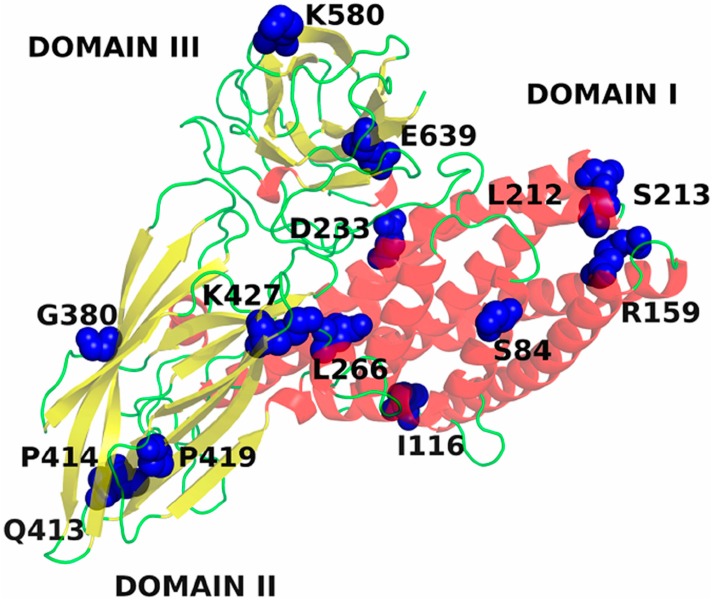
Tertiary structure of Cry1Ia12. α-Helices colored red correspond to Domain I of the toxin. β-Sheets colored yellow color correspond to Domains II and III. Blue spheres represent the mutated residues from DNA shuffling involved in binding to receptors.
Figure 4
Figure 4
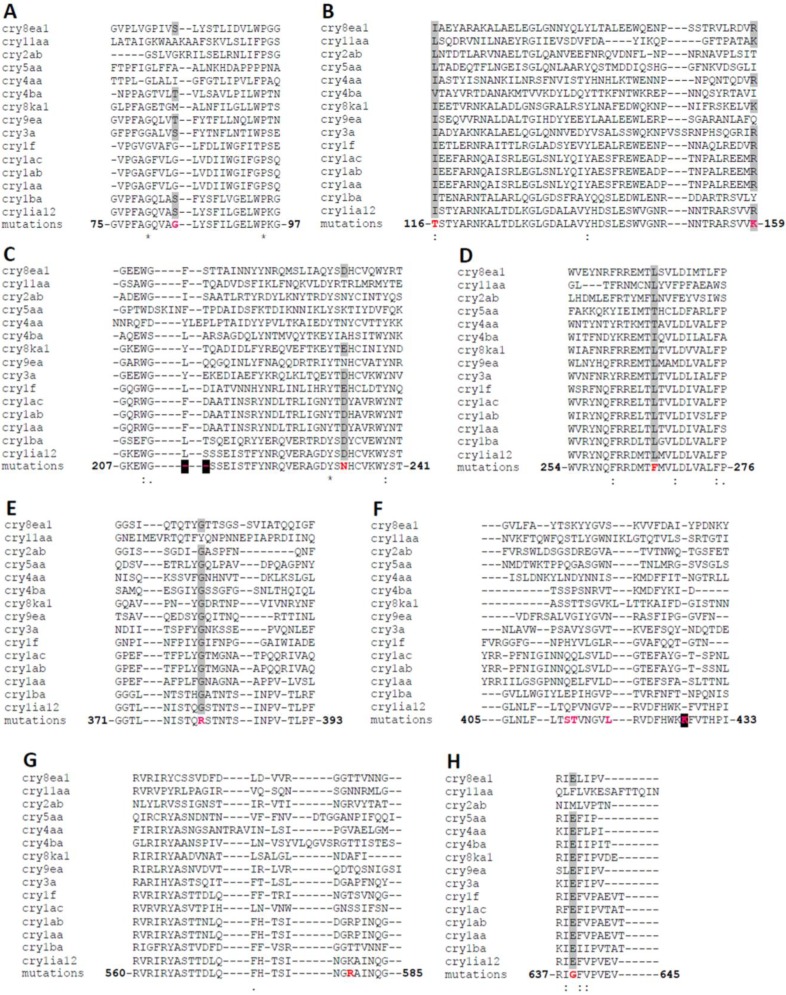
Alignment of 15 Cry toxins: Cry1Aa (AAP40639.1), Cry1Ab (AEV45790.1), Cry1Ac (ACC86135.1), Cry1Ia12 (ADB02877.1), Cry1F (ACD50893.1), Cry1Ba (AAK63251.1), Cry11Aa (YP_001573776.1), Cry8Ea1 (AAQ73470.1), Cry8Ka1 (ACQ99188.1), Cry3A (ABY49136.1), Cry9Ea (ADE60738.1), Cry2Ab (ACC86136.1), Cry4Aa (YP_001573833.1), Cry4Ba (YP_001573790.1) and Cry5Aa (Q45760.1). Polarity conserved residues in mutation regions are highlighted in gray, and residues mutated by DNA shuffling in Cry1Ia12 are depicted in bold red [13] and bold magenta (unpublished results). Deletions or additions of residues are further highlighted in black. Inserts A, B C, D, E, F, G and H correspond to different regions in the alignment.
Figure 5
Figure 5
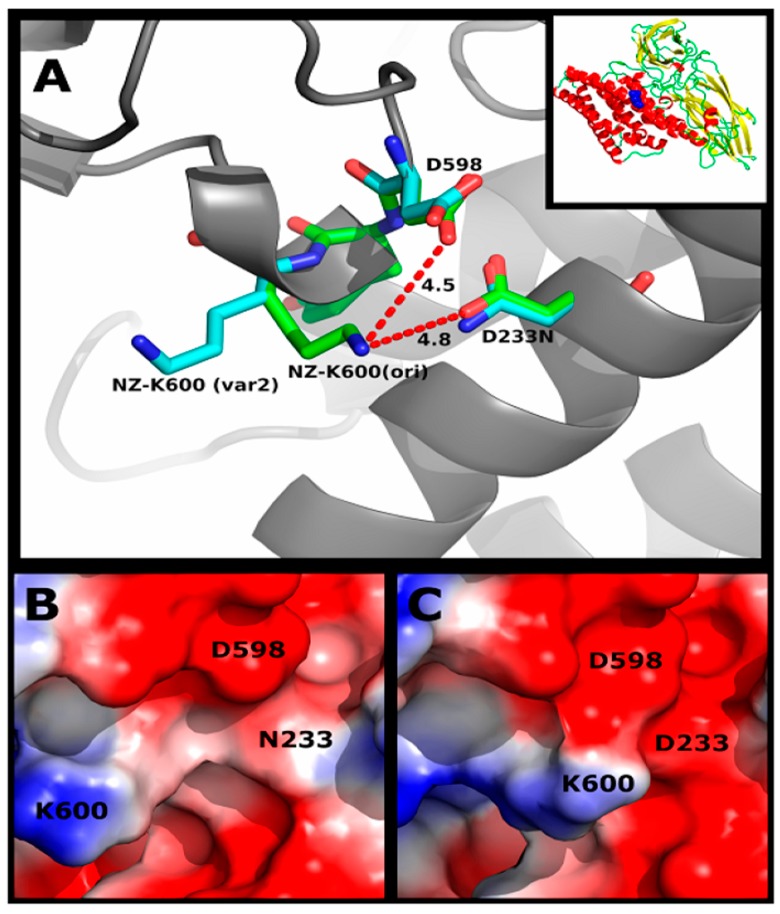
Detailed view of D233 from variant 2. (A) Distance between the NZ atom of K600 and OD2 of D233 (4.8 Å) in wild-type Cry1Ia12; (B) ABPS-SEP of wild-type Cry1Ia12 depicting the proximity between K600, D598 and D233; (C) ABPS-SEP of variant 2 depicting the displacement of K600 from the salt bridge interaction with N233 and D598. The inset in the upper right corner represents the entire Cry1Ia12 structure.
Figure 6
Figure 6
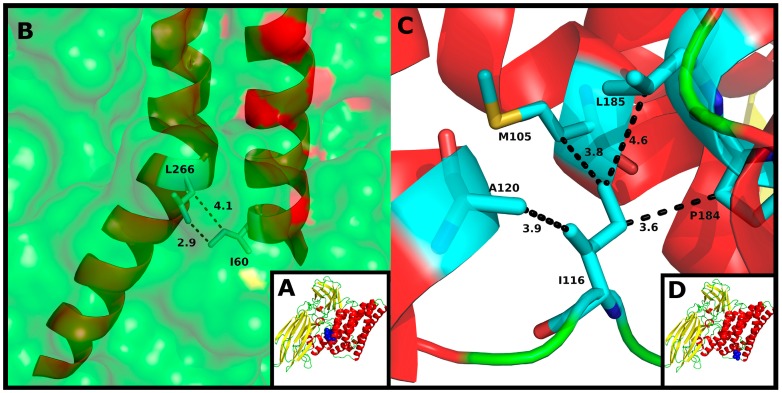
(A) Tertiary structure of Cry1Ia12. Domain I is colored red, whereas Domains II and III are colored yellow; (B) Detailed view of the interaction between L266 within the toxin and I60 in helix α-1. Distances are shown as dashed lines and are measured in angstroms (Å). α-Helix secondary structure is represented in red, and the protein surface is represented in green; (C) Detailed view of I116 interactions with the hydrophobic residues M105, A120, P184 and L185 in Domain I. Distances are shown as dashed lines and measured in angstroms (Å). α-Helices are colored red, and loops are colored green; (D) Tertiary structure of Cry1Ia12. Domain I is colored red, whereas Domains II and III are colored yellow.
Figure 7
Figure 7
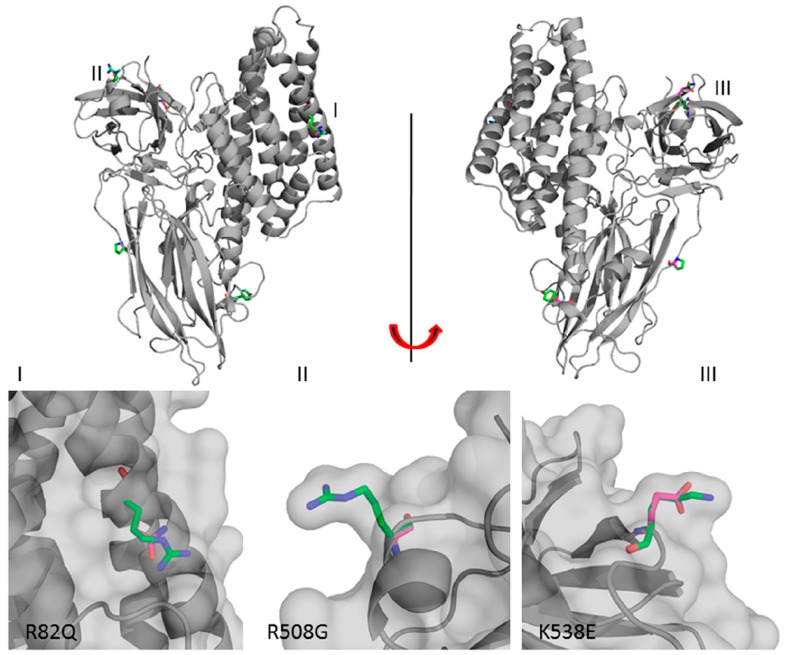
The tertiary structure of Cry8Ka5. Roman numbers indicate the Domains of the Cry toxin. Mutated residues (R82Q, R508G, and K538E) observed in the three Domains are shown in a detailed view.

References

    1. Gilliand A., Chambers C., Bones E., Ellar D. Role of Bacillus thuringiensis Cry1 d-endotoxin binding in determining potency during Lepidopteran Larval development. Appl. Environ. Microbiol. 2002;68:1509–1515. doi: 10.1128/AEM.68.4.1509-1515.2002. - DOI - PMC - PubMed
    1. Zhang X., Candas M., Griko N.B., Taussig R., Bulla L.A., Jr. A mechanism of cell death involving an adenylyl cyclase/PKA signaling pathway is induced by the Cry1Ab toxin of Bacillus thuringiensis. Proc. Natl. Acad. Sci. USA. 2006;103:9897–9902. - PMC - PubMed
    1. Bravo A., Gill S., Soberón M. Mode of action of Bacillus thuringiensis Cry and Cyt and their potential for insect control. Toxicon. 2007;49:423–435. doi: 10.1016/j.toxicon.2006.11.022. - DOI - PMC - PubMed
    1. Li J., Carroll J., Ellar D. Crystal structure of insecticidal d-endotoxin from Bacillus thuringiensis at 2.5A resolution. Nature (London) 1991;353:815–821. doi: 10.1038/353815a0. - DOI - PubMed
    1. Grochulski P., Masson L., Borisova S., Pusztai-Carey M., Schwartz J. Cry1A(a) insecticidal toxin: crystal structure and channel formation. J. Mol. Biol. 1995;254:447–464. doi: 10.1006/jmbi.1995.0630. - DOI - PubMed

Publication types

MeSH terms