


Randomized controlled trial of Qigong/Tai Chi Easy on cancer-related fatigue in breast cancer survivors
- PMID: 25124456
- PMCID: PMC4329282
- DOI: 10.1007/s12160-014-9645-4
Randomized controlled trial of Qigong/Tai Chi Easy on cancer-related fatigue in breast cancer survivors
Abstract
Background: Many breast cancer survivors experience fatigue, mood, and sleep disturbances.
Purpose: This study aims to compare a meditative movement practice, Qigong/Tai Chi Easy (QG/TCE) with sham Qigong (SQG), testing effects of meditation/breath aspects of QG/TCE on breast cancer survivors' persistent fatigue and other symptoms.
Methods: This double-blind, randomized controlled trial tested 12 weeks of QG/TCE versus SQG on fatigue, depression, and sleep among 87 postmenopausal, fatigued breast cancer survivors, stages 0-III, age 40-75.
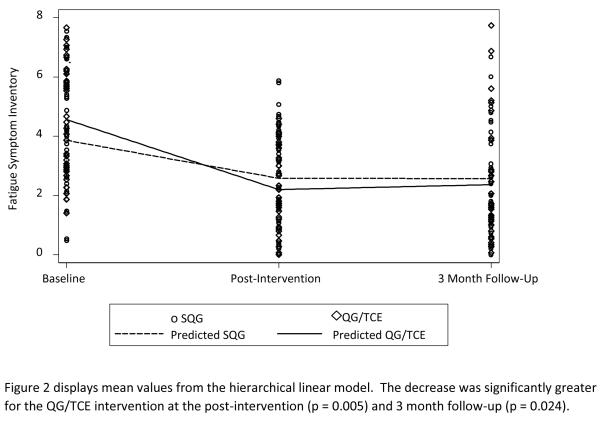
Results: Fatigue decreased significantly in the QG/TCE group compared to control at post-intervention (p = 0.005) and 3 months follow-up (p = 0.024), but not depression and sleep quality. Improvement occurred over time for both interventions in depression and sleep quality (all p < 0.05).
Conclusions: QG/TCE showed significant improvement over time compared to SQG for fatigue, but not depression or sleep. Both QG/TCE and SQG showed improvement for two prevalent symptoms among breast cancer survivors, depression and sleep dysfunction.
Figures

Comment in
-
Advancing the science of mind-body interventions: a comment on Larkey et al.Ann Behav Med. 2015 Apr;49(2):149-50. doi: 10.1007/s12160-014-9652-5. Ann Behav Med. 2015. PMID: 25228455 Free PMC article. No abstract available.
References
-
- Schmidt ME, Chang-Claude J, Vrieling A, Heinz J, Flesch-Janys D, Steindorf K. Fatigue and quality of life in breast cancer survivors: temporal courses and long-term pattern. Journal of Cancer Survivorship. 2012;6(1):11–19. - PubMed
-
- Harrington CB, Hansen JA, Moskowitz M, Todd BL, Feuerstein M. It's not over when it's over: Long-term symptoms in cancer survivors—a systematic review. The International Journal of Psychiatry in Medicine. 2010;40(2):163–181. - PubMed
-
- Cavalli Kluthcovsky A, Urbanetz A, Carvalho D, Pereira Maluf E, Schlickmann Sylvestre G, Bonatto Hatschbach S. Fatigue after treatment in breast cancer survivors: Prevalence, determinants and impact on health-related quality of life. Supportive care in cancer. 2012;20(8):1901. - PubMed
-
- Noal S, Levy C, Hardouin A, et al. One-year longitudinal study of fatigue, cognitive functions, and quality of life after adjuvant radiotherapy for breast cancer. International Journal of Radiation Oncology* Biology* Physics. 2011;81(3):795–803. - PubMed
Publication types
MeSH terms
Grants and funding
LinkOut - more resources
Full Text Sources
Other Literature Sources
Medical
