


Hedonic tone is associated with left supero-lateral medial forebrain bundle microstructure
- PMID: 25124530
- PMCID: PMC4413785
- DOI: 10.1017/S0033291714001949
Hedonic tone is associated with left supero-lateral medial forebrain bundle microstructure
Abstract
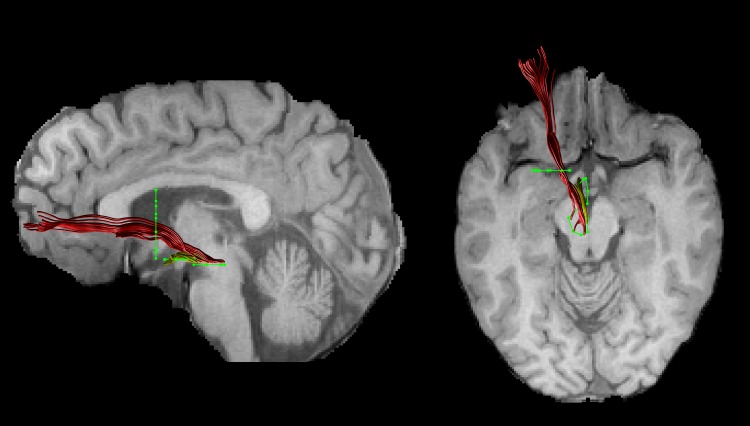
Background: The medial forebrain bundle (MFB) is an important pathway of the reward system. Two branches have been described using diffusion magnetic resonance imaging (MRI)-based tractography: the infero-medial MFB (imMFB) and the supero-lateral MFB (slMFB). Previous studies point to white-matter microstructural alterations of the slMFB in major depressive disorder (MDD) during acute episodes. To extend this finding, this study investigates whether white-matter microstructure is also altered in MDD patients that are in remission. Further, we explore associations between diffusion MRI-based metrics of white-matter microstructure of imMFB, slMFB and hedonic tone, the ability to derive pleasure.
Method: Eighteen remitted depressed (RD) and 22 never depressed (ND) participants underwent high angular resolution diffusion-weighted imaging (HARDI) scans. To reconstruct the two pathways of the MFB (imMFB and slMFB) we used the damped Richardson-Lucy (dRL) algorithm. Mean fractional anisotropy (FA) was sampled along the tracts.
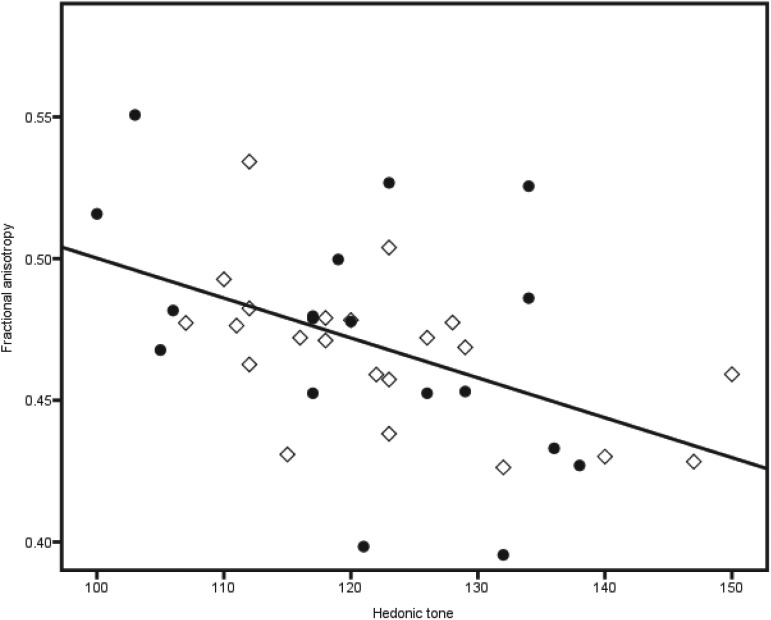
Results: Mean FA of imMFB, slMFB and a comparison tract (the middle cerebellar peduncle) did not differ between ND and RD participants. Hedonic capacity correlated negatively with mean FA of the left slMFB, explaining 21% of the variance.
Conclusions: Diffusion MRI-based metrics of white-matter microstructure of the MFB in RD do not differ from ND. Hedonic capacity is associated with altered white-matter microstructure of the slMFB.
Keywords: white matter.
Figures
References
-
- Bae JN, MacFall JR, Krishnan KR, Payne ME, Steffens DC, Taylor WD (2006). Dorsolateral prefrontal cortex and anterior cingulate cortex white matter alterations in late-life depression. Biological Psychiatry 60, 1356–1363. - PubMed
-
- Basser PJ, Mattiello J, LeBihan D (1994). Estimation of the effective self-diffusion tensor from the NMR spin echo. Journal of Magnetic Resonance. Series B 103, 247–254. - PubMed
-
- Basser PJ, Pierpaoli C (1996). Microstructural and physiological features of tissues elucidated by quantitative-diffusion-tensor MRI. Journal of Magnetic Resonance. Series B 111, 209–219. - PubMed
-
- Beck AT, Steer RA, Brown GK (1996). Beck Depression Inventory, 2nd edn, vol. 4, pp. 561–571 Psychological Corporation: San Antonio, T.
-
- Bewernick BH, Hurlemann R, Matusch A, Kayser S, Grubert C, Hadrysiewicz B, Axmacher N, Lemke M, Cooper-Mahkorn D, Cohen MX, Brockmann H, Lenartz D, Sturm V, Schlaepfer TE (2010). Nucleus accumbens deep brain stimulation decreases ratings of depression and anxiety in treatment-resistant depression. Biological Psychiatry 67, 110–116. - PubMed
Publication types
MeSH terms
Grants and funding
LinkOut - more resources
Full Text Sources
Other Literature Sources
Miscellaneous
