. 2014 Oct;51(10):659-68.
doi: 10.1136/jmedgenet-2014-102573. Epub 2014 Aug 14.

Genetic heterogeneity in Cornelia de Lange syndrome (CdLS) and CdLS-like phenotypes with observed and predicted levels of mosaicism

Morad Ansari  1 Gemma Poke  1 Quentin Ferry  2 Kathleen Williamson  1 Roland Aldridge  1 Alison M Meynert  1 Hemant Bengani  1 Cheng Yee Chan  1 Hülya Kayserili  3 Sahin Avci  3 Raoul C M Hennekam  4 Anne K Lampe  5 Egbert Redeker  4 Tessa Homfray  6 Alison Ross  7 Marie Falkenberg Smeland  8 Sahar Mansour  6 Michael J Parker  9 Jacqueline A Cook  9 Miranda Splitt  10 Richard B Fisher  10 Alan Fryer  11 Alex C Magee  12 Andrew Wilkie  13 Angela Barnicoat  14 Angela F Brady  15 Nicola S Cooper  16 Catherine Mercer  17 Charu Deshpande  18 Christopher P Bennett  19 Daniela T Pilz  20 Deborah Ruddy  18 Deirdre Cilliers  21 Diana S Johnson  9 Dragana Josifova  18 Elisabeth Rosser  14 Elizabeth M Thompson  22 Emma Wakeling  15 Esther Kinning  23 Fiona Stewart  12 Frances Flinter  18 Katta M Girisha  24 Helen Cox  16 Helen V Firth  25 Helen Kingston  26 Jamie S Wee  27 Jane A Hurst  14 Jill Clayton-Smith  26 John Tolmie  23 Julie Vogt  16 Katrina Tatton-Brown  6 Kate Chandler  26 Katrina Prescott  19 Louise Wilson  14 Mahdiyeh Behnam  28 Meriel McEntagart  6 Rosemarie Davidson  23 Sally-Ann Lynch  29 Sanjay Sisodiya  30 Sarju G Mehta  25 Shane A McKee  12 Shehla Mohammed  18 Simon Holden  25 Soo-Mi Park  25 Susan E Holder  15 Victoria Harrison  17 Vivienne McConnell  12 Wayne K Lam  5 Andrew J Green  31 Dian Donnai  26 Maria Bitner-Glindzicz  32 Deirdre E Donnelly  12 Christoffer Nellåker  33 Martin S Taylor  1 David R FitzPatrick  1
Affiliations
Free PMC article

Genetic heterogeneity in Cornelia de Lange syndrome (CdLS) and CdLS-like phenotypes with observed and predicted levels of mosaicism

Morad Ansari et al. J Med Genet. 2014 Oct.
Free PMC article

Abstract

Background: Cornelia de Lange syndrome (CdLS) is a multisystem disorder with distinctive facial appearance, intellectual disability and growth failure as prominent features. Most individuals with typical CdLS have de novo heterozygous loss-of-function mutations in NIPBL with mosaic individuals representing a significant proportion. Mutations in other cohesin components, SMC1A, SMC3, HDAC8 and RAD21 cause less typical CdLS.

Methods: We screened 163 affected individuals for coding region mutations in the known genes, 90 for genomic rearrangements, 19 for deep intronic variants in NIPBL and 5 had whole-exome sequencing.

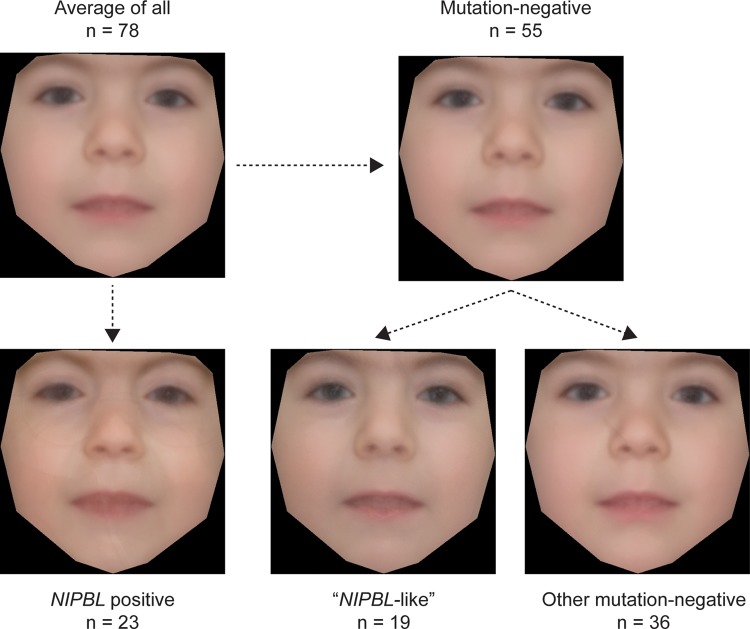
Results: Pathogenic mutations [including mosaic changes] were identified in: NIPBL 46 [3] (28.2%); SMC1A 5 [1] (3.1%); SMC3 5 [1] (3.1%); HDAC8 6 [0] (3.6%) and RAD21 1 [0] (0.6%). One individual had a de novo 1.3 Mb deletion of 1p36.3. Another had a 520 kb duplication of 12q13.13 encompassing ESPL1, encoding separase, an enzyme that cleaves the cohesin ring. Three de novo mutations were identified in ANKRD11 demonstrating a phenotypic overlap with KBG syndrome. To estimate the number of undetected mosaic cases we used recursive partitioning to identify discriminating features in the NIPBL-positive subgroup. Filtering of the mutation-negative group on these features classified at least 18% as 'NIPBL-like'. A computer composition of the average face of this NIPBL-like subgroup was also more typical in appearance than that of all others in the mutation-negative group supporting the existence of undetected mosaic cases.

Conclusions: Future diagnostic testing in 'mutation-negative' CdLS thus merits deeper sequencing of multiple DNA samples derived from different tissues.

Keywords: Clinical genetics; Copy-number; Molecular genetics.


Figures

Figure 1
Figure 1
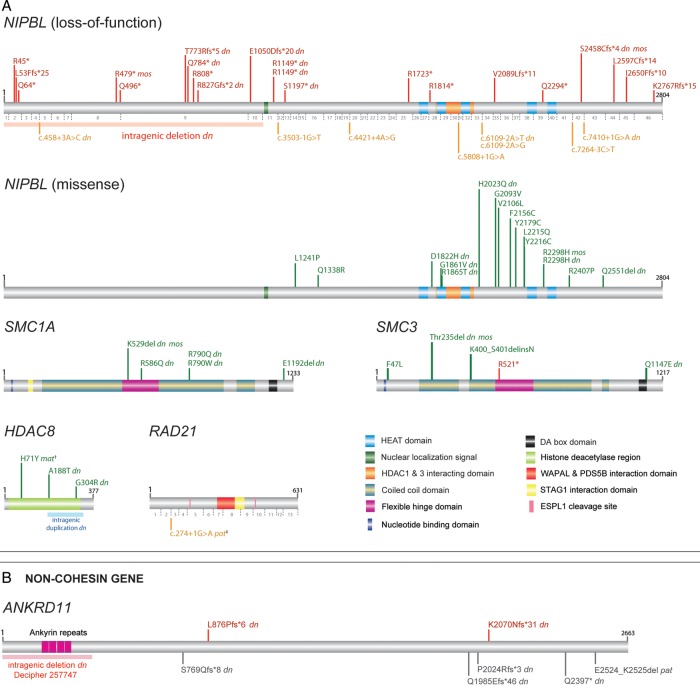
(A) Schematic representation of mutations identified in NIPBL, SMC1A, SMC3, HDAC8 and RAD21 within the MRC Human Genetics Unit Cornelia de Lange syndrome cohort. Mutations involving NIPBL are divided into two classes of loss-of-function (top panel) and missense (bottom panel) with numbers of NIPBL coding exons shown below the NIPBL protein in grey. Position of the NIPBL intragenic deletion is marked by a pink block. The intragenic duplication in HDAC8 is marked by a blue block. Positions of all mutations are drawn to scale along the protein product of the longest isoform, and represented in red (loss-of-function), orange (splice-site) or green (missense). †, denotes the HDAC8 p.(His71Tyr) mutation inherited from a similarly affected mother with skewed X-chromosome inactivation. ‡, denotes the RAD21 essential splice-site mutation, inherited from an apparently unaffected father. (B) Two novel frameshift mutations identified by whole-exome (K2070Nfs*31) and Sanger sequencing (L876Pfs*6) are shown in red over the ANKRD11 protein (grey block). The intragenic deletion involving ANKRD11 is depicted by a pink block (Decipher DDD-EDB257747). ANKRD11 mutations reported previously are shown in grey under the ANKRD11 protein block. The first and last amino acid numbers are marked in black; dn, confirmed de novo; mos, mosaic mutation; mat, inherited maternally; pat, inherited paternally. Protein accession numbers used are as follows: NIPBL, NP_597677.2; SMC1A, NP_006297.2; SMC3, NP_005436.1; HDAC8, NP_060956.1; RAD21, NP_006256.1; ANKRD11, NP_001243111.1. DDD, Deciphering Developmental Disorders.
Figure 2
Figure 2
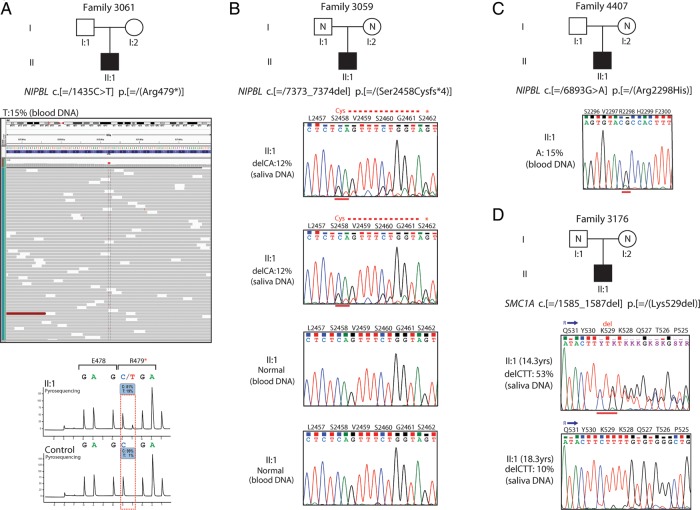
Mosaic mutations identified by next-generation sequence analysis. (A) A mosaic nonsense mutation identified by whole-exome sequencing in NIPBL (alternative allele shown in red) in approximately 15% of the reads (grey bars) (individual II:1, Family 3061) (top). The C>T substitution was confirmed by pyrosequencing (bottom) and found to be at similar levels to the exome data (15%–19%) as compared with a control DNA. (B) Sanger sequence confirmation of a de novo 2 bp deletion mutation in NIPBL as detected by Ion AmpliSeq-Ion PGM sequencing at 12% in two saliva-derived DNA samples. The mutation appears to be completely absent in two blood-derived DNA samples from the same case (individual II:1, Family 3059). (C) Sanger sequence confirmation of a missense NIPBL mutation identified by Ion PGM sequencing at 15% in a blood-derived DNA sample (individual II:1, Family 4407). (D) Sanger sequence confirmation of a de novo in-frame deletion of 3 bp identified by Ion PGM sequencing in SMC1A at significantly different levels in two saliva-derived DNA samples: 53% and 10% from the same case (individual II:1, Family 3176) at ages of 14.3 years and 18.3 years, respectively.
Figure 3
Figure 3
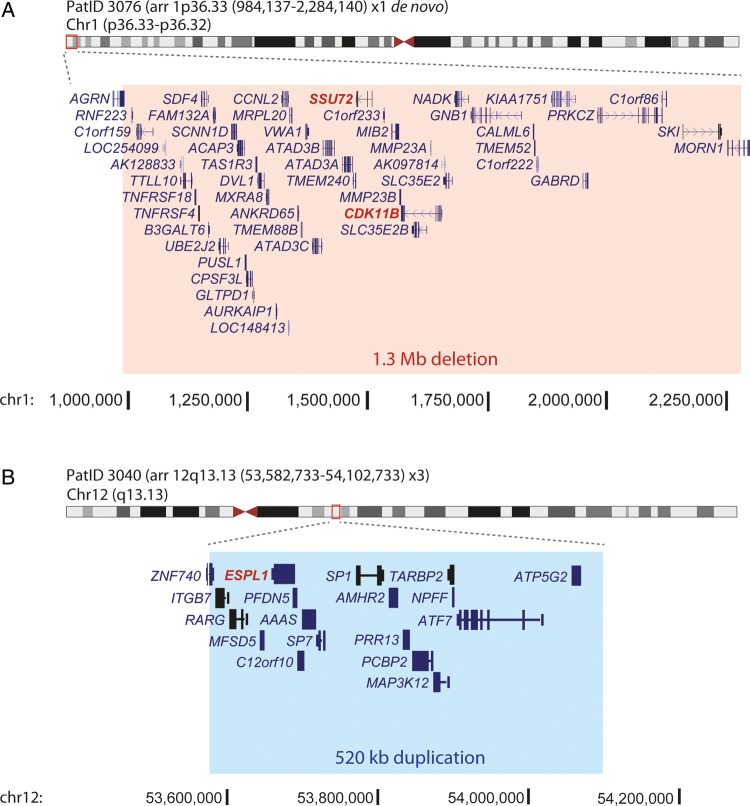
Analysis of genome-wide copy number by array comparative genomic hybridisation. (A) Heterozygous de novo deletion of 1.3 Mb on chromosome 1 (chr1:984 137–2 284 140; hg19) in PatID 3076. (B) Heterozygous duplication of 520 Kb on chromosome 12 (chr12:53 582 733–54 102 733; hg19) in PatID 3040. The regions of deletion and duplication are marked in red and blue boxes, respectively. The genes involved in each chromosomal rearrangement are also shown, with the Cornelia de Lange syndrome candidate genes in each region highlighted in red. The genomic context, marked in black at the bottom of each panel is based on human genome assembly GRCh37/hg19. PatID, patient identification.
Figure 4
Figure 4
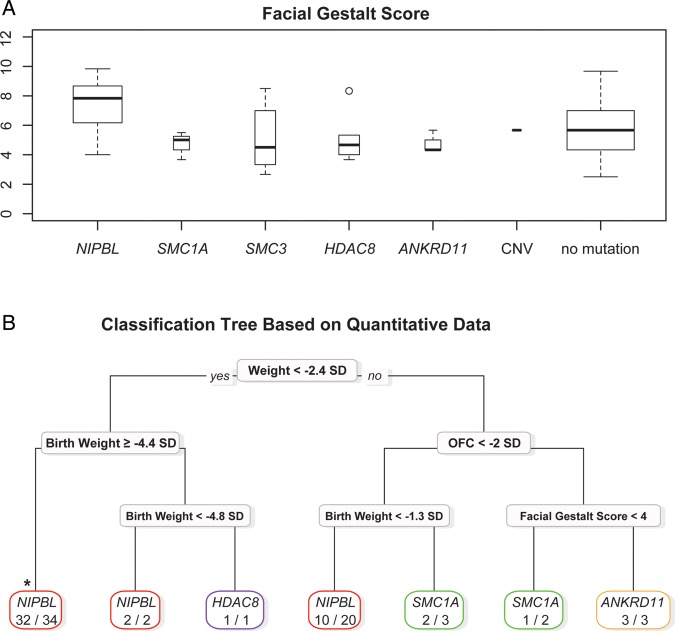
(A) Box plot of the facial gestalt scores for each gene category, genomic rearrangements (copy number variants, CNV) and mutation-negative cases. (B) Classification tree based on prenatal and postnatal growth data, severity and facial gestalt scores and genetic data. *Marks the most NIPBL-positive cases classified in a single branch. OFC, occipital frontal circumference.
Figure 5
Figure 5
Average faces of affected individuals constructed using average of appearance and shape across patient groups. The average face of the whole cohort (where photographs were available) is shown in the top left hand image. The averaged face of the NIPBL-positive subgroup is shown below and that of the subgroup containing all of mutation-negative cases is in the top right image. The NIPBL-like and other mutation-negative patient groups are shown in the bottom middle and bottom right image, respectively (n=numbers of individuals that each average face represents).

References

    1. Kline AD, Krantz ID, Sommer A, Kliewer M, Jackson LG, FitzPatrick DR, Levin AV, Selicorni A. Cornelia de Lange syndrome: clinical review, diagnostic and scoring systems, and anticipatory guidance. Am J Med Genet A 2007;143A:1287–96 - PubMed
    1. Gillis LA, McCallum J, Kaur M, DeScipio C, Yaeger D, Mariani A, Kline AD, Li HH, Devoto M, Jackson LG, Krantz ID. NIPBL mutational analysis in 120 individuals with Cornelia de Lange syndrome and evaluation of genotype-phenotype correlations. Am J Hum Genet 2004;75:610–23 - PMC - PubMed
    1. Krantz ID, McCallum J, DeScipio C, Kaur M, Gillis LA, Yaeger D, Jukofsky L, Wasserman N, Bottani A, Morris CA, Nowaczyk MJM, Toriello H, Bamshad MJ, Carey JC, Rappaport E, Kawauchi S, Lander AD, Calof AL, Li HH, Devoto M, Jackson LG. Cornelia de Lange syndrome is caused by mutations in NIPBL, the human homolog of Drosophila melanogaster Nipped-B. Nat Genet 2004;36:631–5 - PMC - PubMed
    1. Tonkin ET, Wang TJ, Lisgo S, Bamshad MJ, Strachan T. NIPBL, encoding a homolog of fungal Scc2-type sister chromatid cohesion proteins and fly Nipped-B, is mutated in Cornelia de Lange syndrome. Nat Genet 2004;36:636–41 - PubMed
    1. Baquero-Montoya C, Gil-Rodriguez MC, Braunholz D, Teresa-Rodrigo ME, Obieglo C, Gener B, Schwarzmayr T, Strom TM, Gomez-Puertas P, Puisac B, Gillessen-Kaesbach G, Musio A, Ramos FJ, Kaiser FJ, Pie J. Somatic mosaicism in a Cornelia de Lange syndrome patient with NIPBL mutation identified by different next generation sequencing approaches. Clin Genet 2014; 10.1111 - PubMed

Publication types