


Dengue virus 2 American-Asian genotype identified during the 2006/2007 outbreak in Piauí, Brazil reveals a Caribbean route of introduction and dissemination of dengue virus in Brazil
- PMID: 25127366
- PMCID: PMC4134198
- DOI: 10.1371/journal.pone.0104516
Dengue virus 2 American-Asian genotype identified during the 2006/2007 outbreak in Piauí, Brazil reveals a Caribbean route of introduction and dissemination of dengue virus in Brazil
Erratum in
- PLoS One. 2014;9(11):e113777
Abstract
Dengue virus (DENV) is the most widespread arthropod-borne virus, and the number and severity of outbreaks has increased worldwide in recent decades. Dengue is caused by DENV-1, DENV- 2, DENV-3 and DENV-4 which are genetically distant. The species has been subdivided into genotypes based on phylogenetic studies. DENV-2, which was isolated from dengue fever patients during an outbreak in Piaui, Brazil in 2006/2007 was analyzed by sequencing the envelope (E) gene. The results indicated a high similarity among the isolated viruses, as well as to other DENV-2 from Brazil, Central America and South America. A phylogenetic and phylogeographic analysis based on DENV-2E gene sequences revealed that these viruses are grouped together with viruses of the American-Asian genotype in two distinct lineages. Our results demonstrate the co-circulation of two American-Asian genotype lineages in northeast Brazil. Moreover, we reveal that DENV-2 lineage 2 was detected in Piauí before it disseminated to other Brazilian states and South American countries, indicating the existence of a new dissemination route that has not been previously described.
Conflict of interest statement
Figures
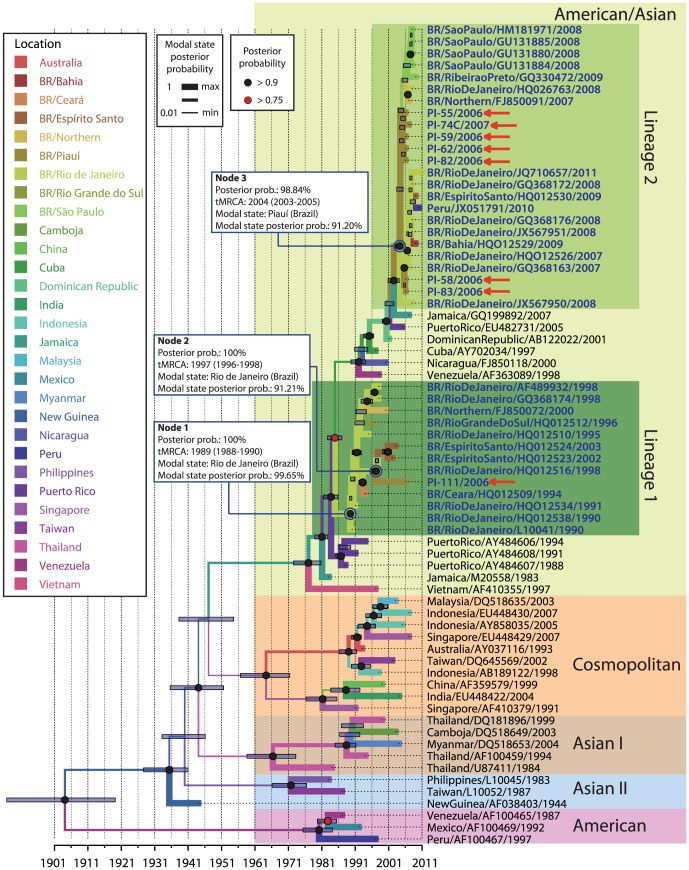
 ), which presented posterior probability value>0.9 and >0.75, respectively. Blue bars represent the extent of the 95% highest probability density (95% HPD) for each divergence time. The most probable geographic state for each internal node was inferred by discrete phylogeographic analysis. Different colors in the branch represent distinct geographical states according to the legend on the left side of the figure. Branch width is proportional to the probability value of the inferred ancestral geographical state.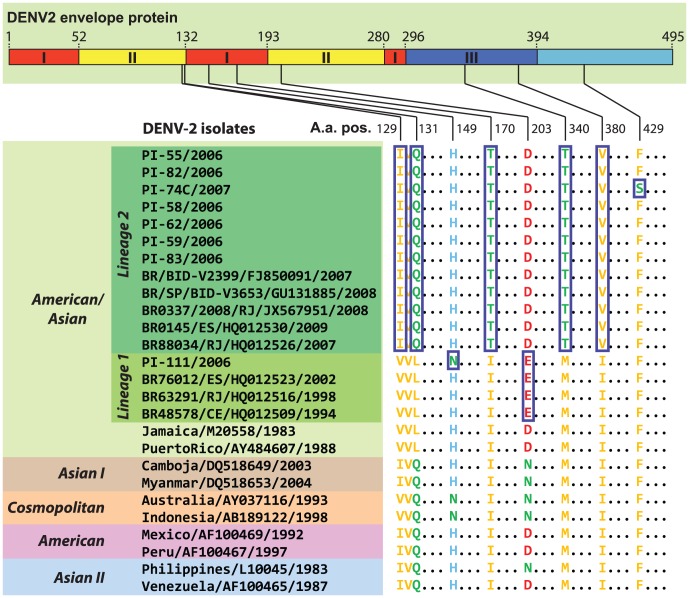
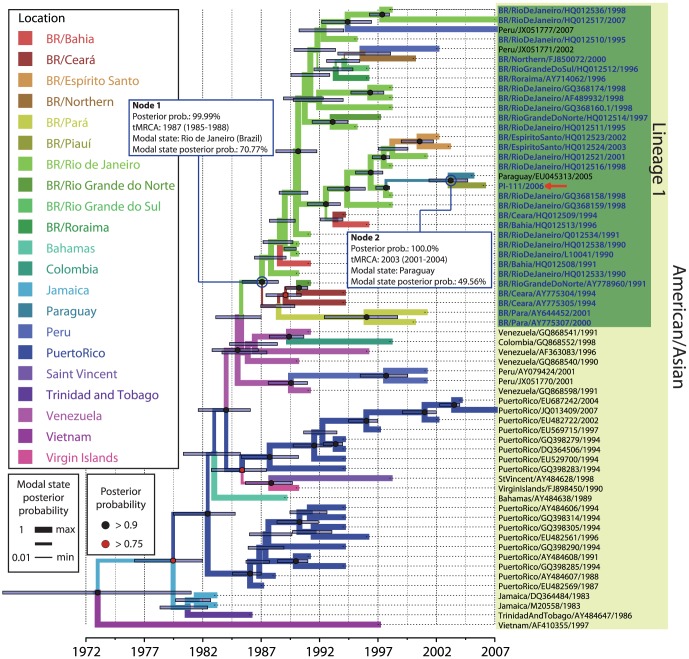
 ), respectively. Blue bars in each node represent the extent of the 95% highest probability density (95% HPD) for each divergence time. The most probable geographic state for each internal node was inferred by discrete phylogeographic analysis. Different colors in the branch represent distinct geographical states according to the legend on the left side of the figure. The branch width is proportional to the probability value of the inferred ancestral geographical state.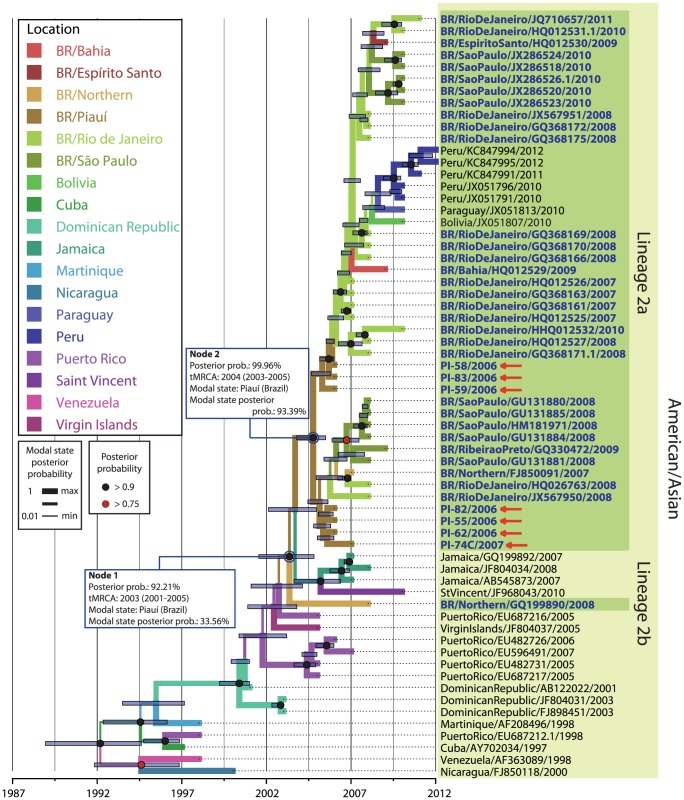
 ), respectively. Different colors in the branch represent the different geographical states according to the legend on the left side of the figure. The branch width is proportional to the probability value of the inferred ancestral geographical state.
References
-
- World Health Organization (2009) Dengue, guidelines for diagnosis, treatment, prevention and control. Available: http://whqlibdoc.who.int/publications/2009/9789241547871_eng.pdf. Accessed 20 September 2013. - PubMed
-
- Gubler DJ (2002) Epidemic Dengue/Dengue Hemorrhagic as a public health, social and economic problem in the 21 st. century. Trends Microbiol 10: 100–103. - PubMed
-
- Halstead SB (2007) Dengue. Lancet 370: 1644–1652. - PubMed
Publication types
MeSH terms
Substances
LinkOut - more resources
Full Text Sources
Other Literature Sources
Medical
