


First-trimester nonsystemic corticosteroid use and the risk of oral clefts in Norway
- PMID: 25127739
- PMCID: PMC4161959
- DOI: 10.1016/j.annepidem.2014.06.005
First-trimester nonsystemic corticosteroid use and the risk of oral clefts in Norway
Abstract
Purpose: Exposure of pregnant mice to corticosteroids can produce oral clefts in offspring. Although data in humans are more mixed, recent reports have suggested that dermatologic steroids are associated with oral clefts.
Methods: We investigated maternal first-trimester exposure to corticosteroids (focusing on dermatologic uses) and oral clefts in offspring using two population-based studies. The Norway Cleft Study (1996-2001) is a national case-control study including 377 infants with cleft lip ± palate (CLP), 196 infants with cleft palate only (CPO), and 763 controls. The Norwegian Mother and Child Cohort Study (MoBa, 1998-2008) is a national birth cohort including 123 infants with CLP, 61 infants with CPO, and 551 controls.
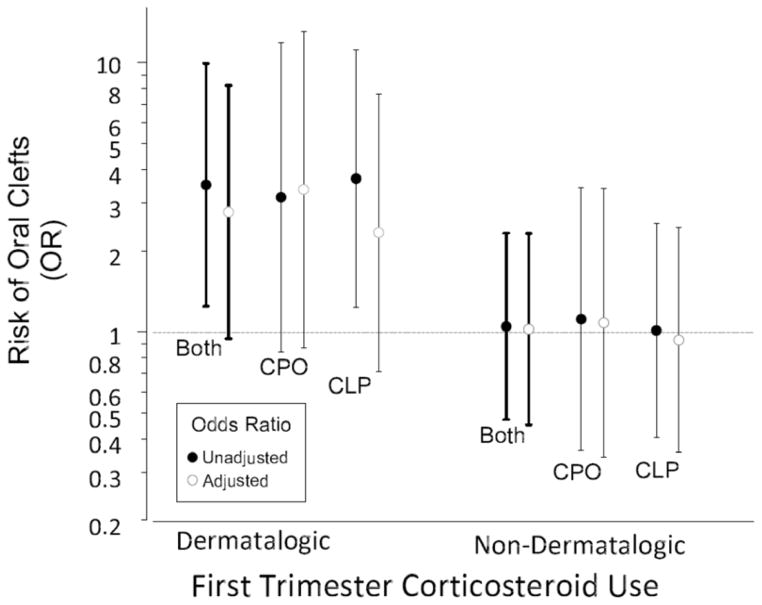
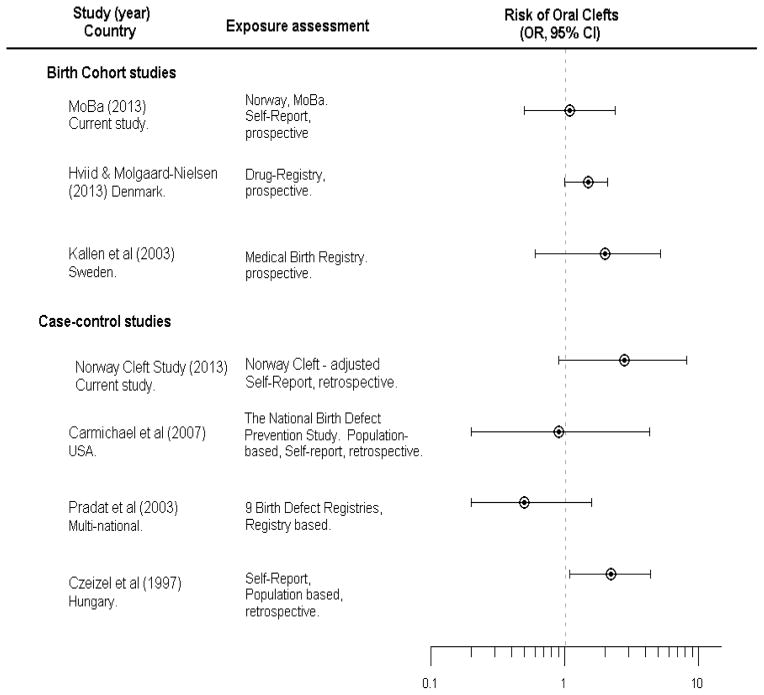
Results: In the case-control study, there was the suggestion of an association of dermatologic corticosteroids with both CLP (adjusted OR [aOR], 2.3; 95% confidence interval [CI], 0.71-7.7) and CPO (aOR, 3.4; CI, 0.87-13). There was no evidence of this association in the cohort data (odds ratio for CLP, 1.2; CI, 0.50-2.8 and odds ratio for CPO, 1.0; CI, 0.30-3.4), although exposure to dermatologic steroids was less specifically ascertained. There were no associations with other types of corticosteroids.
Conclusions: Our data add to the suggestive but inconsistent findings for this association.
Keywords: Cleft lip; Cleft palate; Corticosteroids; Maternal exposure; Moba; Pregnancy.
Copyright © 2014 Elsevier Inc. All rights reserved.
Figures
References
-
- Fraser FC, Fainstat TD. Production of congenital defects in the offspring of pregnant mice treated with cortisone: Progress report. Pediatrics 1951. 1951 Oct 1;8(4):527–33. - PubMed
-
- Walker BE, Fraser FC. The Embryology of Cortisone-induced Cleft Palate. Journal of Embryology and Experimental Morphology 1957. 1957 Jun;5(2):201–9.
-
- Carmichael SL, Shaw GM. Maternal corticosteroid use and risk of selected congenital anomalies. Am J Med Genet. 1999;86(3):242–4. - PubMed
-
- Carmichael SL, Shaw GM, Ma C, Werler MM, Rasmussen SA, Lammer EJ. Maternal corticosteroid use and orofacial clefts. Am J Obstet Gynecol. 2007;197(6):585, e1–e7. - PubMed
-
- Källén B. Maternal drug use and infant cleft lip/palate with special reference to corticoids. The Cleft Palate-Craniofacial Journal 2003. 2003 Nov 01;40(6):624–8. - PubMed
Publication types
MeSH terms
Substances
Grants and funding
LinkOut - more resources
Full Text Sources
Other Literature Sources
Medical
Miscellaneous
