Review
. 2014 Aug 15;21(9):441-8.
doi: 10.1101/lm.035501.114. Print 2014 Sep.

A unifying model of the role of the infralimbic cortex in extinction and habits

Affiliations
Review

A unifying model of the role of the infralimbic cortex in extinction and habits

Jacqueline M Barker et al. Learn Mem. .

Abstract

The infralimbic prefrontal cortex (IL) has been shown to be critical for the regulation of flexible behavior, but its precise function remains unclear. This region has been shown to be critical for the acquisition, consolidation, and expression of extinction learning, leading many to hypothesize that IL suppresses behavior as part of a "stop" network. However, this framework is at odds with IL function in habitual behavior in which the IL has been shown to be required for the expression and acquisition of ongoing habitual behavior. Here, we will review the current state of knowledge of IL anatomy and function in behavioral flexibility and provide a testable framework for a single IL mechanism underlying its function in both extinction and habit learning.


Figures

Figure 1.
Figure 1.
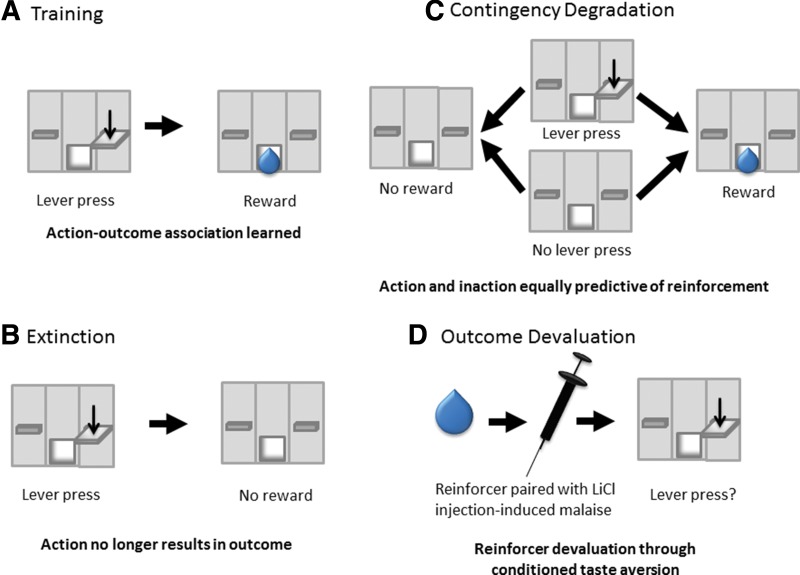
Instrumental extinction and habit models. (A) For extinction and habit models, animals first learn an association between their action (e.g., lever press) and an outcome (e.g., reinforcer delivery). (B) In extinction training, the action–outcome relationship is terminated. Lever pressing no longer results in reinforcer delivery. Acquisition of extinction requires learning that the previously reinforced action no longer produces the delivery of a reinforcer, and the expression of extinction learning requires suppression of the previously reinforced action. (C) Habitual behavior is behavior that is no longer mediated by the relationship between actions and their outcome. One method of assessing habits is to disrupt the contingency between action and outcome. In contingency degradation, action and inaction are equivalently likely to be associated with the delivery of the reinforcer. Goal-directed animals are expected to reduce responding for the previously learned contingency when it is degraded through noncontingent reinforcement while habitual animals are insensitive to this change in contingency. (D) Habitual behavior can also be assessed through altering the value of the outcome. Typically, the outcome is devalued through association of the reinforcer with illness (i.e., a conditioned taste aversion). As with contingency degradation, when behavior is sensitive to the action–outcome contingency (i.e., goal-directed), a reduction in behavior is expected. Habitual animals, whose behavior is stimulus-driven, are insensitive to the effects of outcome devaluation on instrumental responding.
Figure 2.
Figure 2.
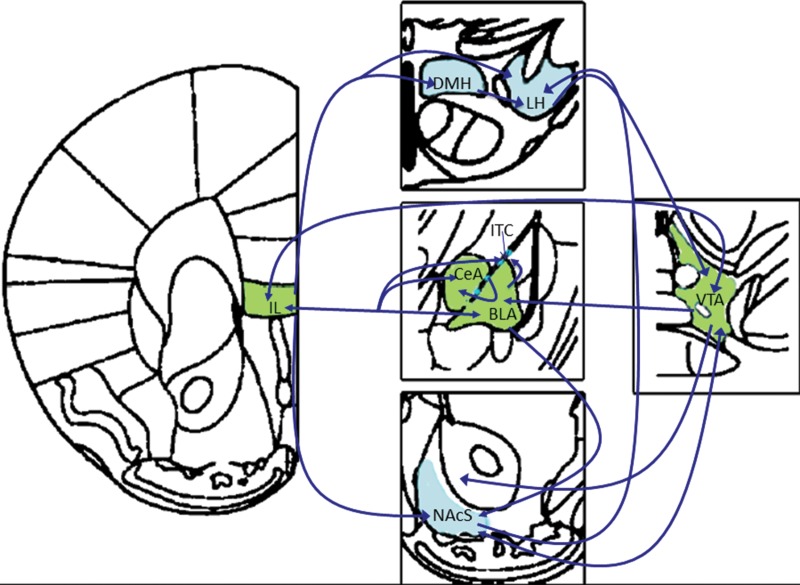
Subcortical targets of IL involved with extinction and habit learning. The IL projects to a number of subcortical targets, many of which have been shown to be critical substrates of extinction and habit learning. In addition, these subcortical regions have extensive interconnectivity, implicating a large potential network in mediating the acquisition and expression of extinction and stimulus–response habits. Although a number of additional targets exist, the dorsomedial hypothalamus has been identified as a substrate of extinction learning, and may be involved in habitual behavior as well. Additionally, amygdalar nuclei, which are extensively connected with the prefrontal cortex, the ventral striatum, and dopaminergic nuclei, have been implicated in extinction and habit formation, and are likely to be an important focus of investigation into the regulation of flexible reward seeking. The accumbens shell, which receives input from IL as well as a number of other limbic and midbrain structures, has been identified as a key regulator of extinction. Reports have implicated brain regions in green in both extinction and habitual behavior. To date, brain regions highlighted in blue have only been associated with extinction learning and their role in habitual behavior is as yet unclear.
Figure 3.
Figure 3.
Testing the model. Based on the existing literature, we have outlined four separate, but potentially coexisting, hypotheses for the separable role of the IL in the acquisition and expression of extinction and habit learning. Assessing the precise role of IL function in behavioral flexibility will likely require the elegant combination of behavioral, genetic, and molecular techniques. (a,b) IL may promote extinction and habit learning through interactions with distinct input and output sites. To determine the neuroanatomical substrates that participate in IL activity to drive the expression of extinction learning and habitual behaviors, inactivation and lesion studies can be performed. The timing of these procedures can disentangle the role of IL and its projection targets in the acquisition and expression of habitual behavior and extinction. While these traditional methods enable significant anatomical specificity, the use of optogenetic and DREADD strategies can further refine our understanding of the neuroanatomy of these behaviors to include cell-type specificity together with regional selectivity. If separate neural circuits mediate these behaviors, we would expect distinctions in the effect of lesions on these behaviors—e.g., disconnection of IL from projection targets or input structures may impact one, neither, or both of these behaviors enabling a greater understanding of the neurocircuitry of habitual behavior and extinction. (c) These anatomical studies should be incorporated with novel behavioral approaches to assessing the overarching role of IL in behavior. One hypothesis is that IL function facilitates the acquisition of stimulus–response behavior, including habits and extinction. We propose that the most simple way to disentangle these hypotheses is through the critical evaluation of loss of IL function in the acquisition of novel stimulus–response behaviors and in return to previously required action–outcome strategies. Specifically, inactivation or lesion of IL (or IL circuits) could be performed in tandem with assessments of the expression or acquisition of stimulus–response behaviors other than habit. (d) Alternatively, IL may promote habits and extinction learning through the suppression of the ability of action–outcome relationships to guide behavior. Testing this hypothesis would require suppression of previously acquired action–outcome relationships, in tandem with alterations of IL function, to determine whether loss of IL still results in a reversion to goal-directed behavior in the absence of the neurons encoding this relationship.

References

    1. Adams CD 1982. Variations in the sensitivity of instrumental responding to reinforcer devaluation. Q J Exp Psychol B 34: 77–98
    1. Arnsten AFT 2007. Catecholamine and second messenger influences on prefrontal cortical networks of “representational knowledge”: a rational bridge between genetics and the symptoms of mental illness. Cereb Cortex 17 Suppl 1: i6–i15 - PubMed
    1. Balleine BW, Dickinson A 1998. Goal-directed instrumental action: contingency and incentive learning and their cortical substrates. Neuropharmacology 37: 407–419 - PubMed
    1. Barker JM, Torregrossa MM, Taylor JR 2012. Low prefrontal PSA-NCAM confers risk for alcoholism-related behavior. Nat Neurosci 15: 1356–1358 - PMC - PubMed
    1. Barker JM, Torregrossa MM, Taylor JR 2013. Bidirectional modulation of infralimbic dopamine D1 and D2 receptor activity regulates flexible reward seeking. Front Neurosci 7: 126. - PMC - PubMed

Publication types

LinkOut - more resources