In vitro preliminary study of osteoblast response to surface roughness of titanium discs and topical application of melatonin
- PMID: 25129252
- PMCID: PMC4320427
- DOI: 10.4317/medoral.19953
In vitro preliminary study of osteoblast response to surface roughness of titanium discs and topical application of melatonin
Abstract
Objectives: To observe human osteoblast behavior cultured in vitro on titanium discs (Ti) in relation to surface roughness and melatonin application.
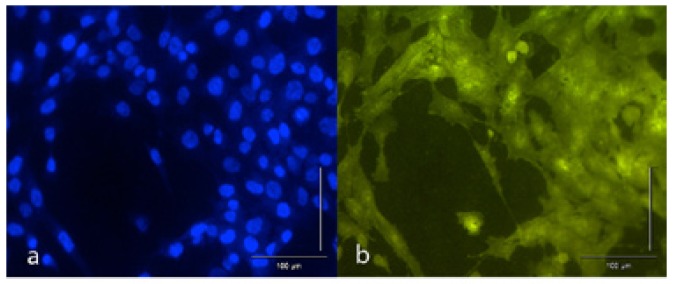
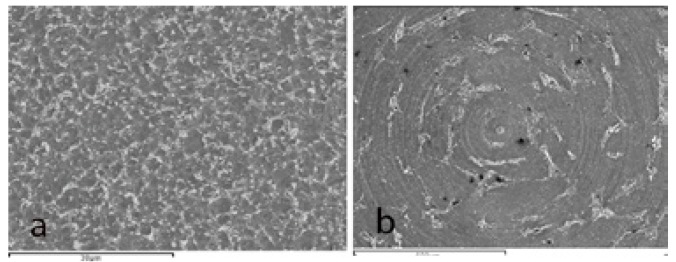
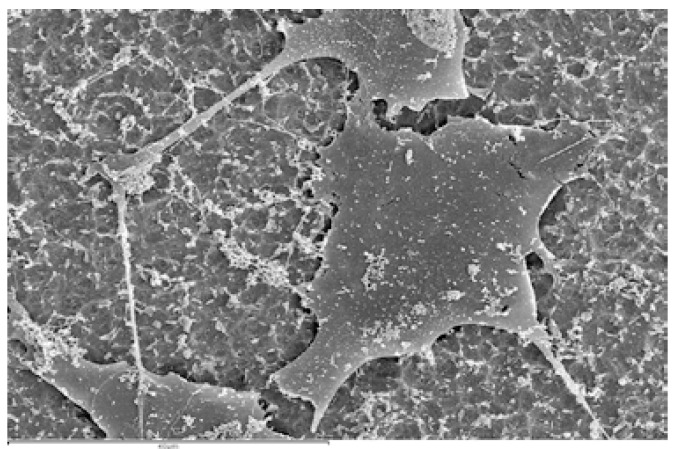
Study design: Human osteoblasts (MG-63) were cultured on 60 Ti6Al4V discs divided into three groups: Group I: discs treated with dual acid etching; Group II dual acid etching and blasting with calcium phosphate particles; Group III (control) machined discs. Surface roughness and topography of the discs were examined with scanning electron microscope (SEM) and confocal laser scanning electron microscope( CLSM). Osteoblast adhesion, proliferation and cell morphology were determined by means of fluorescence microscopy with Image-Pro Plus software and SEM.
Results: Group II presented the roughest discs, while the least rough were Group III. Cell adhesion was greatest in Group II. The addition of melatonin improved cell proliferation.
Conclusions: 1. Surface treatments (dual acid etching, calcium phosphate impaction) increase surface roughness in comparison with machined titanium. 2. Greater surface roughness tends to favor cell adhesion after 24-hour cell culture. 3. The addition of melatonin tends to favor osteoblast proliferation.
Conflict of interest statement
Figures
References
-
- Cooper LF, Harris CT, Bruder SP, Kowalski R, Kadiyala S. Incipient analysis of mesenchymal stem-cell-derived osteogenesis. J Dent Res. 2001;80:314–20. - PubMed
-
- Aparicio C, Padrós A, Gil FJ. In vivo evaluation of micro-rough and bioactive titanium dental implants using histometry and pull-out tests. J Mech Behav Biomed Mater. 2011;4:1672–82. - PubMed
-
- Lohmann CH, Sagun R, Sylvia VL, Cochran DL, Dean DD, Boyan BD. Surface roughness modulates the response of MG63 osteoblast-like cells to 1,25-(OH)(2)D(3) through regulation of phospholipase A(2) activity and activation of protein kinase A. J Biomed Mater Res. 1999;47:139–51. - PubMed
-
- Schwartz Z, Lohmann CH, Sisk M, Cochran DL, Sylvia VL, Simpson J. Local factor production by MG63 osteoblast-like cells in response to surface roughness and 1,25-(OH)2D3 is mediated via protein kinase C- and protein kinase A-dependent pathways. Biomaterials. 2001;22:731–41. - PubMed
-
- Eisenbarth E, Meyle J, Nachtigall W, Breme J. Influence of the surface structure of titanium materials on the adhesion of fibroblasts. Biomaterials. 1996;17:1399–403. - PubMed
MeSH terms
Substances
LinkOut - more resources
Full Text Sources
Other Literature Sources