Acute type B aortic dissection: insights from the International Registry of Acute Aortic Dissection
- PMID: 25133099
- PMCID: PMC4128929
- DOI: 10.3978/j.issn.2225-319X.2014.07.06
Acute type B aortic dissection: insights from the International Registry of Acute Aortic Dissection
Abstract
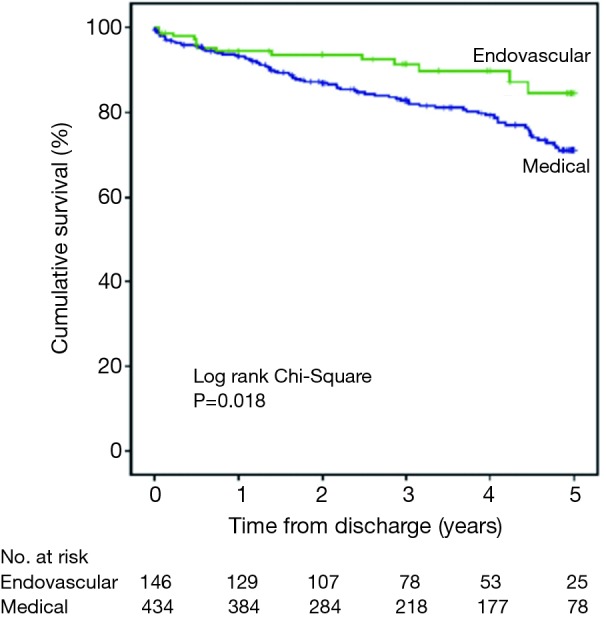
Acute type B aortic dissection comprises approximately one-third of all aortic dissection cases. Although this catastrophic cardiovascular condition was first described in the medical literature over two centuries ago, data on the optimal diagnostic and treatment modalities for type B dissection was slow to evolve throughout the latter half of the twentieth century, even as newer diagnostic techniques and management strategies became commonplace. To further elucidate contemporary practice patterns and outcomes of aortic dissection, the International Registry of Acute Aortic Dissection (IRAD) was established in 1996. Over the past two decades, IRAD publications have steadily increased our knowledge and understanding about aortic dissection. Specifically in recent years, analyses of IRAD data have gone beyond simply characterizing the patient with acute type B aortic dissection and have attempted to identify the means by which the outcome of such a patient could be improved. Thus, we present herein three areas in which IRAD data has recently advanced our understanding of acute type B aortic dissection: temporal classification especially for the subacute time period, risk stratification for identifying complicated cases, and thoracic endovascular aortic repair (TEVAR).
Keywords: International Registry of Acute Aortic Dissection (IRAD); Type B dissection; acute aortic dissection; aorta; thoracic endovascular aortic repair (TEVAR).
Figures
References
-
- Nicholls F.Observations concerning the Body of His Late Majesty, October 26, 1760, by Frank Nicholls, M. D. F. R. S. Physician to His Late Majesty. Philosophical Transactions 1761;52:265-75
-
- Hirst AE, Jr, Johns VJ, Jr, Kime SW., Jr Dissecting aneurysm of the aorta: a review of 505 cases. Medicine (Baltimore) 1958;37:217-79 - PubMed
-
- Debakey ME, Henly WS, Cooley DA, et al. Surgical management of dissecting aneurysms of the aorta. J Thorac Cardiovasc Surg 1965;49:130-49 - PubMed
-
- Daily PO, Trueblood HW, Stinson EB, et al. Management of acute aortic dissections. Ann Thorac Surg 1970;10:237-47 - PubMed
Publication types
LinkOut - more resources
Full Text Sources
Medical
Miscellaneous