. 2014 Aug 18;9(8):e104567.
doi: 10.1371/journal.pone.0104567. eCollection 2014.

Tandem RNA chimeras contribute to transcriptome diversity in human population and are associated with intronic genetic variants

Collaborators, Affiliations

Tandem RNA chimeras contribute to transcriptome diversity in human population and are associated with intronic genetic variants

Liliana Greger et al. PLoS One. .

Abstract

Chimeric RNAs originating from two or more different genes are known to exist not only in cancer, but also in normal tissues, where they can play a role in human evolution. However, the exact mechanism of their formation is unknown. Here, we use RNA sequencing data from 462 healthy individuals representing 5 human populations to systematically identify and in depth characterize 81 RNA tandem chimeric transcripts, 13 of which are novel. We observe that 6 out of these 81 chimeras have been regarded as cancer-specific. Moreover, we show that a prevalence of long introns at the fusion breakpoint is associated with the chimeric transcripts formation. We also find that tandem RNA chimeras have lower abundances as compared to their partner genes. Finally, by combining our results with genomic data from the same individuals we uncover intronic genetic variants associated with the chimeric RNA formation. Taken together our findings provide an important insight into the chimeric transcripts formation and open new avenues of research into the role of intronic genetic variants in post-transcriptional processing events.


Conflict of interest statement

Competing Interests: The authors have declared that no competing interests exist.

Figures

Figure 1
Figure 1. Characterization of tandem RNA chimeras.
Barplot representing the frequency of the predicted structural classes for all tandem RNA chimeras. The most prevalent observed class is a promoter swap event.
Figure 2
Figure 2. Distances between chimeric partner genes.
Shown are distances between the tandem RNA chimeric partner genes in Mb. The majority of the distances are in the range between 5 kb and 170 kb.
Figure 3
Figure 3. Tandem RNA chimeras frequency plots in five human populations.
All populations show similar patterns with most of the chimeric transcripts found only in a few individuals.
Figure 4
Figure 4. Venn diagrams.
Venn diagrams displaying the relations between tandem RNA chimeras in five human populations (A); intrachromosomal chimeras located on different strands (B); and interchromosomal chimeras (C).
Figure 5
Figure 5. Exon exclusion pattern.
Plot showing the proportions of the exon exclusion patterns in the tandem RNA chimeras. The numbers of the exons for the 5′ partner gene are counted from last to first, while the numbers of the exons for the 3′ partner gene are counted from first to last. The most abundant exon exclusion pattern involves the exclusion of the terminal exon of the 5′ partner gene and the first exon of the 3′ partner gene.
Figure 6
Figure 6. Expression level distributions of tandem RNA chimeras and their partner genes.
RNA chimeras are lower expressed than their partner genes.
Figure 7
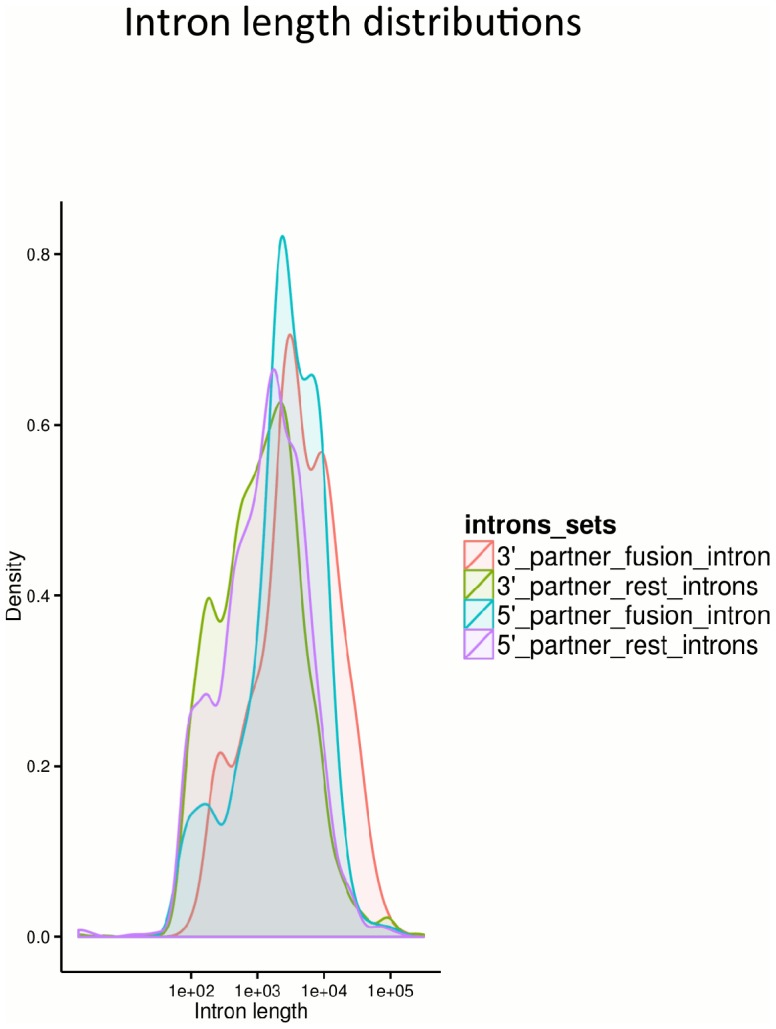
Figure 7. Intron length density plots.
Density plots showing the distributions of the fusion 5′ and 3′ introns length versus the length of the rest of the introns comprising the fusion partner genes. Observed is a notable higher proportion of larger introns at the breakpoint.

References

    1. Mitelman F, Johansson B, Mertens F (2007) The impact of translocations and gene fusions on cancer causation. Nat Rev Cancer 7: 233–245 10.1038/nrc2091 - DOI - PubMed
    1. Magrangeas F, Pitiot G, Dubois S, Bragado-Nilsson E, Chérel M, et al. (1998) Cotranscription and intergenic splicing of human galactose-1-phosphate uridylyltransferase and interleukin-11 receptor alpha-chain genes generate a fusion mRNA in normal cells. Implication for the production of multidomain proteins during evolution. J Biol Chem 273: 16005–16010. - PubMed
    1. Kapranov P, Drenkow J, Cheng J, Long J, Helt G, et al. (2005) Examples of the complex architecture of the human transcriptome revealed by RACE and high-density tiling arrays. Genome Res 15: 987–997 10.1101/gr.3455305 - DOI - PMC - PubMed
    1. Denoeud F, Kapranov P, Ucla C, Frankish A, Castelo R, et al. (2007) Prominent use of distal 5′ transcription start sites and discovery of a large number of additional exons in ENCODE regions. Genome Res 17: 746–759 10.1101/gr.5660607 - DOI - PMC - PubMed
    1. Parra G, Reymond A, Dabbouseh N, Dermitzakis ET, Castelo R, et al. (2006) Tandem chimerism as a means to increase protein complexity in the human genome. Genome Res 16: 37–44 10.1101/gr.4145906 - DOI - PMC - PubMed

Publication types

LinkOut - more resources