


Passport officers' errors in face matching
- PMID: 25133682
- PMCID: PMC4136722
- DOI: 10.1371/journal.pone.0103510
Passport officers' errors in face matching
Abstract
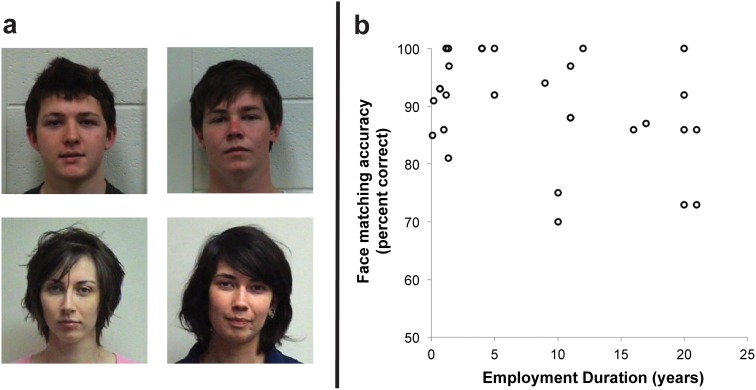
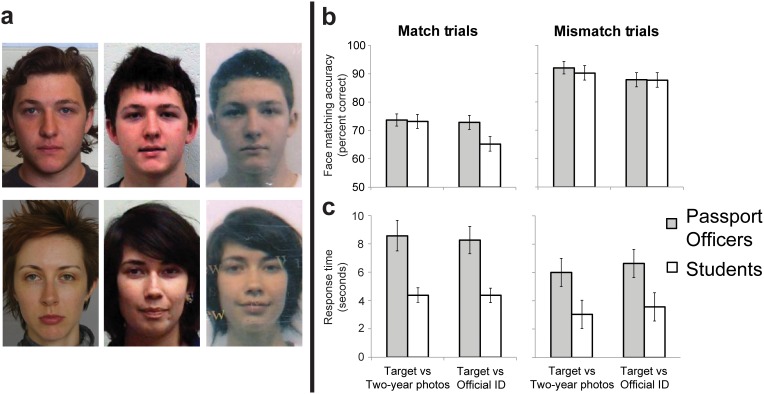
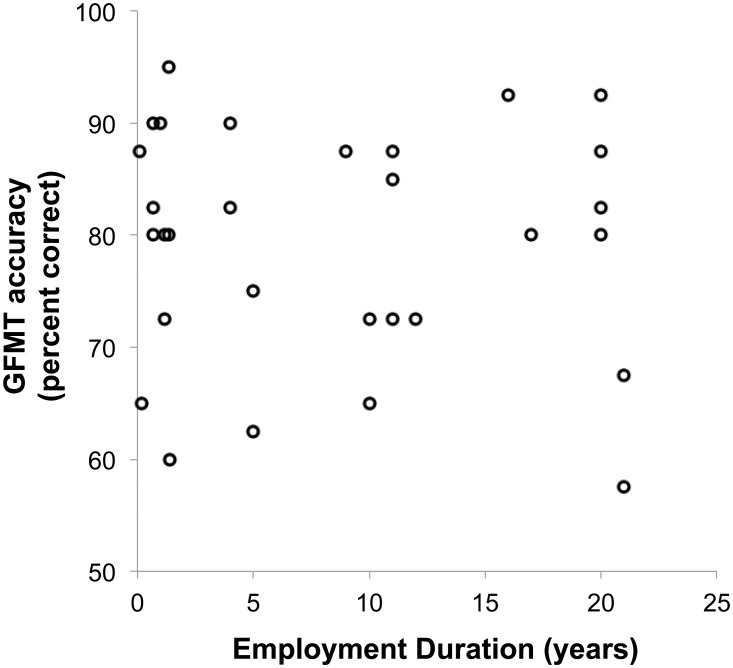
Photo-ID is widely used in security settings, despite research showing that viewers find it very difficult to match unfamiliar faces. Here we test participants with specialist experience and training in the task: passport-issuing officers. First, we ask officers to compare photos to live ID-card bearers, and observe high error rates, including 14% false acceptance of 'fraudulent' photos. Second, we compare passport officers with a set of student participants, and find equally poor levels of accuracy in both groups. Finally, we observe that passport officers show no performance advantage over the general population on a standardised face-matching task. Across all tasks, we observe very large individual differences: while average performance of passport staff was poor, some officers performed very accurately--though this was not related to length of experience or training. We propose that improvements in security could be made by emphasising personnel selection.
Conflict of interest statement
Figures
References
-
- Bruce V, Henderson Z, Greenwood K, Hancock PJ, Burton AM, et al. (1999) Verification of face identities from images captured on video. J Exp Psychol Appl 5: 339–360.
-
- Megreya AM, Burton AM (2006) Unfamiliar faces are not faces: Evidence from a matching task. Mem Cognition 34: 865–876. - PubMed
-
- Burton AM, White D, McNeill A (2010) The Glasgow Face Matching Test. Behav Res Methods 42: 286–291. - PubMed
-
- Kemp RI, Towell N, Pike G (1997) When seeing should not be believing: Photographs, credit cards and fraud. Appl Cognitive Psych 11: 211–222.
-
- Davis JP, Valentine T (2009) CCTV on trial: Matching video images with the defendant in the dock. Appl Cognitive Psych 23: 482–505.
Publication types
MeSH terms
LinkOut - more resources
Full Text Sources
Other Literature Sources
