


Mice in Bion-M 1 space mission: training and selection
- PMID: 25133741
- PMCID: PMC4136787
- DOI: 10.1371/journal.pone.0104830
Mice in Bion-M 1 space mission: training and selection
Abstract
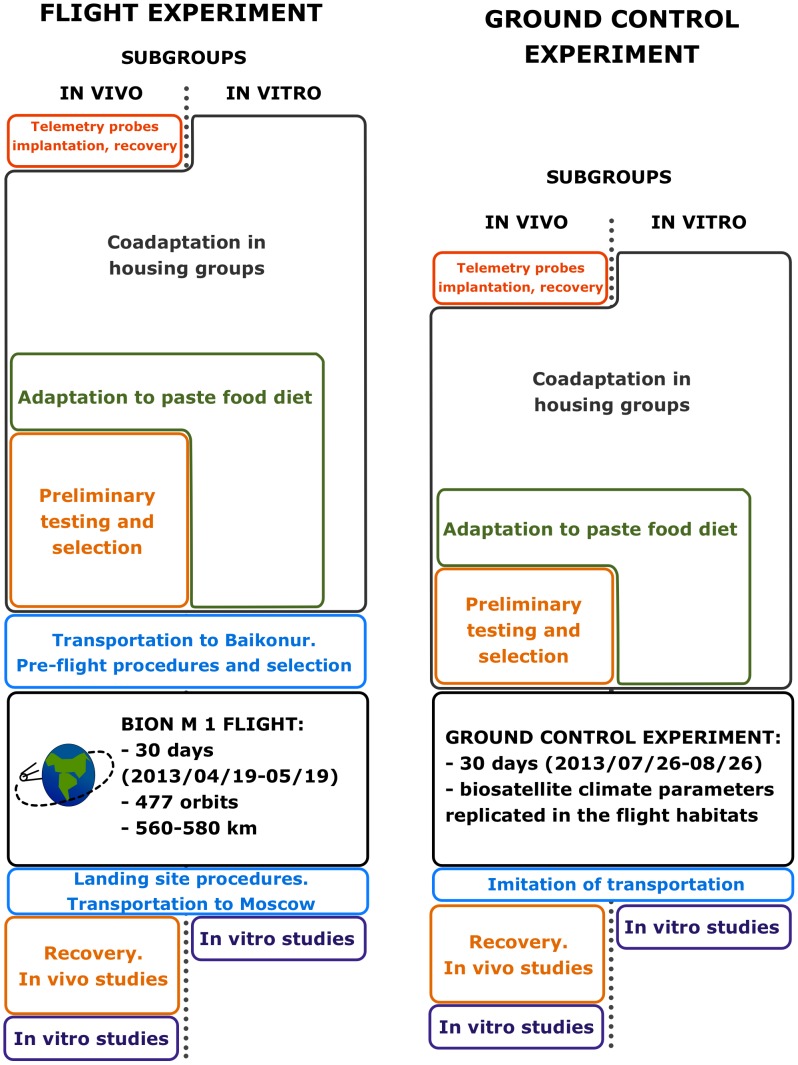
After a 16-year hiatus, Russia has resumed its program of biomedical research in space, with the successful 30-day flight of the Bion-M 1 biosatellite (April 19-May 19, 2013). The principal species for biomedical research in this project was the mouse. This paper presents an overview of the scientific goals, the experimental design and the mouse training/selection program. The aim of mice experiments in the Bion-M 1 project was to elucidate cellular and molecular mechanisms, underlying the adaptation of key physiological systems to long-term exposure in microgravity. The studies with mice combined in vivo measurements, both in flight and post-flight (including continuous blood pressure measurement), with extensive in vitro studies carried out shortly after return of the mice and in the end of recovery study. Male C57/BL6 mice group housed in space habitats were flown aboard the Bion-M 1 biosatellite, or remained on ground in the control experiment that replicated environmental and housing conditions in the spacecraft. Vivarium control groups were used to account for housing effects and possible seasonal differences. Mice training included the co-adaptation in housing groups and mice adaptation to paste food diet. The measures taken to co-adapt aggressive male mice in housing groups and the peculiarities of "space" paste food are described. The training program for mice designated for in vivo studies was broader and included behavioral/functional test battery and continuous behavioral measurements in the home-cage. The results of the preliminary tests were used for the selection of homogenous groups. After the flight, mice were in good condition for biomedical studies and displayed signs of pronounced disadaptation to Earth's gravity. The outcomes of the training program for the mice welfare are discussed. We conclude that our training program was effective and that male mice can be successfully employed in space biomedical research.
Conflict of interest statement
Figures
References
-
- Grigoriev AI, Iliyn EA (2007) Animals in space. Vestnik Rossijskoj Akademii Nauk 77: 963–973.
-
- Ilyin EA (2000) Historical overview of the Bion project. J Gravit Physiol 7: S1–S8. - PubMed
-
- Burgess C, Dubbs C (2007) Animals in Space. From Research Rockets to the Space Shuttle. UK: Springer Praxis. 406 p.
-
- Buckey JC, Homick JL, editors (2003) The Neurolab Spacelab mission: neuroscience research in space: results from the STS-90, Neurolab Spacelab mission. Houston: National Aeronautics and Space Administration, Lyndon B. Johnson Space Center. 333 p.
-
- Pecaut MJ, Nelson GA, Peters LL, Kostenuik PJ, Bateman TA, et al. (2003) Genetic models in applied physiology: selected contribution: effects of spaceflight on immunity in the C57BL/6 mouse. I. Immune population distributions. J Appl Physiol 94: 2085–2094. - PubMed
Publication types
MeSH terms
LinkOut - more resources
Full Text Sources
Other Literature Sources
Miscellaneous
