


Resistance exercise, disability, and pain catastrophizing in obese adults with back pain
- PMID: 25133997
- PMCID: PMC4137474
- DOI: 10.1249/MSS.0000000000000294
Resistance exercise, disability, and pain catastrophizing in obese adults with back pain
Abstract
Purpose: The purpose of this study was to compare the effects of two different resistance exercise protocols on self-reported disability, fear avoidance beliefs, pain catastrophizing, and back pain symptoms in obese, older adults with low back pain (LBP).
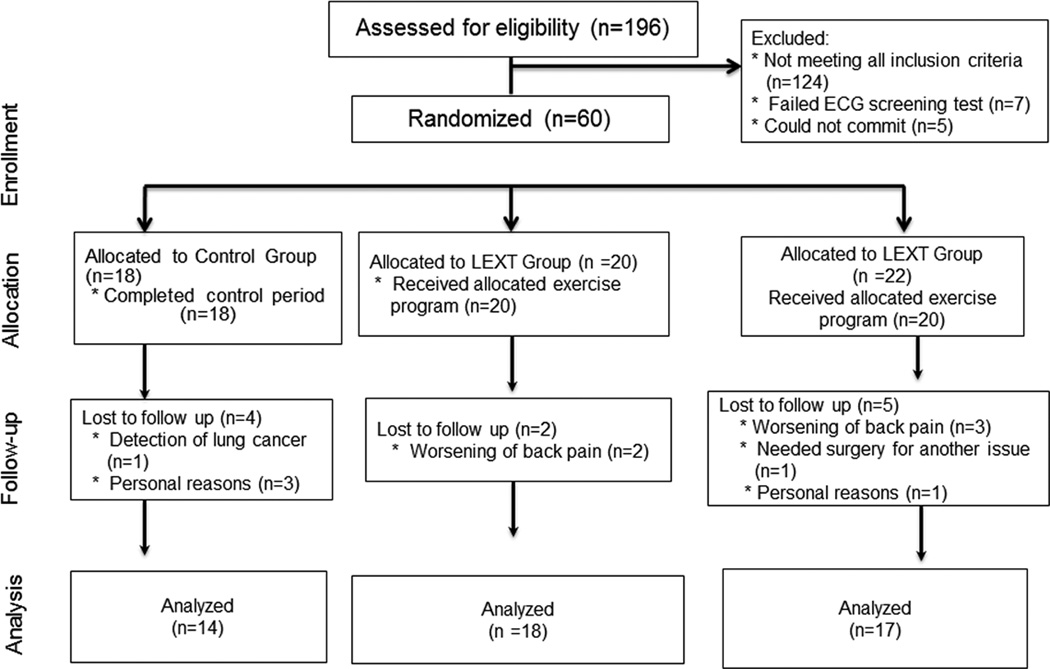
Methods: Obese adults (n = 49, 60-85 yr) with chronic LBP were randomized into a total body resistance exercise intervention (TOTRX), lumbar extensor exercise intervention (LEXT), or a control group (CON). Main outcomes included perceived disability (Oswestry Disability Index, Roland Morris Disability Questionnaire). Psychosocial measures included the Fear Avoidance Beliefs survey, Tampa Scale of Kinesiophobia, and Pain Catastrophizing Scale. LBP severity was measured during three functional tasks: walking, stair climbing, and chair rise using an 11-point numerical pain rating scale.
Results: The TOTRX group had greater reductions in self-reported disability scores due to back pain (Oswestry Disability Index, Roland Morris Disability Questionnaire) compared with those in the LEXT (P < 0.05). The Pain Catastrophizing Scale scores decreased in the TOTRX group compared with that in the CON group by month 4 (64.3% vs 4.8%, P < 0.05). Pain severity during chair rise activity and walking was decreased in both the LEXT and TOTRX groups relative to the CON group.
Conclusions: Greater reductions in perceived disability due to LBP can be achieved with TOTRX compared with those achieved with LEXT. Pain catastrophizing and pain severity decreased most with TOTRX. The positive change in psychological outlook may assist obese, older adults with chronic back pain in reconsidering the harmfulness of the pain and facilitate regular participation in other exercise programs.
Conflict of interest statement
Figures
References
-
- Asmundson GJ, Norton GR, Allerdings MD. Fear and avoidance in dysfunctional chronic back pain patients. Pain. 1997;69(3):231–236. - PubMed
-
- Crombez G, Vlaeyen JW, Heuts PH, Lysens R. Pain-related fear is more disabling than pain itself: evidence on the role of pain-related fear in chronic back pain disability. Pain. 1999;80(1–2):329–339. - PubMed
-
- Danneels LA, Cools AM, Vanderstraeten GG, Cambier DC, Witvrouw EE, Bourgois J, de Cuyper HJ. The effects of three different training modalities on the cross-sectional area of the paravertebral muscles. Scand J Med Sci Sports. 2001;11(3):335–341. - PubMed
-
- de Jong JR, Vlaeyen JW, Van Eijsden M, Loo C, Onhenga P. Reduction of pain-related fear and increased function and participation in work-related upper extremity pain (WRUEP): effects of exposure in vivo. Pain. 2012;153(10):2109–2118. - PubMed
-
- Dworkin RH, Turk DC, Wyrwich KW, Beaton D, Cleeland CS, Farrar JT, Haythornthwaite JA, Jensen MP, Kerns RD, Ader DN, Brandenburg N, Burke LB, Cella D, Chandler J, Cowan P, Dimitrova R, Dionne R, Hertz S, Jadad AR, Katz NP, Kehlet H, Kramer LD, Manning DC, McCormick C, McDermott MP, McQuay HJ, Patel S, Porter L, Quessy S, Rappaport BA, Rauschkolb C, Revicki DA, Rothman M, Schmader KE, Stacey BR, Stauffer JW, von Stein T, White RE, Witter J, Zavisic S. Interpreting the clinical importance of treatment outcomes in chronic pain clinical trials: IMMPACT recommendations. J Pain. 2008;9(2):105–112. - PubMed
Publication types
MeSH terms
Grants and funding
LinkOut - more resources
Full Text Sources
Other Literature Sources
Medical
Miscellaneous
