Review
. 2014 Sep 26;369(1652):20130507.
doi: 10.1098/rstb.2013.0507.

The role of long non-coding RNAs in neurodevelopment, brain function and neurological disease

Affiliations
Review

The role of long non-coding RNAs in neurodevelopment, brain function and neurological disease

Thomas C Roberts et al. Philos Trans R Soc Lond B Biol Sci. .

Abstract

Long non-coding RNAs (lncRNAs) are transcripts with low protein-coding potential that represent a large proportion of the transcriptional output of the cell. Many lncRNAs exhibit features indicative of functionality including tissue-restricted expression, localization to distinct subcellular structures, regulated expression and evolutionary conservation. Some lncRNAs have been shown to associate with chromatin-modifying activities and transcription factors, suggesting that a common mode of action may be to guide protein complexes to target genomic loci. However, the functions (if any) of the vast majority of lncRNA transcripts are currently unknown, and the subject of investigation. Here, we consider the putative role(s) of lncRNAs in neurodevelopment and brain function with an emphasis on the epigenetic regulation of gene expression. Associations of lncRNAs with neurodevelopmental/neuropsychiatric disorders, neurodegeneration and brain cancers are also discussed.

Keywords: brain; epigenetics; long non-coding RNA; neurodegeneration; neurodevelopment.


Figures

Figure 1.
Figure 1.
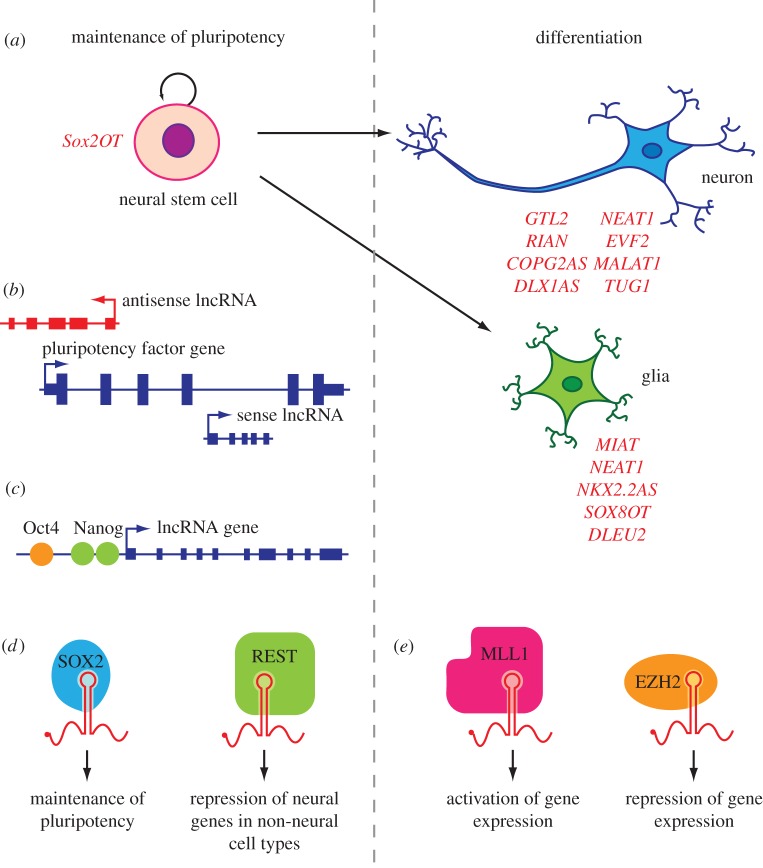
Long non-coding RNAs regulate pluripotency and neuronal-glial differentiation. (a) Multipotent NSCs differentiate to form neurons and glia. lncRNAs are differentially expressed between the undifferentiated state and the neuronal-glia lineages. Lineage/state-specific upregulated lncRNAs are labelled in red. (b) Protein-coding genes involved in the maintenance of a pluripotent state may have associated sense or antisense lncRNAs which regulate their expression. (c) lncRNA genes are themselves transcriptionally regulated by pluripotency factors such as Oct4 and Nanog. (d) lncRNAs form ribonucleoprotein complexes with pluripotency factors such as SOX2 or the master regulator of neurogenesis REST. The lncRNA components act as guides to their respective complexes in order to direct them to specific chromatin loci. As a result lncRNAs directly contribute to the maintenance of pluripotency and the repression of neural genes in non-neural cell types. (e) Upon lineage commitment, lncRNAs act as guides to ribonucleoprotein complexes which epigenetically modulate gene expression. In so doing, lncRNAs regulate the patterns of differential gene expression required for differentiation. lncRNAs may have an activating or repressive effect on gene expression depending on their respective protein partners (e.g. the trithorax protein MLL1 is a H3K4 trimethylase which promotes gene activation, whereas the polycomb component EZH2 is a H3K27 trimethylase which has a repressive effect on gene expression).
Figure 2.
Figure 2.
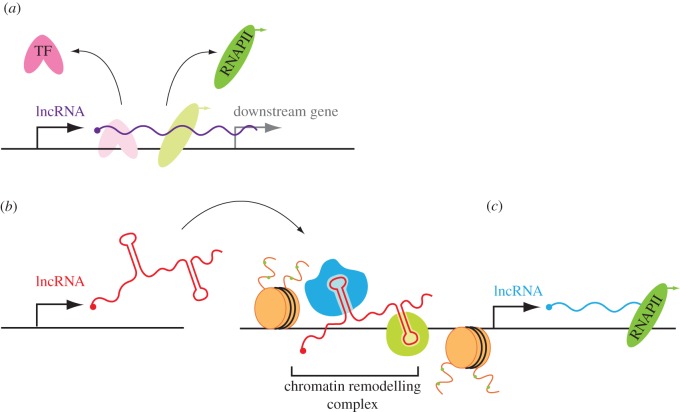
Mechanisms of gene regulation by long non-coding RNAs. (a) Transcriptional interference by an adjacent lncRNA gene. lncRNAs can regulate neighbouring genes in cis in a sequence-independent manner by inhibiting the assembly of the transcriptional machinery (i.e. RNA polymerase II, RNAPII and TFs) at the promoter of a downstream gene. (b) lncRNAs can act as guides for chromatin remodelling activities and transcription factors in both trans (depicted) and cis. The lncRNA forms a ribonucleoprotein complex with one or more transcriptional regulators and guides them to specific chromatin loci in order to induce local changes in chromatin structure (active chromatin marks indicated by green circles). (c) lncRNA genes themselves are targets of epigenetic regulation, thereby facilitating a feed-forward cascade of gene expression states.

References

    1. Clark MB, et al. 2011. The reality of pervasive transcription. PLoS Biol. 9, e1000625 (discussion e1001102). (10.1371/journal.pbio.1000625) - DOI - PMC - PubMed
    1. Carninci P, et al. 2005. The transcriptional landscape of the mammalian genome. Science 309, 1559–1563. (10.1126/science.1112014) - DOI - PubMed
    1. ENCODE Project Consortium et al. 2007. Identification and analysis of functional elements in 1% of the human genome by the ENCODE pilot project. Nature 447, 799–816. (10.1038/nature05874) - DOI - PMC - PubMed
    1. Katayama S, et al. 2005. Antisense transcription in the mammalian transcriptome. Science 309, 1564–1566. (10.1126/science.1112009) - DOI - PubMed
    1. Engström PG, et al. 2006. Complex loci in human and mouse genomes. PLoS Genet. 2, e47 (10.1371/journal.pgen.0020047) - DOI - PMC - PubMed

MeSH terms

Substances