Review
. 2014 Sep 26;369(1652):20130511.
doi: 10.1098/rstb.2013.0511.

Epigenetic setting and reprogramming for neural cell fate determination and differentiation

Affiliations
Review

Epigenetic setting and reprogramming for neural cell fate determination and differentiation

Takuya Imamura et al. Philos Trans R Soc Lond B Biol Sci. .

Abstract

In the mammalian brain, epigenetic mechanisms are clearly involved in the regulation of self-renewal of neural stem cells and the derivation of their descendants, i.e. neurons, astrocytes and oligodendrocytes, according to the developmental timing and the microenvironment, the 'niche'. Interestingly, local epigenetic changes occur, concomitantly with genome-wide level changes, at a set of gene promoter regions for either down- or upregulation of the gene. In addition, intergenic regions also sensitize the availability of epigenetic modifiers, which affects gene expression through a relatively long-range chromatinic interaction with the transcription regulatory machineries including non-coding RNA (ncRNA) such as promoter-associated ncRNA and enhancer ncRNA. We show that such an epigenetic landscape in a neural cell is statically but flexibly formed together with a variable combination of generally and locally acting nuclear molecules including master transcription factors and cell-cycle regulators. We also discuss the possibility that revealing the epigenetic regulation by the local DNA-RNA-protein assemblies would promote methodological innovations, e.g. neural cell reprogramming, engineering and transplantation, to manipulate neuronal and glial cell fates for the purpose of medical use of these cells.

Keywords: DNA methylation; REST; histone acetylation; histone methylation; non-coding RNA; polycomb repressive complex 2.


Figures

Figure 1.
Figure 1.
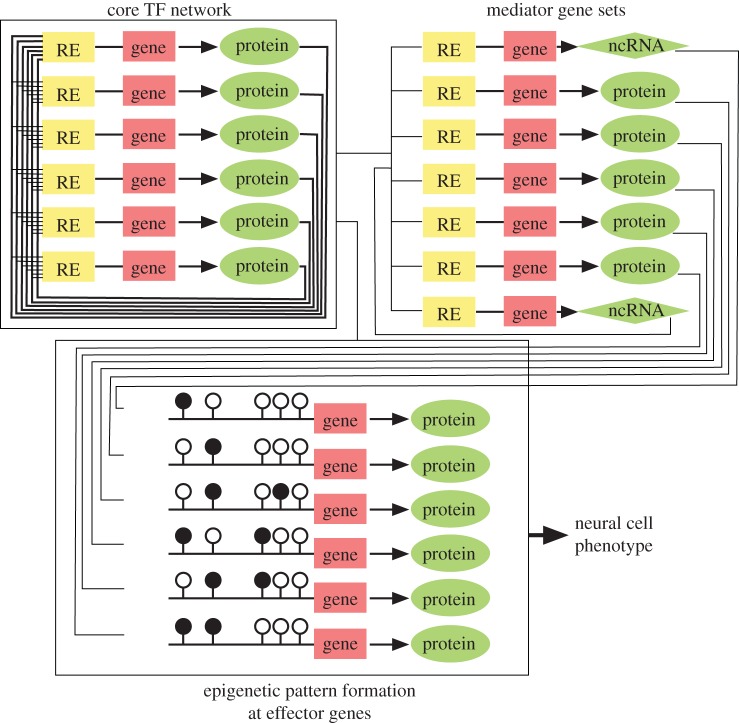
Core networks and their predominant effects on effector genes in neural cells. Open and filled lollipops denote unmethylated and methylated CpG sites, respectively. In the central nervous system, TFs such as SOX2, NEUROG1 and ASCL1 direct formation of the robust network of neural cells. The TF network controls the expression of mediator and effector gene sets, thereby establishing the neural cell functions. Note that fluctuations in the core gene network can be amplified through these pathways, resulting in the generation of epigenetic variations such as those frequently seen after TF-based reprogramming.
Figure 2.
Figure 2.
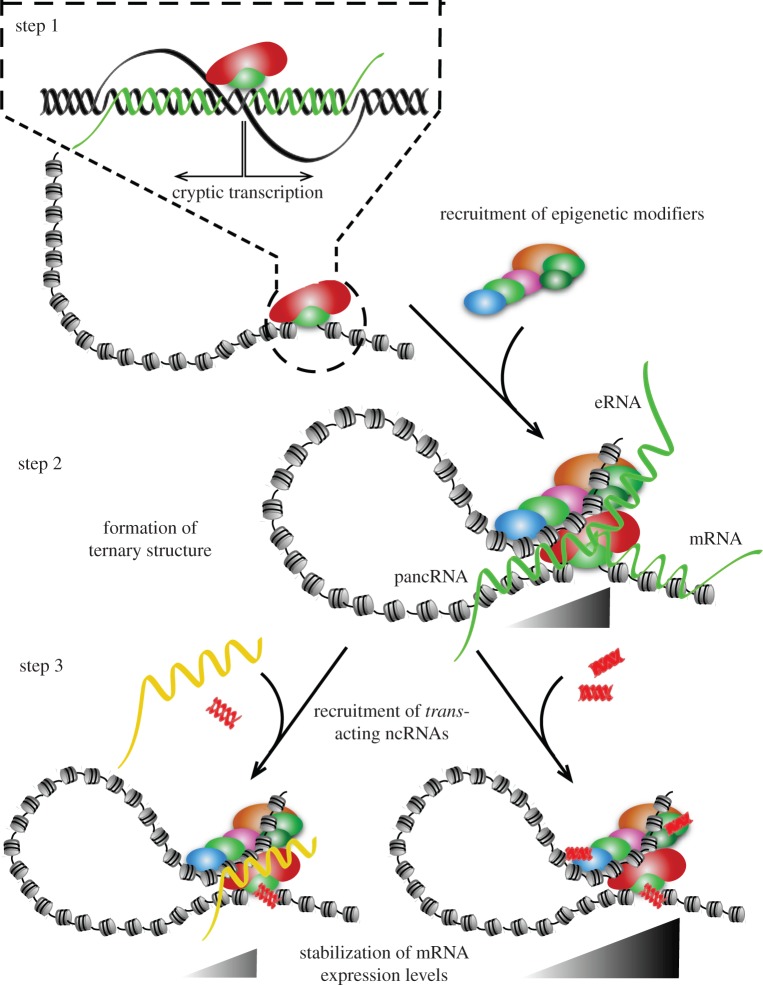
Possible steps of local chromatin formation triggered by associations with lncRNAs. Step 1: basal transcription of mRNA and cis-acting lncRNA. Cryptic RNA transcription occurs in conjunction with mRNA expression [48]. Many CpG island-bearing genes show bidirectional transcription. It has been reported that G-skew in a CpG island leads to a directionality of the transcription, generating mRNAs that start from G-rich sequences. Associated cryptic transcripts with G-rich structures are involved in cis in a local chromatin set-up that is reminiscent of the transcriptionally competent structure, called the R-loop [52]. The R-loop structure is favoured by H3K4 methylation, but not by DNMT activity, which may explain the unmethylated characteristics of CpG island type promoters. However, it should be noted that R-loop structure constitutes a repressed state in a different context in plants [53]. The mechanisms of switching between opening and closing of chromatin structure via lncRNA might be coupled with association with different components in steps 2 and 3. Step 2: upregulation of epigenetic modifiers to strengthen transcription through ternary structure formation. Transcriptionally competent structure can spread beyond the promoter regions. Such expanded open chromatin status can be recognized by a set of distally located enhancer-associated proteins to form a ternary structure for effective transcription of the target genes. Recent studies have suggested that, for example, SOX2 can be located not only on the target gene promoter regions but also on a fraction of enhancers together with BRN2 [54]. Although we do not yet know how polyA+ eRNA is generated, association of eRNA transcription may be coupled with such a structure involving RNAPII that is originally associated with the promoter sequences. Step 3: stabilization or antagonization of gene activation by trans-acting lncRNA and dsRNA. In addition, if interaction of chromatinic lncRNA with small dsRNA occurs, it would add further complexity to the transcription regulatory dimensions. In fact, association between lncRNAs (eRNA and pancRNA) and mRNAs have been reported to be modulated further by the association of small dsRNAs with the lncRNAs and/or genomic DNA, as described above. In addition, small dsRNA can associate with trans-acting proteins including DNMT and MBD proteins, to allosterically modulate their functions or to mask their catalytic domains, as described in the text.
Figure 3.
Figure 3.
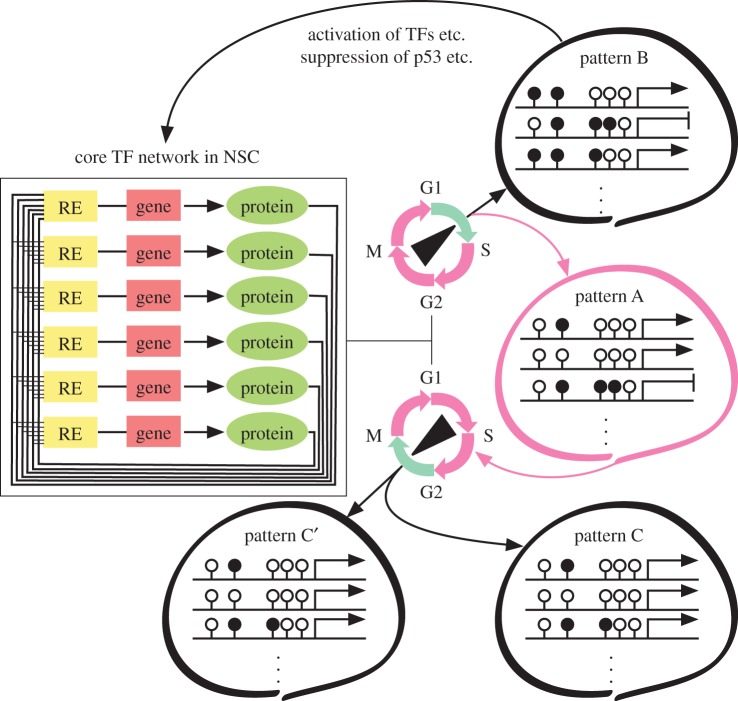
A model for cell-cycle-dependent epigenetic choice driven by master regulator networks. Pink and blue curved arrows indicate hypothetical cell-cycle phases at which cellular genomes are affected by stable and fluctuating epigenetic modifiers, respectively. Neural differentiation occurs in a restricted time window at the transition from G1 to S phase [75]. If the asymmetric division occurs to produce a differentiating cell (pattern A) and a proliferative cell (pattern B), the respective epigenetic patterns become different from each other. If epigenetic choice occurs after S phase, such cells may produce two daughter cells in which the epigenetic patterns are similar to each other (patterns C and C′).

References

    1. Yoshida K, Chambers I, Nichols J, Smith A, Saito M, Yasukawa K, Shoyab M, Taga T, Kishimoto T. 1994. Maintenance of the pluripotential phenotype of embryonic stem cells through direct activation of gp130 signalling pathways. Mech. Dev. 45, 163–171. (10.1016/0925-4773(94)90030-2) - DOI - PubMed
    1. Namihira M, Nakashima K. 2013. Mechanisms of astrocytogenesis in the mammalian brain. Curr. Opin. Neurobiol. 23, 921–927. (10.1016/j.conb.2013.06.002) - DOI - PubMed
    1. Takahashi K, Yamanaka S. 2006. Induction of pluripotent stem cells from mouse embryonic and adult fibroblast cultures by defined factors. Cell 126, 663–676. (10.1016/j.cell.2006.07.024) - DOI - PubMed
    1. Dinger ME, Pang KC, Mercer TR, Mattick JS. 2008. Differentiating protein-coding and noncoding RNA: challenges and ambiguities. PLoS Comput. Biol. 4, e1000176 (10.1371/journal.pcbi.1000176) - DOI - PMC - PubMed
    1. Tochitani S, Hayashizaki Y. 2008. Nkx2.2 antisense RNA overexpression enhanced oligodendrocytic differentiation. Biochem. Biophys. Res. Commun. 372, 691–696. (10.1016/j.bbrc.2008.05.127) - DOI - PubMed

Publication types

Substances

LinkOut - more resources