Review
. 2014 Sep 26;369(1652):20130512.
doi: 10.1098/rstb.2013.0512.

DNA modifications in the mammalian brain

Affiliations
Review

DNA modifications in the mammalian brain

Jaehoon Shin et al. Philos Trans R Soc Lond B Biol Sci. .

Abstract

DNA methylation is a crucial epigenetic mark in mammalian development, genomic imprinting, X-inactivation, chromosomal stability and suppressing parasitic DNA elements. DNA methylation in neurons has also been suggested to play important roles for mammalian neuronal functions, and learning and memory. In this review, we first summarize recent discoveries and fundamental principles of DNA modifications in the general epigenetics field. We then describe the profiles of different DNA modifications in the mammalian brain genome. Finally, we discuss roles of DNA modifications in mammalian brain development and function.

Keywords: 5-hydroxymethylcytosine; 5-methylcytosine; DNA methylation; learning and memory.


Figures

Figure 1.
Figure 1.
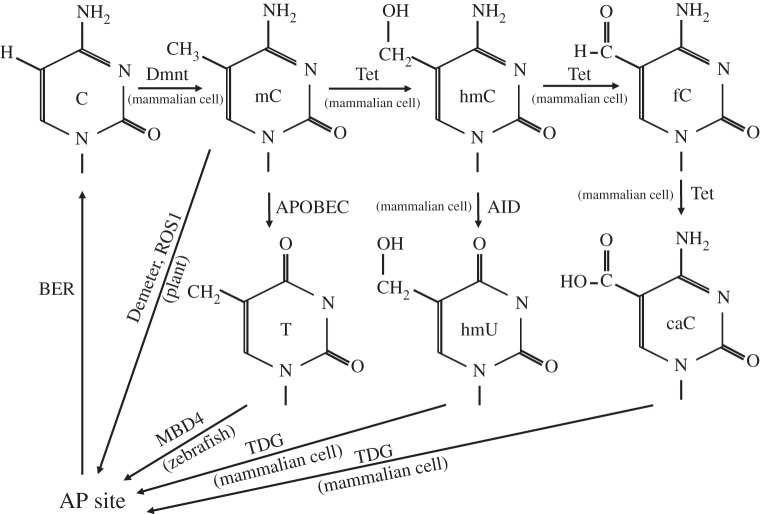
DNA modification models in the mammalian genome. In mammalian cells, three DNA methyltransferase proteins generate 5-methylcytosine. 5-Methylcytosine is directly removed in plant genome, but the plant enzymes responsible for such processes are not conserved in the mammalian genome. 5-Methylcytosine can be deaminated by APOBEC proteins to generate T-G mismatch base pairs and the thymine is removed by MBD4, but the existence and relevance of this pathway has not been shown in mammalian cells. The 5-methyl group can be oxidized by Tet proteins to generate 5-hydroxymethycytosine, which is then deaminated by AID and generates 5-hydroxyuracil that is then removed by TDG. Tet proteins can further oxidize 5-hydroxymethylcytosine to generate 5-formylcytosine and 5-carboxylcytosine. 5-formylcytosine and 5-carboxylcytosine are readily recognized and removed by TDG in mammalian cells. BER, Base excision repair; AP site, apurinic site; Dnmt, DNA methyltransferase; Tet, ten-eleven translocation methylcytosine dioxygenase; APOBEC, apolipoprotein B mRNA editing enzyme, catalytic polypeptide-like; MBD4, methyl-CpG-binding domain protein 4; TDG, thymine-DNA glycosylase; C, cytosine; mC, 5-methylcytosine; hmC, 5-hydroxymethylcytosine; fC, 5-formylcytosine; caC, 5-carboxylcytosine; T, thymine; hmU, 5-hydroxymethyluracil.
Figure 2.
Figure 2.
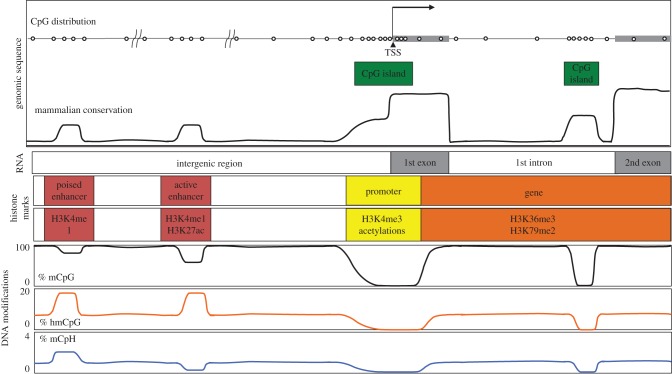
Schematic for genome and epigenome of mammalian neurons. CpG (shown as open circles) dinucleotide sequences are unevenly distributed throughout the genome; CpG dinucleotides are largely depleted in most genomic regions. Half of the promoters and some enhancers have an unusually high density of CpG dinucleotides, which are called CpG islands. Enhancers and promoters are defined by the composition of histone marks and show characteristic 5-mC or 5-hmC features. Poised enhancers, marked by H3K4me1 without H3K27ac have an intermediate level of 5-mCpG and a high level of 5-hmC and 5-mCpH. Active enhancers, which are marked by H3K4me1 and H3K27ac have lower or similar levels of 5-mCpG as poised enhancers, and low levels of 5-mCpH. Promoters, which are marked by H3K4me3 with histone acetylation, such as H3K27ac, are largely devoid of all DNA modifications. (Online version in colour.)

References

    1. Agranoff BW, Davis RE, Casola L, Lim R. 1967. Actinomycin D blocks formation of memory of shock-avoidance in goldfish. Science 158, 1600–1601. (10.1126/science.158.3808.1600) - DOI - PubMed
    1. Barondes SH, Cohen HD. 1966. Puromycin effect on successive phases of memory storage. Science 151, 594–595. (10.1126/science.151.3710.594) - DOI - PubMed
    1. Flexner LB, Flexner JB, Roberts RB. 1967. Memory in mice analyzed with antibiotics. Antibiotics are useful to study stages of memory and to indicate molecular events which sustain memory. Science 155, 1377–1383. (10.1126/science.155.3768.1377) - DOI - PubMed
    1. Bailey CH, Kandel ER, Si K. 2004. The persistence of long-term memory: a molecular approach to self-sustaining changes in learning-induced synaptic growth. Neuron 44, 49–57. (10.1016/j.neuron.2004.09.017) - DOI - PubMed
    1. Shyu AB, Greenberg ME, Belasco JG. 1989. The c-fos transcript is targeted for rapid decay by two distinct mRNA degradation pathways. Genes Dev. 3, 60–72. (10.1101/gad.3.1.60) - DOI - PubMed

Publication types

Substances

LinkOut - more resources