Review
. 2014 Sep 26;369(1652):20130514.
doi: 10.1098/rstb.2013.0514.

Regulation of histone H3K4 methylation in brain development and disease

Affiliations
Review

Regulation of histone H3K4 methylation in brain development and disease

Erica Shen et al. Philos Trans R Soc Lond B Biol Sci. .

Abstract

The growing list of mutations implicated in monogenic disorders of the developing brain includes at least seven genes (ARX, CUL4B, KDM5A, KDM5C, KMT2A, KMT2C, KMT2D) with loss-of-function mutations affecting proper regulation of histone H3 lysine 4 methylation, a chromatin mark which on a genome-wide scale is broadly associated with active gene expression, with its mono-, di- and trimethylated forms differentially enriched at promoter and enhancer and other regulatory sequences. In addition to these rare genetic syndromes, dysregulated H3K4 methylation could also play a role in the pathophysiology of some cases diagnosed with autism or schizophrenia, two conditions which on a genome-wide scale are associated with H3K4 methylation changes at hundreds of loci in a subject-specific manner. Importantly, the reported alterations for some of the diseased brain specimens included a widespread broadening of H3K4 methylation profiles at gene promoters, a process that could be regulated by the UpSET(KMT2E/MLL5)-histone deacetylase complex. Furthermore, preclinical studies identified maternal immune activation, parental care and monoaminergic drugs as environmental determinants for brain-specific H3K4 methylation. These novel insights into the epigenetic risk architectures of neurodevelopmental disease will be highly relevant for efforts aimed at improved prevention and treatment of autism and psychosis spectrum disorders.

Keywords: autism; chromatin; epigenetic; histone; nucleosome; schizophrenia.


Figures

Figure 1.
Figure 1.
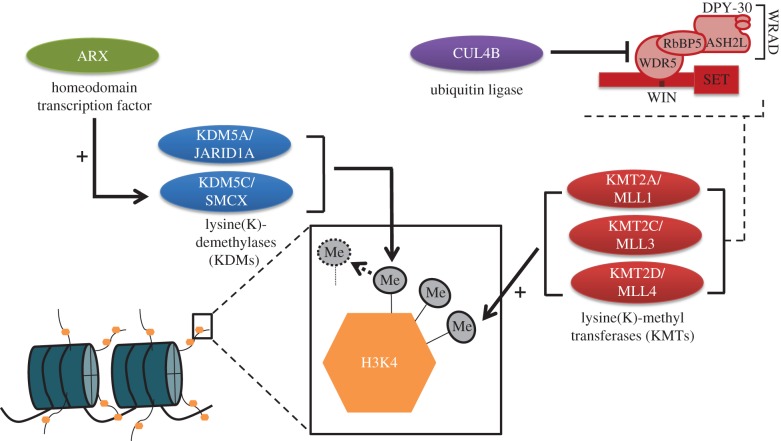
Molecular mechanisms of the seven genes (ARX, CUL4B, KDM5A, KDM5C, KMT2A, KMT2C, KMT2D) that play an essential role in H3K4 methylation and for which loss-of-function mutations are implicated in monogenic disorders of the developing brain. ARX is a homeodomain transcription factor; CUL4B is a ubiquitin ligase; KDM5A and KDM5C are H3K4 demethylases; KMT2A, KMT2C and KMT2D are H3K4-specific methyl transferases. ARX is a key transcriptional regulator for KDM5C, and CUL4B plays a role in the degradation of WDR5, a key component of the WRAD (MLL cofactor) complex. See text for further details. (Online version in colour.)
Figure 2.
Figure 2.
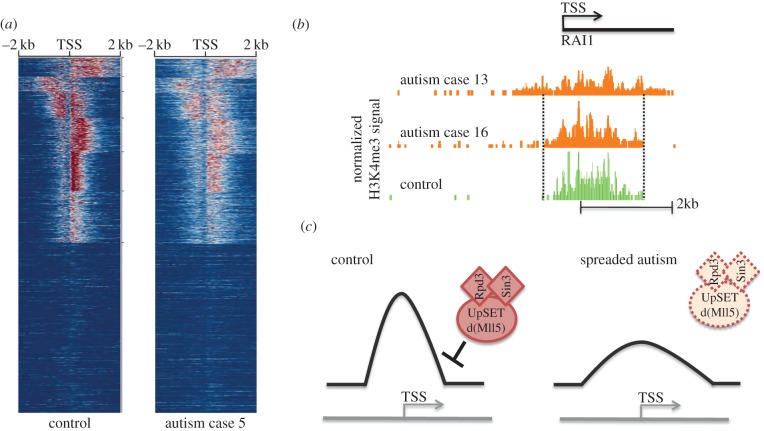
Broadening and ‘spreading’ of H3K4me3 peaks observed in some autism cases and the possible molecular explanation. (a) Clustered H3K4me3 profiles for entire Refseq transcription start sites (TSSs), within a −2 kilobase (kb) to +2 kb window around TSSs for prefrontal neurons from control and autism case no. 5. H3K4me3 signal intensity is illustrated using colour scaling with red representing a strong signal, white representing an intermediate signal and blue representing a weak signal. Note the extensive spreading of H3K4me3 profiles in the diseased case, compared with control. (b) Genome Browser tracks (from the University of California, Santa Cruz, CA) illustrate altered H3K4me3 profiles of the autism-susceptible gene RAI1 in cortical neurons of autism cases no. 13 and 16 compared with the control subject. Note abnormally broad and flattened (‘spreaded’) peak shape in case no. 13. (c) Hypothesized role of UpSET (Mll5) repressive chromatin complex to maintain normal promoter H3K4 methylation profiles. See text and Shulha et al. [11] for further details. (Online version in colour.)

References

    1. Numata S, et al. 2012. DNA methylation signatures in development and aging of the human prefrontal cortex. Am. J. Hum. Genet. 90, 260–272. (10.1016/j.ajhg.2011.12.020) - DOI - PMC - PubMed
    1. Siegmund KD, Connor CM, Campan M, Long TI, Weisenberger DJ, Biniszkiewicz D, Jaenisch R, Laird PW, Akbarian S. 2007. DNA methylation in the human cerebral cortex is dynamically regulated throughout the life span and involves differentiated neurons. PLoS ONE 2, e895 (10.1371/journal.pone.0000895) - DOI - PMC - PubMed
    1. Hernandez DG, et al. 2011. Distinct DNA methylation changes highly correlated with chronological age in the human brain. Hum. Mol. Genet. 20, 1164–1172. (10.1093/hmg/ddq561) - DOI - PMC - PubMed
    1. Cheung I, Shulha HP, Jiang Y, Matevossian A, Wang J, Weng Z, Akbarian S. 2010. Developmental regulation and individual differences of neuronal H3K4me3 epigenomes in the prefrontal cortex. Proc. Natl Acad. Sci. USA 107, 8824–8829. (10.1073/pnas.1001702107) - DOI - PMC - PubMed
    1. Ronan JL, Wu W, Crabtree GR. 2013. From neural development to cognition: unexpected roles for chromatin. Nat. Rev. Genet. 14, 347–359. (10.1038/nrg3413) - DOI - PMC - PubMed

Publication types