


Community based interventions for the prevention and control of tuberculosis
- PMID: 25136445
- PMCID: PMC4136404
- DOI: 10.1186/2049-9957-3-27
Community based interventions for the prevention and control of tuberculosis
Abstract
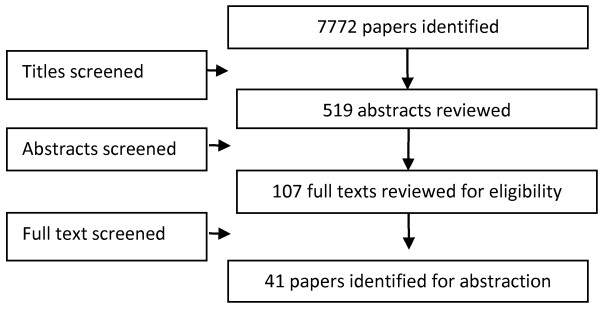
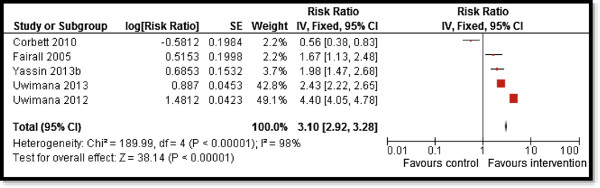
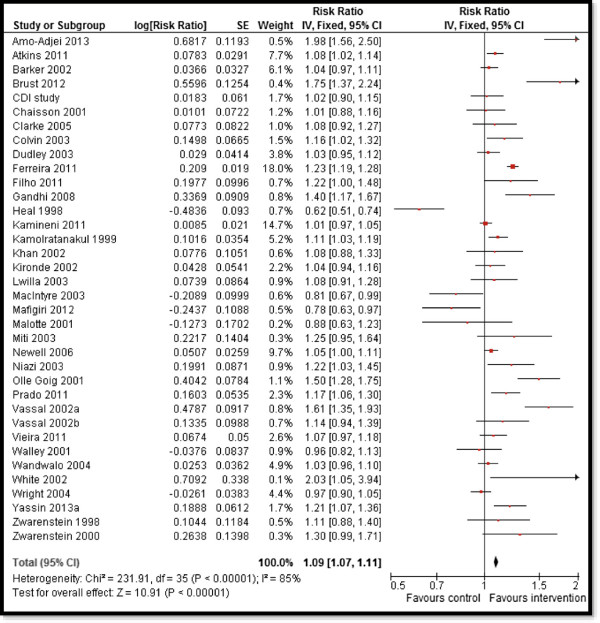
In 2012, an estimated 8.6 million people developed tuberculosis (TB) and 1.3 million died from the disease. With its recent resurgence with the human immunodeficiency virus (HIV); TB prevention and management has become further challenging. We systematically evaluated the effectiveness of community based interventions (CBI) for the prevention and treatment of TB and a total of 41 studies were identified for inclusion. Findings suggest that CBI for TB prevention and case detection showed significant increase in TB detection rates (RR: 3.1, 95% CI: 2.92, 3.28) with non-significant impact on TB incidence. CBI for treating patients with active TB showed an overall improvement in treatment success rates (RR: 1.09, 95% CI: 1.07, 1.11) and evidence from a single study suggests significant reduction in relapse rate (RR: 0.26, 95% CI: 0.18, 0.39). The results were consistent for various study design and delivery mechanism. Qualitative synthesis suggests that community based TB treatment delivery through community health workers (CHW) not only improved access and service utilization but also contributed to capacity building and improving the routine TB recording and reporting systems. CBI coupled with the DOTS strategy seem to be an effective approach, however there is a need to evaluate various community-based integrated delivery models for relative effectiveness.
Keywords: CHWs; Community-based interventions; DOTS; Tuberculosis; integrated delivery.
Figures
References
-
- World Health Organization. Global Tuberculosis Report. 2013. Availabel at http://apps.who.int/iris/bitstream/10665/91355/1/9789241564656_eng.pdf?ua=1.
-
- WHO. Global Tuberculosis Control: Epidemiology, Strategy, Financing: WHO, 2009. Geneva, Switzerland: WHO; 2009.
-
- Schluger NW, Burzynski J. Tuberculosis and HIV infection: epidemiology, immunology, and treatment. HIV Clin Trials. 2001;2(4):356–365. - PubMed
-
- WHO. WHO. Geneva: World Health Organization; 2003. Community contribution to TB care: practice and policy.
LinkOut - more resources
Full Text Sources
Other Literature Sources
