


Somatic mutations identify a subgroup of aplastic anemia patients who progress to myelodysplastic syndrome
- PMID: 25139356
- PMCID: PMC4383793
- DOI: 10.1182/blood-2014-05-574889
Somatic mutations identify a subgroup of aplastic anemia patients who progress to myelodysplastic syndrome
Abstract
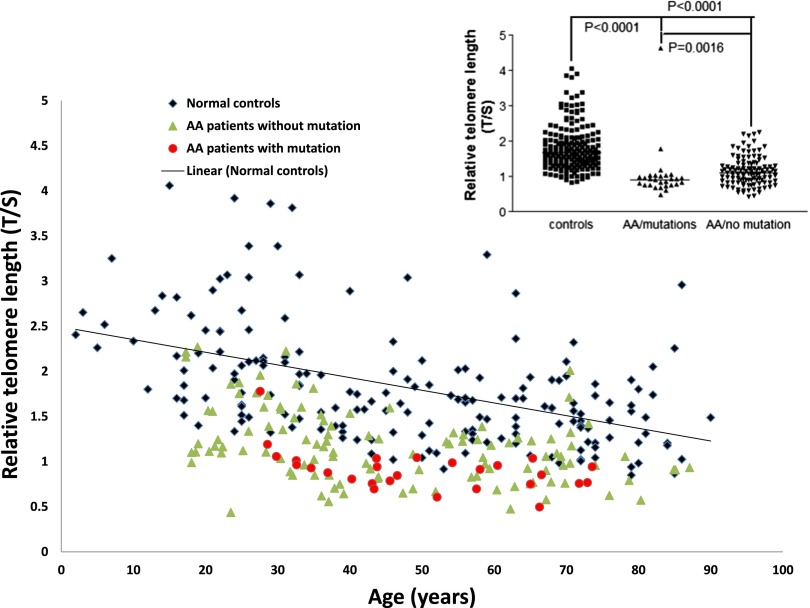
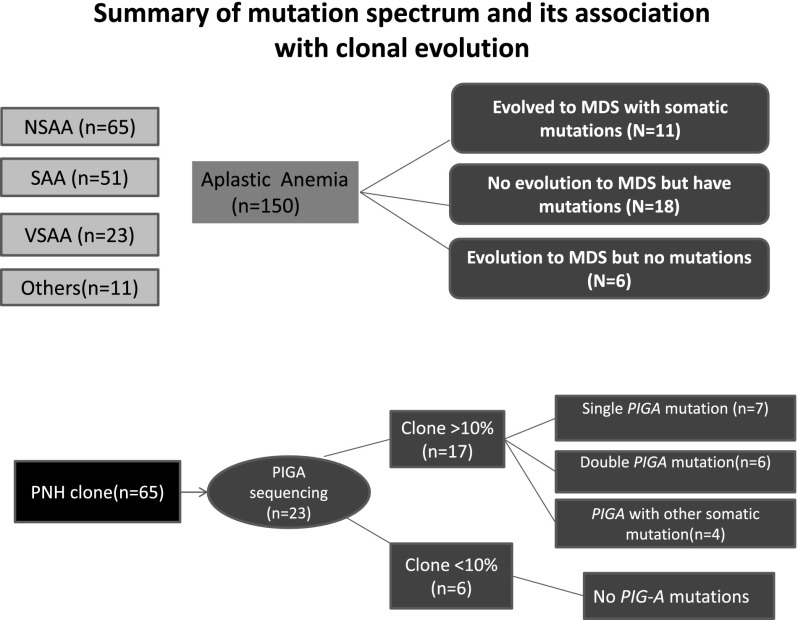
The distinction between acquired aplastic anemia (AA) and hypocellular myelodysplastic syndrome (hMDS) is often difficult, especially nonsevere AA. We postulated that somatic mutations are present in a subset of AA, and predict malignant transformation. From our database, we identified 150 AA patients with no morphological evidence of MDS, who had stored bone marrow (BM) and constitutional DNA. We excluded Fanconi anemia, mutations of telomere maintenance, and a family history of BM failure (BMF) or cancer. The initial cohort of 57 patients was screened for 835 known genes associated with BMF and myeloid cancer; a second cohort of 93 patients was screened for mutations in ASXL1, DNMT3A, BCOR, TET2, and MPL. Somatic mutations were detected in 19% of AA, and included ASXL1 (n = 12), DNMT3A (n = 8) and BCOR (n = 6). Patients with somatic mutations had a longer disease duration (37 vs 8 months, P < .04), and shorter telomere lengths (median length, 0.9 vs 1.1, P < .001), compared with patients without mutations. Somatic mutations in AA patients with a disease duration of >6 months were associated with a 40% risk of transformation to MDS (P < .0002). Nearly one-fifth of AA patients harbor mutations in genes typically seen in myeloid malignancies that predicted for later transformation to MDS.
© 2014 by The American Society of Hematology.
Figures
Comment in
-
MDS-related mutations in aplastic anemia.Blood. 2014 Oct 23;124(17):2619-20. doi: 10.1182/blood-2014-09-597708. Blood. 2014. PMID: 25342663 No abstract available.
References
-
- Marsh JC, Ball SE, Cavenagh J, et al. British Committee for Standards in Haematology. Guidelines for the diagnosis and management of aplastic anaemia. Br J Haematol. 2009;147(1):43–70. - PubMed
-
- Kordasti S, Marsh J, Al-Khan S, et al. Functional characterization of CD4+ T cells in aplastic anemia. Blood. 2012;119(9):2033–2043. - PubMed
-
- Afable MG, 2nd, Tiu RV, Maciejewski JP. Clonal evolution in aplastic anemia. Hematology Am Soc Hematol Educ Program. 2011;2011:90-55. - PubMed
Publication types
MeSH terms
Substances
Grants and funding
LinkOut - more resources
Full Text Sources
Other Literature Sources
Medical
Research Materials
Miscellaneous
