. 2014 Oct;42(18):e137.
doi: 10.1093/nar/gku677. Epub 2014 Aug 19.

Invincible DNA tethers: covalent DNA anchoring for enhanced temporal and force stability in magnetic tweezers experiments

Affiliations

Invincible DNA tethers: covalent DNA anchoring for enhanced temporal and force stability in magnetic tweezers experiments

Richard Janissen et al. Nucleic Acids Res. 2014 Oct.

Abstract

Magnetic tweezers are a powerful single-molecule technique that allows real-time quantitative investigation of biomolecular processes under applied force. High pulling forces exceeding tens of picoNewtons may be required, e.g. to probe the force range of proteins that actively transcribe or package the genome. Frequently, however, the application of such forces decreases the sample lifetime, hindering data acquisition. To provide experimentally viable sample lifetimes in the face of high pulling forces, we have designed a novel anchoring strategy for DNA in magnetic tweezers. Our approach, which exploits covalent functionalization based on heterobifunctional poly(ethylene glycol) crosslinkers, allows us to strongly tether DNA while simultaneously suppressing undesirable non-specific adhesion. A complete force and lifetime characterization of these covalently anchored DNA-tethers demonstrates that, compared to more commonly employed anchoring strategies, they withstand 3-fold higher pulling forces (up to 150 pN) and exhibit up to 200-fold higher lifetimes (exceeding 24 h at a constant force of 150 pN). This advance makes it possible to apply the full range of biologically relevant force scales to biomolecular processes, and its straightforward implementation should extend its reach to a multitude of applications in the field of single-molecule force spectroscopy.


Figures

Figure 1.
Figure 1.
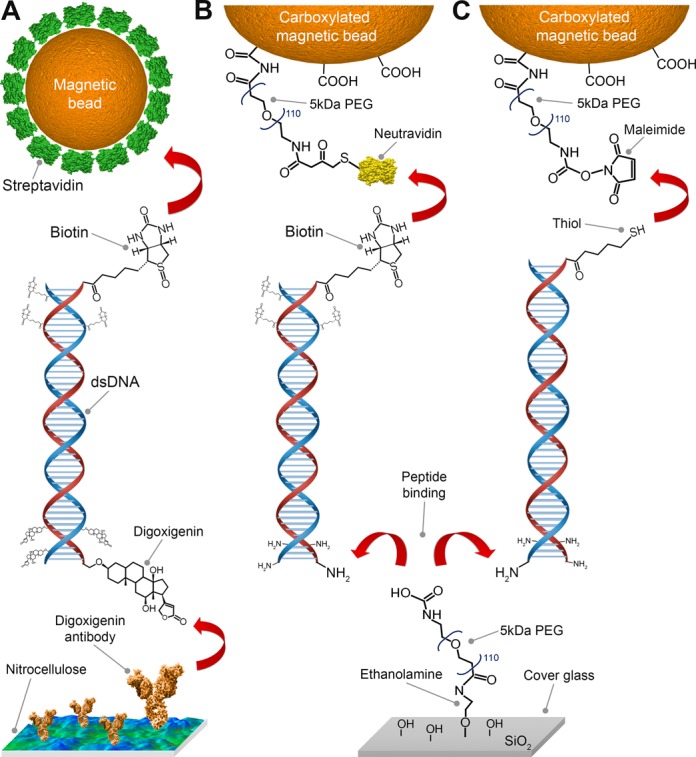
Schematic overview of DNA anchoring strategies used in this study. (A) Tethering of DNA in magnetic tweezers by coupling a multiply biotinylated handle on one extremity of the DNA to a streptavidin-coated magnetic bead, and by binding a handle containing multiple digoxigenin molecules on the other extremity of the DNA to anti-digoxigenin IgG antibodies adsorbed on nitrocellulose. (B and C) Tethering of one DNA extremity via covalent coupling NH2-enriched handles on the DNA to a surface. The other DNA extremity can then be bound to either (B) neutravidin-coated magnetic beads using labeled DNA handles containing multiple biotins or to (C) maleimide-labeled magnetic beads using a single DNA 5′ thiol-modification. In both cases (B and C) the magnetic bead coatings include PEG polymers that serve both as a passivation layer and as a covalent crosslinker.
Figure 2.
Figure 2.
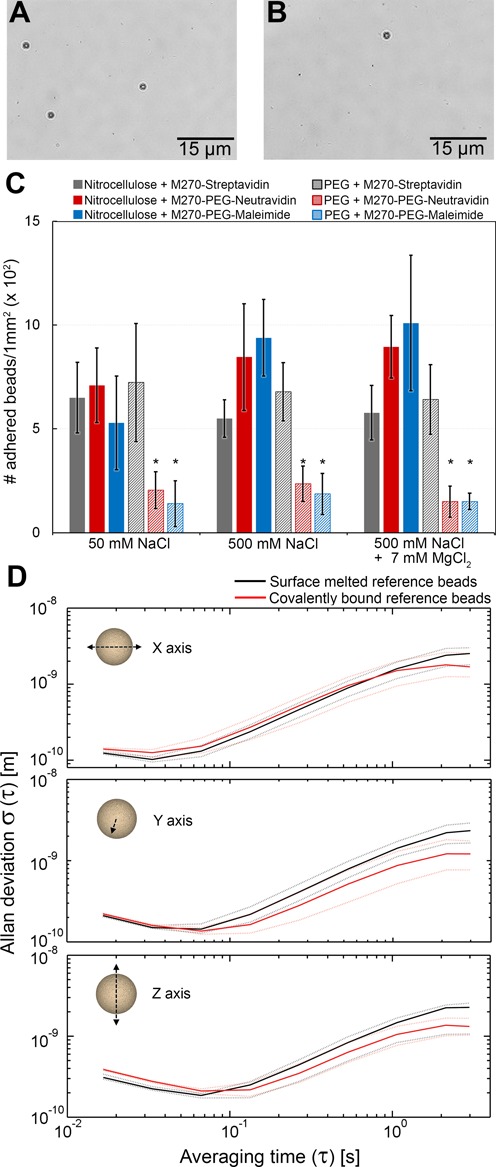
Non-specific adhesion and spatial stability of beads. (A and B) Images of a flow cell with non-specifically adhered magnetic beads. (C) The number of adhered magnetic beads is summarized in the histogram for different combinations of bead-surface for a variety of buffer conditions. The error bars represent the mean standard deviations and the asterisks denote the significance threshold level of the applied analysis of variance (1-way ANOVA; *P < 0.05) for each buffer condition. (D) The position stability of reference beads affixed via surface-melting (black) or covalent attachment (red) is analyzed by computing their respective Allan deviations (48) as a function of time in all three dimensions. For each attachment method, the median of n = 25 reference beads is presented as continuous lines and the 25th and 75th percentiles as dashed lines.
Figure 3.
Figure 3.
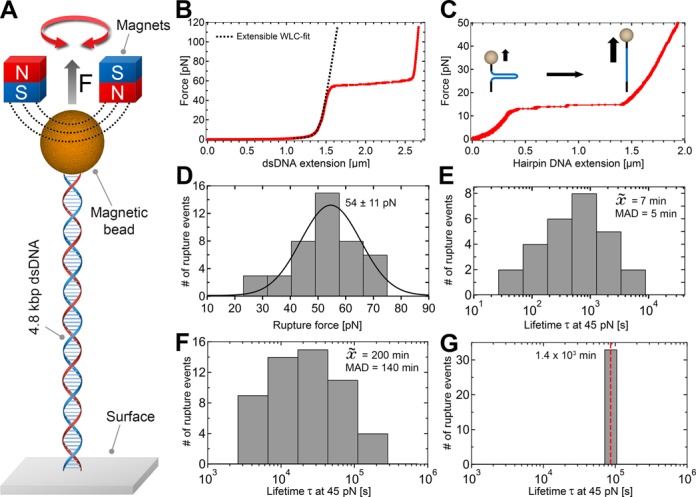
DNA stability under high forces. (A) DNA tethers were stretched by applying a magnetic field via a pair of superparamagnetic magnets. (B) Force-extension plot for a covalently anchored linear 4.8 kbp dsDNA tether. The black dashed line is a fit of the extensible worm-like-chain fit to the data. At ∼60 pN, the overstretching transition of DNA is observed. (C) Force-extension plot for a covalently surface-bound single 1 kbp hairpin DNA construct. (D) Histogram of measured rupture forces (n = 43) via DFS with constant loading rate of 10pN/s up to 150 pN and applied Gaussian fit (black curve). (E) Histogram of measured lifetimes at constant pulling force of 45 pN (n = 37) for dsDNA tethers anchored via DIG:anti-DIG to the surface and streptavidin:biotin to the magnetic bead. (F and G) Histograms of observed lifetimes at applied forces of 45 pN for DNA molecules anchored covalently to the surface alone (n = 52) (F) and anchored covalently to both surface and bead (n = 32) (G). The median of tether lifetimes in (E and F) is denoted within the histogram panels as formula image with the corresponding median absolute deviation (MAD). The red dashed line in (G) is meant to indicate that the measured lifetimes are lower bounds, as the experiment itself was terminated after 24 h.

References

    1. Greenleaf W.J., Woodside M.T., Block S.M. High-resolution, single-molecule measurements of biomolecular motion. Annu. Rev. Biophys. Biomol. Struct. 2007;36:171–190. - PMC - PubMed
    1. Dulin D., Lipfert J., Moolman M.C., Dekker N.H. Studying genomic processes at the single-molecule level: introducing the tools and applications. Nat. Rev. Genet. 2013;14:9–22. - PubMed
    1. Neuman K.C., Nagy A. Single-molecule force spectroscopy: optical tweezers, magnetic tweezers and atomic force microscopy. Nat. Methods. 2008;5:491–505. - PMC - PubMed
    1. Fazal F.M., Block S.M. Optical tweezers study life under tension. Nat. Photonics. 2011;5:318–321. - PMC - PubMed
    1. Janssen X.J., Lipfert J., Jager T., Daudey R., Beekman J., Dekker N.H. Electromagnetic torque tweezers: a versatile approach for measurement of single-molecule twist and torque. Nano Lett. 2012;12:3634–3639. - PubMed

Publication types